wayground logo

Free Printable Worksheets

NEW

Font size

S
M
L
XL
Worksheets

2019 Plate Tectonics

Total questions: 36

Worksheet time: 1hrs 4mins

Name
Class
Date
1.
The area where two or more plates meet is called a __________________.
a)
fault
b)
plate boundary
c)
plate edge
d)
ring of fire
2.
Mountains form from ...
a)
plates sliding past one another
b)
collision of plates
c)
plates moving away from each other
3.

What geologic event occurs where two continental crusts collide?

a)

rift valley

b)

ocean basin

c)

mountain range

d)

volcano

4.
Plates slide past one another at ____________ boundaries.
a)
divergent
b)
convergent
c)
transform
d)
submergent
5.
Plates move towards one another at ______________ boundaries.
a)
divergent
b)
convergent
c)
transform
d)
detergent
6.

Which image below shows a transform boundary?

a)
b)
c)
7.

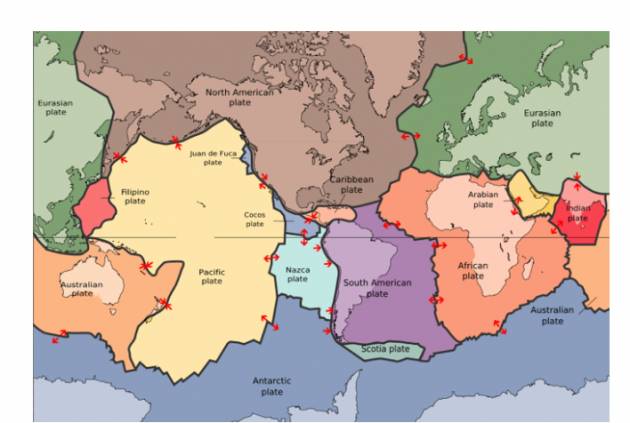
What is the name of plate 6

a)

Eurasian plate

b)

Indo-Australian plate

c)

North American plate

d)

Antarctic plate

8.

What is the name of plate 3

a)

Pacific plate

b)

Eurasian plate

c)

Antarctic plate

d)

South American plate

9.

What is the name of plate 4

a)

African plate

b)

Indo-Australian plate

c)

Pacific plate

d)

Antarctic plate

10.

What is the name of plate 1

a)

African plate

b)

North American plate

c)

Pacific plate

d)

Pacific plate

11.

What is the name of plate 5

a)

African plate

b)

South American plate

c)

Eurasian plate

d)

Indo-Australian plate

12.
Plate 1
a)
Indo-Australian
b)
Pacific Plate
c)
South American
d)
Eurasian
13.

Most of the United States is a part of which tectonic plate?

a)

Pacific Plate

b)

Eurasian Plate

c)

North American Plate

d)

South American Plate

14.
Scientists think that convection currents that move the plates flow in Earth's
a)
Continental crust
b)
Oceanic crust
c)
Asthenosphere
d)
Lithosphere
15.
What heat transfer happens when you burn your hand by touching a fire?
a)
Radiation
b)
Conduction
c)
Convectio
d)
I don't know!!!!!!!!!!!
16.
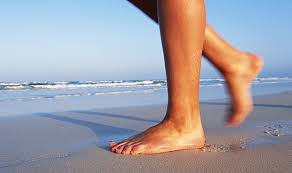
Walking on the warm sand sand with your bare feet demonstrates this type of heat transfer. 
a)
conduction
b)
convection
c)
radiation
17.
Johnny accidentally grabbed the handle of the hot pot.
a)
conduction
b)
convection
c)
radiation
18.
A group of friends gather around a fire to stay warm.
a)
conduction
b)
convection
c)
radiation
19.
Near the ceiling of a room the air is warmer.  The warm air rises because of
a)
conduction
b)
convection
c)
radiation
20.
When the 2nd story of a house is warmer than the 1st floor of a house is heat transfer through 
a)
conduction
b)
convection
c)
radiation
d)
thermal equilibrium
21.

At what temperature did the hot and cold water reach thermal equilibrium ?

a)

5

b)

10

c)

30

d)

70

22.
After cooking an egg in boiling water, you cool the egg by putting it into a bowl of cold water.  Which of the following explains the egg's cooling process?
a)
Temperature is transferred from the egg to the water.
b)
Energy is transferred from the water to the egg.
c)
Energy is transferred from the egg to the water.
d)
Cold moves from the water into the egg.
23.
In heat transfer, heat always flows from the _______________ substance to the _______________ substance.
a)
Hotter to colder
b)
Colder to hotter
c)
Hotter to hotter
d)
Colder to colder
24.
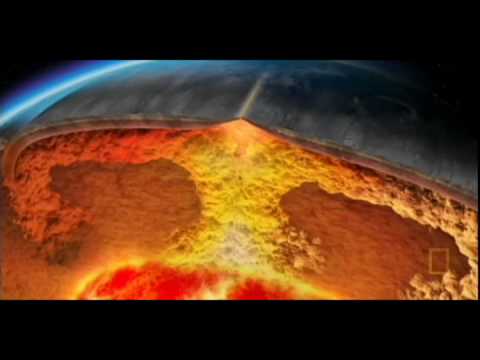
Which of these two layers is a solid?
a)
innercore
b)
Outercore
25.
A dense ball of solid iron and nickel.
a)
crust
b)
inner core
c)
mantle 
d)
outer core
26.
Which best describes the asthenosphere?
a)
molten metal
b)
dense, solid metal ball
c)
solid that flows
d)
dry land and ocean floor
27.
What part of the earth is a layer of rock that comprises 67% of Earth’s mass?
a)
mesosphere
b)
mantle
c)
asthenosphere
d)
lithosphere
28.
What is the rigid layer of the Earth's surface made up of the  crust and upper mantle called?
a)
asthenosphere
b)
lithosphere
c)
mesosphere
d)
continental crust
29.
Temperature _____________________ as you go deeper into the earth.
a)
increases
b)
decreases
c)
goes up and down depending on the layer
d)
stays the same
30.

What type elements make up the solid Earth ?

a)

metals only

b)

all the elements on the periodic table

c)

only a few of the elements on the periodic table

d)

nonmetals only

31.

The movement of the tectonic plates is caused by

a)

the rotation of the Earth.

b)

convection currents in the Asthenosphere

c)

the gravity of the iron-nickel core.

d)

the Moho discontinuity.

32.

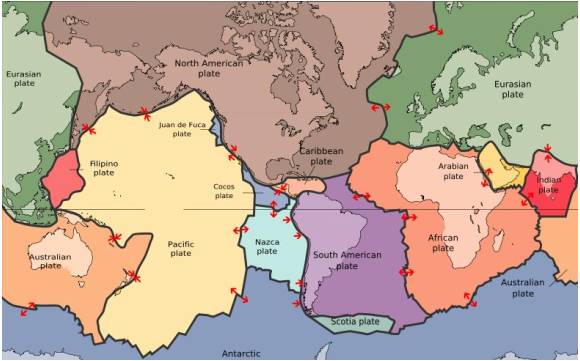
The map in the picture shows tectonic plate boundaries. This map would be useful in predicting the location of future

a)

droughts

b)

hurricanes

c)

earthquakes

d)

tornadoes

33.

Where are earthquakes most likely to occur?

a)

close to the equator

b)

close to the center of tectonic plates

c)

down by the ocean

d)

at any plate boundary

34.

What geologic feature/event would you most likely to find at a divergent boundary between two pieces of oceanic crust?

a)

mountain range

b)

ocean basin

c)

Island Arc

d)

Flat land

35.
What happens when ice cubes melt in a glass?
a)
Heat travels from the ice to the warmer water.
b)
No energy is transferred.
c)
Heat is transferred from the warmer water to the ice cubes.
d)
The water warms up due to the humidity
36.

What will happen to the temperature of a cup of hot chocolate if you leave it on your desk while you go out to play for an hour ?

a)

the temperature will increase

b)

the temperature will become room temperature

c)

the temperature will decrease only slightly

d)

the temperature will increase to boil