
 Worksheets
Important Chemistry - Coach Reid
Total questions: 100
Worksheet time: 7hrs 26mins
Name the 3 subatomic particles
Proton, Neutron, Tic Tac
Proton, Neutron, Electron
A proton has a __________ charge.
positive
negative
neutral
An electron has a ______________ charge.
Positive
Negative
Neutral
A neutron has a ____________ charge
positive
negative
neutral
___________________ discovered the proton.
Chadwick
Dalton
Rutherford
_________________ discovered the electron.
Thompson
Dalton
Walter White
________________ discovered the neutron.
Walter White
John Smith
Chadwick.
This subatomic particle identifies the element.
Proton
Neutron
Megatron
This subatomic particle, in particular the ones in the outer shell determine reactivity.
Proton
Neutron
Electron
The gold foil experiment determined that___________
the nucleus is large
that electrons are negative
the nucleus is small, dense, and positively charged.
A cathode ray tube was used to discover this subatomic particle.
Proton
Mega
Electron
In a stable element the number of _____________ equals the number of ______________.
protons, electrons
neutrons, electrons
protons, neutrons
The atomic number represents the number of ______________
protons plus neutrons
neutrons
protons
The mass number is the number of ___________ plus ___________.
protons, neutrons
protons, protons
electrons, protons
An isotope has different number of__________________.
neutrons
protons
electrons
Electrons in the outermost shell are called _______________.
lost electrons
neutral electrons
reactive electrons
valence electrons
_________________ invented the periodic table.
Bohr
Dalton
White
Mendelev
The modern periodic table is arranged by this subatomic particle.
proton
neutron
electron
A _______________ runs horizontally(left to right) on the periodic table
Period
Group
Neutron
A _____________ runs up and down on the periodic table.
Group
Period
Sub Shell
Elements in a group react similarly because they have the same number of_______________.
Protons
Shells
Valence Electrons
Another name for a group is a ________________.
Period
Quantum
Family
Group 1 elements are called___________________.
Non Metals
Alkali Earth
Alkali
Group 18 elements are called___________________.
Noble Gases
Alkali
Halogens
Transition Metals
Group 2 elements are called__________________.
Alkali Earth
Protons
Stable
Halogens
Group 17 elements are called_______________.
Halogens
Noble Gases
Alkali
Metals
The most reactive elements are in groups___________
2 and 18
17 and 18
1 and 2
1 and 17
The most stable elements are in group______.
1
5
13
18
How many valence electrons are in group 18?
Full or 8
Full or 1
7
18
A ion is an atom with a ___________________.
Proton
Electron
Charge
A cation has a ______________ charge
positive
neutral
negative
An anion has a _____________ charge.
positive
negative
neutral
A metal tends to lose electrons and will have a ____________ charge.
positive
no charge
negative
A non-metal tends to gain electrons and will have a ___________ charge.
positive
negative
neutral
In which group would an element that is not reactive most likely be located?
1
2
16
18
KF
Cr3+ O2-
K1+ S2-
How many valence electron does Oxygen (O) have?
2
8
6
7
What is the charge of Sodium (Na)?
+1
-1
0
+2
What is the charge of Chlorine (Cl)?
+1
-1
0
-2
What is the charge of Chlorine (Cl)?
+1
-1
0
-2

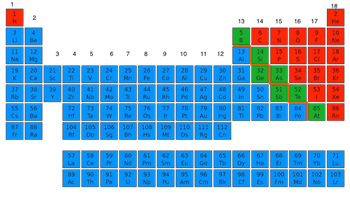
Which element has 3 valence electrons?
A
B
E
C


This is a picture of a
Beaker
Graduated Cylinder
Test tube
Flask

Which of the following is a chemical change?
Cutting bread
Slicing carrots
Melting butter
Soured milk


(a) is a measure of how close measurements come to each other when they are made in the same way.
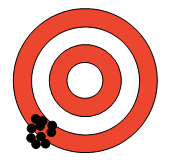
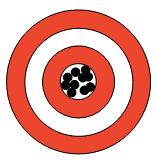
This bullseye demonstrates...
High Accuracy & High Precision
High Accuracy & Low Precision
Low Accuracy & High Precision
Low Accuracy & Low Precision

Describe the accuracy and precision of the image
Very accurate and somewhat precise
Very accurate but not precise at all
Not accurate at all but very precise
not accurate and not very precise
A set of data are all close in value to each other, but they are not close to the actual value. This set of data can be described as _________________.
precise
accurate

Which best describes the target?
Precise, but not accurate
Accurate but not precise
Precise and accurate
Neither accurate nor precise
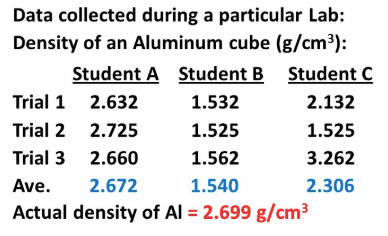
Which student is the most ACCURATE?
A
B
C

Which of the following diagram represents more accurate and more precise ?
A
B
C
D

Which of the following weighing balance is more precise?
A
B
C
Which of the following weighing balance is more accurate?
A
B
C
The atomic number is always a
whole number which tells you the number of protons, also the smallest number
a large number with a decimal point
Atomic Mass on the periodic table will always be
the number with a decimal point and is the largest number
the number without a decimal point
IN the following reaction what are the products:
2H₂ + CO₂ → CH₃OH
2H₂ + CO₂
CH₃OH
IN the following reaction what are the reactants:
2H₂ + CO₂ → CH₃OH
CH₃OH
2H₂ + CO₂
-->
The ability of an atom to attract electrons in a bond is called
Ionization energy
electronegativity
atomic radius
proton affinity

What group is highlighted here on the periodic table (Group 1A)?
Noble Gases
Halogens
Alkali Metals
Alkaline Earth Metals

What group is highlighted here on the periodic table (Group 8A)?
Noble Gases
Halogens
Alkali Metals
Alkaline Earth Metals

