
 Worksheets
Nuclear Decay
Total questions: 25
Worksheet time: 17mins
Name
Class
Date
1.
Alpha particles.....
a)
a) are positively charged.
b)
b) consist of two protons and four neutrons.
c)
c) can penetrate any thickness of matter
d)
d) All of the above
2.
During beta decay, a nucleus ....
a)
gives up two protons and two neutrons.
b)
maintains the same number of protons and neutrons.
c)
loses a proton and gains a neutron.
d)
gains a proton and loses a neutron.
3.
When a nucleus undergoes nuclear decay by gamma rays, the atomic number of the element....
a)
remains the same
b)
decreases by one.
c)
increases by one.
d)
increases by two.
4.
Radioactive materials have unstable...
a)
electrons
b)
protons
c)
nuclei
d)
neutrons
5.
The type of radioactive particle that can be stopped by a sheet of paper is the ____.
a)
alpha particle
b)
beta particle
c)
gamma ray
d)
uranium
6.
The most penetrating type of radiation is the ____.
a)
alpha particle
b)
gamma ray
c)
beta particle
d)
uranium
7.
A helium nucleus with two protons and two neutrons is called a(n) ____.
a)
alpha particle
b)
electroscope
c)
beta particle
d)
gamma ray
8.
Negatively charged particles emitted from a nucleus at a high speed are ____.
a)
alpha particle
b)
gamma rays
c)
beta particles
d)
X rays
9.
What type of decay is shown here
23892U ---> 23490Th + 42He.
a)
alpha
b)
beta
c)
gamma
10.
What type of nuclear decay is shown here
13756Ba →→ 13756Ba + γ rays
a)
alpha
b)
beta
c)
gamma
11.
Finish this equation
20983Bi--> _______ + 20581Tl
a)
42He
b)
0-1e
c)
y
12.
finish the equation
22688Ra --> ____ + 22688Ra
a)
42He
b)
0-1e
c)
y
13.
Identify the type of nuclear decay shown here
21483Bi → 0-1e + 21484Po
a)
alpha
b)
beta
c)
gamma
14.
Takes two small nuclei and combines them into a larger nucleus
a)
fission
b)
fusion
15.
The splitting of a nucleus into smaller nuclei is
a)
fusion
b)
fission
c)
half-life
d)
gamma radiation
16.
How do nuclear power-plants work?
a)
Fusion
b)
Half-life
c)
Fission
d)
Fusion or fission
17.
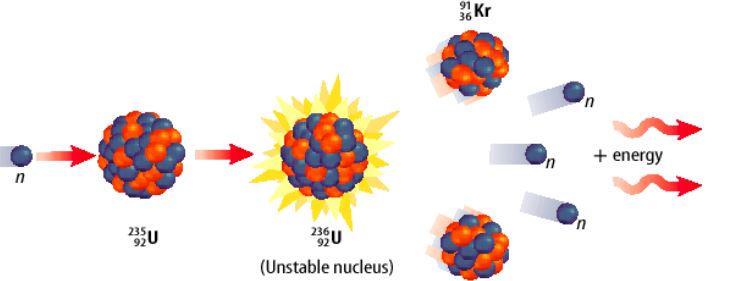
This is an example of...
a)
Fission reaction
b)
Fusion reaction
c)
Decomposition reaction
d)
Decay
18.
Where does fusion occur naturally?
a)
Underwater
b)
All around us
c)
In the radioactive waste
d)
On the sun
19.
An example of an uncontrolled fission reaction is _______________
a)
Nuclear power plants
b)
Radio active decay
c)
Atomic Bomb
d)
On the surface of the sun
20.
Which of these statements correctly describes how the chain reaction occurs in nuclear fission.
a)
Uranium releases electrons to create electricity
b)
When a nuclear fission reaction occurs, the electrons emitted can strike other nuclei in the sample, and cause them to split
c)
When a nuclear fission reaction occurs, the neutrons emitted can strike other nuclei in the sample, and cause them to split
d)
Protons and neutrons change to electrons because the nuclei are so big
21.
What is a benefit of nuclear fission?
a)
The ability to absorb energy
b)
The ability to release tremendous amounts of energy
c)
The ability to produce more energy than nuclear fusion
d)
There are no beneficial aspects of nuclear fission
22.
One disadvantage of nuclear energy is ___.
a)
it is a fossil fuel
b)
it leaves behind radioactive waste
c)
it emits large amounts of pollution into the atmosphere
d)
there are no disadvantages
23.
Which of the following is true about nuclear fusion?
a)
It is easy to implement.
b)
It produces less energy than nuclear fission.
c)
It produces more energy than nuclear fission.
d)
It has the ability to occur easily in everyday life.
24.
Nuclear fusion releases energy when:
a)
heavy ions fuse together
b)
very light nuclei fuse together
c)
uranium splits into two fragments
d)
uranium emits a neutron
25.
In the symbol 20682Pb what does 206 stand for?
a)
Mass number
b)
Atomic number
c)
Atomic mass
d)
Number of protons
100 %

