wayground logo

Free Printable Worksheets

NEW

Font size

S
M
L
XL
Worksheets

Chemistry Final Exam Review 2

Total questions: 40

Worksheet time: 1hrs 20mins

Name
Class
Date
1.
Particles in an atom that are neutral and have no charge are 
a)
negatrons 
b)
electrons 
c)
neutrons 
d)
protons 
2.
the central region of an atom where its neutrons and protons are is its 
a)
nucleus 
b)
electron cloud
c)
core 
d)
center 
3.
The positive particles of an atom are 
a)
electrons 
b)
positrons 
c)
neutrons 
d)
protons 
4.

What does the nucleus of an atom contain?

a)

Electrons and neutrons

b)

Protons and neutrons

c)

Neutrinos and positrons

d)

DNA and RNA

5.

Who discovered the nucleus?

a)

Dalton

b)

Thomson

c)

Bohr

d)

Rutherford

6.
What contribution did John Dalton make to atomic theory? 
a)
He discovered that every atom was positively charged. 
b)
He discovered that every element consisted of one type of atom.  
c)
He discovered that atoms had nuclei. 
d)
He discovered that atoms could be divided into smaller parts. 
7.
If an atom has more protons that electrons, it will have a ___ charge?
a)
Positive
b)
Negative
c)
Neutral
d)
No charge, it would just disappear
8.

If an atoms has more electrons that Protons, what will the charge be?

a)

Positive

b)

Negative

c)

Super Negative

d)

Super Positive

9.
All atoms of the same element have the same
a)
atomic mass
b)
mass number
c)
number of neutrons
d)
atomic number
10.

Which scientist is credited with discovering the negatively charged subatomic particles in the atom?

a)

Bohr

b)

Thomson

c)

Rutherford

d)

Dalton

11.
What is the atomic number?
a)
the number of protons
b)
the number of protons and neutrons
c)
the number of neutrons
d)
the number of protons and electrons
12.
an atom with atomic number 6 would have how many protons 
a)
6
b)
12
c)
3
d)
cannot be determined 
13.
How many protons does this atom have?
a)
2.5
b)
6
c)
5
d)
10.811
14.

Which of the following represents an element?

a)

H2O

b)

H

c)

NaCl

d)

CaCO3

15.

Which of the following is NOT a compound?

a)

HCl

b)

Cl

c)

NaCl

d)

CO2

16.
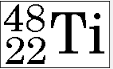
How many protons does this isotope of titanium have?
a)
48
b)
22
c)
26
d)
70
17.
How many neutrons does the isotope of lithium have?
a)
8
b)
3
c)
4
d)
5
18.
How many neutrons does uranium-235 have?
a)
238
b)
92
c)
146
d)
143
19.

In a correctly written isotope symbol what would be located in the "A" position?

a)

number of neutrons

b)

atomic number

c)

number of electrons

d)

mass number

20.

In a correctly written isotope symbol what would be located in the "Z" position?

a)

number of neutrons

b)

atomic number

c)

number of electrons

d)

mass number

21.
What quantities vary between isotopes of an element?
a)
protons, electrons, and atomic mass
b)
protons, electrons, and atomic number
c)
neutrons and electrons
d)
neutrons and atomic mass
22.

Cations are

a)

positive

b)

negative

c)

on the right side of the periodic table.

d)

nonmetals

23.

Negative ions form when atoms _________ electrons.

a)

lose

b)

gain

c)

share

24.

Which of the following will have a larger atomic radius than Zinc?

a)

Gallium

b)

Aluminum

c)

Magnesium

d)

Strontium

25.

Which of the following will have a higher electronegativity than arsenic (As)?

a)

Carbon (C)

b)

Neon (Ne)

c)

Antimony (Sb)

d)

Germanium (Ge)

26.
Which of the following will have a lower ionization energy than Scandium (Sc)?
a)
Helium (He)
b)
Titanium (Ti)
c)
Calcium (Ca)
d)
Magnesium (Mg)
27.

Atomic radius generally increases as we move __________.

a)

down a group and from right to left across a period

b)

up a group and from left to right across a period

c)

down a group and from left to right across a period

d)

up a group and from right to left across a period

28.

The tendency of an atom to attract electrons and create a bond is _________.

a)

electronegativity

b)

ion

c)

ionization energy

d)

atomic radius

29.

Which has the greater electronegativity:

N or C?

a)

C

b)

N

30.
What atom matches this electron configuration?
1s22s22p63s23p64s23d10
a)
Zinc
b)
Copper
c)
Nickel
d)
Germanium
31.

What atom matches this electron configuration?

1s22s22p63s23p64s1

a)

Neon

b)

Magnesium

c)

Aluminum

d)

Potassium

32.
What electron configuration matches an oxygen atom?
a)
1s22s22p63s2, 3p64s23d104p5
b)
1s22s22p4
c)
1s22s22p6
d)
1s22s22p63s23p64s23d1
33.
How many electrons does Si contain? (click to see image)
a)
14
b)
28
c)
2
d)
4
34.
How many electrons can the first energy level hold?
a)
1
b)
2
c)
8
d)
0
35.
What do you start electron configuration with?
a)
1s2
b)
1d10
c)
1f14
d)
1p6
36.
Which element is depicted from this orbital diagram
a)
Fluorine
b)
Neon
c)
Chlorine
d)
Argon
37.
This orbital diagram represents:  
a)
C
b)
B
c)
N
d)
O
38.
Electrons occupy orbitals of lowest energy first is part of what electron configuration rule?
a)
Hund’s Rule
b)
Aufbau Principle
c)
Pauli Exclusion Principle
39.

Orbitals can hold a maximum of two electrons each with opposite arrows is which rule?

a)

Aufbau Principle

b)

Pauli Exclusion Principle

c)

Hund's Rule

40.
The maximum number of electrons that can be placed in an p orbital.  
a)
2
b)
6
c)
10
d)
14