
 Worksheets
UNIT REVIEW - The Earth in Space
Total questions: 35
Worksheet time: 26mins
The orbit of an object around another object is
ROTATION
AXIS
REVOLUTION
EQUINOX
The spin of an object around its axis is
ORBIT
SOLSTICE
REVOLUTION
ROTATION
Which movement of the Earth causes night and day?
ORBIT
REVOLUTION
ROTATION
EXPANSION
Which movement of the Earth causes the changing of seasons?
REVOLUTION
ROTATION
EXPANSION
GRAVITATIONAL PULL
A(n) ____________ occurs when Earth's rotation axis is titled neither toward nor away from the Sun.
SOLSTICE
ORBIT
EQUINOX
REVOLUTION
A(n) _________ occurs when the Earth's rotation axis is tilted directly toward or away from the Sun.
SOLSTICE
EQUINOX
ORBIT
ROTATION
How long does it take for the Earth to complete one REVOLUTION?
27 DAYS
365.25 DAYS
24 HOURS
4 WEEKS
How long does it take for Earth to complete one ROTATION?
24 HOURS
365.25 DAYS
1 MONTH
27 DAYS
Which of the following occurs twice a year, marking the beginning of AUTUMN and SPRING?
EQUINOX
SOLSTICE
ROTATION
REVOLUTION
Which of the following occurs twice a year marking the beginning of SUMMER and WINTER?
EQUINOX
SOLSTICE
ROTATION
REVOLUTION

Which force keeps the planets orbiting the Sun?
Gravity
Magnetism
Wind
Electricity

The imaginary line from the North Pole to the South Pole around which Earth rotates is called its ____________.
equator
atomosphere
axis
rotate
When the Moon passes into the Earth's shadow, it is called a ____________.
solar eclipse
lunar eclipse
waxing moon
waning moon
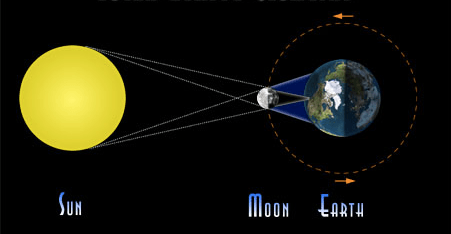
When the moon passes between the Earth and Sun, blocking the sunlight, it is called a ________________.
lunar eclipse
waning moon
solar eclipse
waxing moon

Which moon phase is pictured?
First Quarter
Waxing gibbous
Waning gibbous
Third Quarter
When the lit portion of the moon appears to be getting smaller, it is said to be...
waxing
decreasing
eclipsing
waning

If you saw a full moon today, how long would you have to wait to see another full moon?
One day
One week
One month
One year


___________ are period rise and fall of the oceans' surfaces caused by the gravitational force between the Earth and the Moon and Sun.
Tides
Phases of the moon
Eclipses
Rotations
The movement of one solar system object into the shadow of another object is a(n) ____________.
eclipse
tide
waxing crescent
waning gibbous


What is the theory that states the universe began from one point and has been expanding and cooling ever since?
Apparent Magnitude
Light year
Big Bang Theory
Galaxy
What is a huge group of solar systems, stars, dust, and gas held together by gravity?
protostar
nebula
black hole
galaxy
What does a light year measure?
Temperature
Distance
Brightness
A large sphere of gas which generates energy in its core and emits light, heat, and other radiation is a _____________.
constellation
asteroid
star
galaxy
Which word means the distance that light travels in one year?
Astronomical Unit
light year
parsec
kilometer
The Milky Way is a....
spiral galaxy
elliptical galaxy
irregular galaxy
star
What do we call space and all of the matter and energy in it - everything that exists?
solar system
galaxy
universe
the internet

