Wayground logo

Free Printable Worksheets

Font size

S
M
L
XL
Worksheets

Momentum, Impulse, and Collisions Review

Total questions: 50

Worksheet time: 1hrs 4mins
Name
Class
Date
1.
A biker with a mass of 75 kg moves along the path with a constant velocity of 5 m/s. What is the biker's momentum?
a)
25 m/s
b)
375 m/s
c)
25 kg m/s
d)
375 kg m/s
2.
A runner has a momentum of 670 kg m/s and is travelling at a velocity of 9 m/s. What is his mass?
a)
6030 kg
b)
0.0134 kg
c)
74.4 kg
d)
80 kg
3.
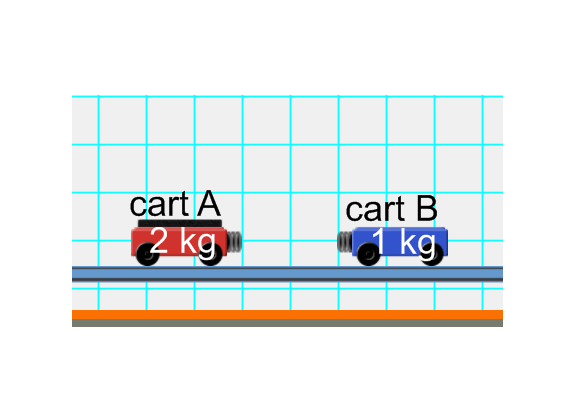
Cart A is pulled with a 2 Newton force for 2 seconds, and Cart B is pulled with a 1 Newton force for 3 seconds.  Which cart experiences the greatest impulse?
a)
Cart B
b)
Cart A
c)
they are the same
4.

A boy kicks a football with a force of 20 N, the time the force acts for is 0.3 s.

Calculate the impulse on the ball.

a)

1 N·s

b)

6 N·s

c)

66 N·s

d)

None of these

5.
The purpose of crumble zones on a car is to
a)
decrease time of impact.
b)
increase force of impact.
c)
increase the time of impact.
d)
decrease the impulse during impact.
6.
The difference between a car hitting a wall vs. a car hitting a hay stack is
a)
the Impulse on the car hitting the wall is greater
b)
the change in momentum of the car hitting the wall is greater
c)
the force on the car hitting the hay stack is greater
d)
the collision time of the car hitting the hay stack is greater
7.
The impulse-momentum theorem states that
a)
the impulse on an object is equal to the change in momentum it causes 
b)
the force on a moving object is equal to the magnitude of the impulse.
c)
the impulse on an object is greater than the change in momentum it causes 
d)
the impulse on an object is less than the change in momentum it causes
8.
can a bullet have the same momentum a truck?
a)
yes
b)
no
9.

The momentum of an object depends upon the object's ___________&_____________.

a)

size and shape

b)

mass and speed

c)

mass and veloctiy

d)

mass and energy

10.

Determine the momentum of 1,000-kg car moving northward at 20 m/s.

a)

20,000 N

b)

20,000 Joules

c)

20,000 Kg * m/s

d)

20,000 kg * m/s north

11.

When the speed of an object is doubled, its momentum...

a)

remains unchanged in accord with the conservation of momentum.

b)

doubles.

c)

quadruples.

d)

decreases.

12.
A 2 kg cart has a momentum of 16 kg m/s. What is its velocity?
a)
8 m/s
b)
32 m/s
c)
0.125 m/s
d)
18 m/s
13.
If two objects have the same mass, then the faster moving object has ____________ momentum.
a)
more 
b)
less
c)
the same
14.
While playing pool, the white cue ball strikes the 8 ball. Before the collision, the cue ball's velocity was 10 m/s and the 8 ball was at rest. If both ball's have a mass of 0.15 kg and the cue ball's velocity after the collision is 2 m/s, what is the 8 ball's velocity?
a)
2 m/s
b)
8 m/s
c)
-2 m/s
d)
1.5 m/s
15.
The total momentum before a collision is _________ the total momentum after a collision.
a)
equal to 
b)
less than 
c)
more than
d)
It depends on the type of collision
16.

Juan observed a collision in a lab where the kinetic energy after the collision was equal to the kinetic energy before the collision. This type of collision is

a)

Inelastic

b)

Elastic

c)

Explosion

17.

Extending the time of a collision allows you to...

a)

change the impulse of the collision.

b)

diffuse the collision.

c)

increase the force of impact.

d)

decrease the force of impact.

18.

A grocery shopper tosses a 9.0 kg bag of rice into a stationary 18.0 kg grocery cart. The bag hits the cart with a horizontal speed of 5.5 m/s toward the front of the cart. What is the final speed of the cart and bag?

a)

3.66 m/s

b)

1.83 m/s

c)

1.38 m/s

d)

6.33 m/s

19.
In this type of collision, objects tend to "stick" together.
a)
elastic
b)
inelastic 
c)
They "stick" together in both types of collisions
20.
A 10kg toy truck moves at 5m/s East. It collides and bounces off of a 5kg toy car moving 10 m/s moving west. Which equation would you use to solve for the final velocity of the car?
a)
m1v1i+m2v2i=m1v1f+m2v2f
b)
(m1+m2)vi=m1v1f+m2v2f 
c)
m1v1i+m2v2i=(m1+m2)vf
21.

According to Newton's Laws, for every action there is an ....

a)

equal and opposite reaction.

b)

equal and parallel reaction.

c)

unequal and opposite reaction.

d)

unequal and unrelated reaction.

22.

In an elastic collision, ______ is conserved.

a)

Momentum only

b)

Kinetic Energy only

c)

Both momentum and energy

23.
In a perfectly inelastic collision, ______ is conserved. 
a)
Momentum only
b)
Kinetic Energy only
c)
Both momentum and kinetic energy
24.
The recoil speed of a rifle is much less than the exit velocity of a bullet because...
a)
the rifle experiences a smaller force
b)
the rifle experiences a smaller change in momentum
c)
the rifle has a much greater mass
d)
the rifle does not obey the laws of physics
25.
A 50 kg ball rolls down the street at 5 m/s. Calculate the momentum of the ball. 
a)
55 kg*m/s
b)
100 kg*m/s
c)
250 kg*m/s
d)
500 kg*m/s
26.

Two skaters begin at rest. Skater 1 has a smaller mass than Skater 2. After they push off each other,...

a)

Skater 1 experiences a greater change in momentum

b)

Skater 2 experiences a greater change in momentum

c)

Skater 1 has a greater speed than Skater 2

d)

Skater 1 experiences a greater force

27.
What happens to the speed of the wagon as the rain collects inside of it?
a)
it decreases
b)
it remains constant
c)
it increases
28.
Parkour Peter bends his knees upon landing in order to ____
a)
reduce his change in momentum
b)
increase his change in momentum
c)
increasing his landing time
d)
increasing his landing force
29.
Both students experience the same ____
a)
force of impact
b)
time of impact
c)
change in momentum
d)
all of the above
30.

A block of mass M slides across a frictionless surface with velocity v until collides with a stationary block of mass m. If the two blocks stick together, what is their velocity after the collision?

a)

(M+m)v / m

b)

(M-m)v

c)

Mv / (M+m)

d)

(M-m)v / M

31.
Δp is the symbol for
a)
velocity
b)
impulse
c)
momentum
d)
change in momentum
32.
The symbol for impulse is 
a)
m
b)
p
c)
v
d)
J
33.

The units for momentum are

a)

kg

b)

m/s

c)

N *S

d)

kg * m/s

34.
Jorge noticed a collision outside the coffee shop where two cars collided and stuck together.  What type of collision did he observe?
a)
Elastic
b)
Inelastic
c)
Completely inelastic
d)
none
35.
The equation to calculate momentum is
a)
p=mv
b)
p=1/2mv2
c)
p=mgh
d)
p=mg
36.
Momentum is a ____________________ quantity
a)
science
b)
scalar
c)
vector
d)
energy
37.
When two objects collide, the Pbefore is ____________ the Pafter.
a)
more than 
b)
less than 
c)
equal to
d)
unrelated to
38.
What is the unit for velocity?
a)
m/sec
b)
kg/sec
c)
kg/m
d)
kg m/sec
39.
What is the unit for mass?
a)
m/sec
b)
kg/sec
c)
kg
d)
kg m/sec
40.
The speed and direction of an object's motion.
a)
Inertia
b)
Equilibrium
c)
Velocity
d)
Acceleration
41.
A push or pull that acts on an object.
a)
Force
b)
Gravity
c)
Friction
d)
Lubricant
42.
The change in position of an object.
a)
Acceleration
b)
Motion
c)
Equilibrium
d)
Unbalanced Force
43.
The combination of different forces acting on an object at the same time.
a)
Net force
b)
Balanced force
c)
Equilibrium
d)
Unbalanced force
44.
The state an object is in when all forces acting on it balance each other.
a)
Inertia
b)
Net force
c)
Equilibrium
d)
Velocity
45.
Forces that are not equal in size and direction.
a)
Equilibrium
b)
Unbalanced forces
c)
Acceleration
d)
Velocity
46.
The rate at which the velocity of an object changes over time.
a)
Acceleration
b)
Speed
c)
Direction
d)
Motion
47.
A force that resists the movement of one surface past another surface.
a)
Acceleration
b)
Gravity
c)
Friction
d)
Lubricant
48.
The tendency of an object to resist any change in motion.
a)
Net force
b)
Motion
c)
Momentum
d)
Inertia
49.

Is the constant velocity of a falling object when the force of air resistance equals the force of gravity.

a)

Orbit

b)

Inertia

c)

Terminal Velocity

d)

Gravity

50.
The force with which something moves
a)
Momentum
b)
Motion
c)
Speed
d)
Force