wayground logo

Free Printable Worksheets

NEW

Font size

S
M
L
XL
Worksheets

Evidence to Explain the Universe

Total questions: 22

Worksheet time: 22mins

Name
Class
Date
1.
Which electromagnetic waves have the highest frequencies and the shortest wavelengths?
a)
microwaves
b)
visible light
c)
gamma rays
2.
How much of the electromagnetic spectrum is made up of visible light?
a)
only a small portion
b)
a very l;arge portion
c)
about half
3.
True or false: as you move along the spectrum, radio to gamma waves, the wavelengths decrease in size (get smaller)
a)
true
b)
false
4.
A wave with a large wavelength will have a ______ frequency and _____ energy
a)
high, low
b)
high, high
c)
low, high
d)
low, low
5.
Which has the LONGEST wavelength and, therefore, the lowest frequency/energy
a)
Gamma Rays
b)
Radio Waves
c)
Visible Light
d)
Infrared rays
6.
Which has the SHORTEST wavelength and, therefore, the highest frequency/most energy
a)
Radio waves
b)
Ultraviolet Rays
c)
Gamma Rays
d)
X-rays
7.
Which section of the spectrum is the ONLY one we can see?
a)
X-rays
b)
Visible Light
c)
Gamma Rays
d)
Ultraviolet Rays
8.
The distance between two crests or two troughs of a wave is called:
a)
frequency
b)
amplitud
c)
wavelength
d)
hertz
9.

Quasars are extremely distant celestial bodies. Investigators using a special telescope determined that a certain quasar was emitting waves with a frequency of 1.41 x 10⁹ Hz. Using the electromagnetic spectrum provided, investigators were most likely using a telescope that detects -

a)

microwaves

b)

visible light

c)

x-rays

d)

gamma rays

10.
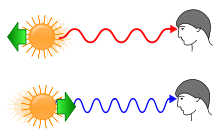
If an object is moving toward us, its spectrum will experience
a)
no shift
b)
red shift
c)
black spectrum
d)
blue shift
11.
Why is the light from distant galaxies red-shifted?
a)
They produce more red light than nearby galaxies
b)
They are moving away from us
c)
The longer wavelengths are filtered out more by dust
d)
They are moving toward us
12.
What is red shift?
a)
Things in space are red
b)
Things in space will appear redder than they are if moving toward you
c)
Things in space will appear redder than they are if they are stationery
d)
Things in space will appear redder than they are if moving away from you
13.

Most scientists believe the Big Bang Theory explains which of the following questions?

a)

How our planets and moons formed

b)

How our universe began

c)

How the sun turns hydrogen into helium

d)

How fast light travels through space

14.

Which statement is true?

a)

The galaxies are moving toward us.

b)

The galaxies are moving away from us.

c)

The universe remains static or unchanged in motion.

d)

None of the above

15.

Why is the light from distant galaxies red-shifted?

a)

They produce more red light than nearby galaxies

b)

They are moving away from us

c)

The longer wavelengths are filtered out more by dust

d)

They are moving toward us

16.

In relation to us, most galaxies are…

a)

Moving toward us

b)

Moving away from us

c)

Not moving

17.
_____ have the longest wavelengths and lowest frequencies of all electromagnetic waves.
a)
microwaves
b)
radio waves
c)
gamma rays
d)
ultraviolet
18.

What theory explains how the universe was formed?

a)

The expanding universe

b)

The big bang

c)

The heliocentric model

d)

The geocentric model

19.
What is the best evidence for the Big Bang theory?
a)
How fast light can travel
b)
The expansion of the Universe
c)
Creation of new planets
20.
If a star is being observed from Earth and it's light has shifted towards the blue side of the electromagnetic spectrum it would be...
a)
Moving towards the Earth
b)
Moving away from the Earth
c)
This is a trick question that cannot be answered
d)
It isn't a star, it is a very large blueberry.
21.
The vast majority of galaxies in our universe are moving away from us.  We know this because we observe __________ in the galaxies absorption spectra.
a)
Redshift
b)
Blueshift
c)
Turbulance
d)
Superposition
22.
What does the Red-shift tell us about the universe
a)
the universe is expanding
b)
the universe is contracting
c)
the big bang is false
d)
nothing