
 Worksheets
ecosystem and processes activate 2
Total questions: 40
Worksheet time: 20mins
Name
Class
Date
1.
Complete the photosynthesis word equation. Carbon dioxide + wate --> ...............
a)
Glucose + oxygen
b)
Food + oxygen
c)
Lactic acid + carbon dioxide
d)
Energy + water
2.
Animals which eat other organisms are called...
a)
Consumers
b)
Produces
c)
Parasites
d)
Animals
3.
What are the reactants of photosynthesis?
a)
Carbon dioxide + water
b)
Oxygen + glucose
c)
Water + glucose
d)
Carbon dioxide + glucose
4.
Organisms that make their own food are called....
a)
Producers
b)
Consumers
c)
Parasites
d)
Omnivores
5.
What is the green pigment called in plants?
a)
Chlorophyll
b)
Cells
c)
Roots
d)
Rhodopsin
6.
What are the small openings called on the underside of the leaf?
a)
Stomata
b)
Guard cells
c)
Chloroplasts
d)
Gap cells
7.
What are the four important plant minerals?
a)
nitrates, phosphates, potassium, magnesium
b)
nitrates, phosphates, potassium, calcium
c)
nitrates, phosphates, calcium, magnesium
d)
nitrates, carbohydrates, potassium, magnesium
8.
What are the effects of nitrate deficiency?
a)
Poor growth and some yellow leaves
b)
Poor root growth
c)
Dead patches on leaves
d)
Root rot
9.
What animal can perform chemosynthesis?
a)
Tubeworms
b)
Fish
c)
Sea slugs
d)
Carp
10.
How does oxygen get from your lungs to the rest of the body?
a)
Carried by the blood
b)
Dissolves through the body
c)
Mitochondria
d)
Breathing in
11.
What are the reactants of aerobic respiration?
a)
Glucose + oxygen
b)
Carbon dioxide + water
c)
Glucose + water
d)
Oxygen + carbon dioxide
12.
What do red blood cells contain which oxygen binds to?
a)
Haemoglobin
b)
Cells
c)
Chlorophyll
d)
Stomata
13.
What kind of respiration does not require oxygen?
a)
Aerobic respiration
b)
Anaerobic respiration
c)
Lactic respiration
d)
Breathing
14.
What chemical is produced in anaerobic respiration?
a)
Lactic acid
b)
Carbon dioxide
c)
Water
d)
Glucose
15.
What are the products of fermentation?
a)
Ethanol + carbon dioxide
b)
Carbon dioxide + water
c)
Lactic acid
d)
Glucose
16.
What is it called when dangerous chemicals become more concentrated up a food chain?
a)
Bioaccumulation
b)
Photosynthesis
c)
Food web
d)
distillation
17.
What is glucose?
a)
A mineral
b)
A vitamin
c)
A sugar
d)
A salt
18.
What are the products of photosynthesis? (The plant makes these)
a)
Carbon dioxide and water
b)
Glucose and oxygen
c)
Carbon dioxide and oxygen
d)
Glucose and water
19.
What are the reactants in photosynthesis? (The plant takes them in)
a)
Sunlight and oxygen
b)
Carbon dioxide and water
c)
Oxygen and minerals
d)
Sunlight and water
20.
How does water get into a plant?
a)
Stem
b)
Flowers
c)
Leaves
d)
Roots
21.
What mineral do plants need to make chlorophyll?
a)
Potassium
b)
Nitrogen
c)
Magnesium
d)
Carbon dioxide
22.
What contain the chlorophyll in a leaf?
a)
Waxy layer
b)
Chloroplasts
c)
Stem
d)
Roots
23.
Where does most of the photosynthesis happen?
a)
In the chloroplasts
b)
In the roots under the ground
c)
In the waxy layer
d)
In the petals
24.
Eats only meat
a)
Carnivore
b)
Herbivore
c)
Omnivore
d)
Prey
25.
Kills other animals for food (example: A lion)
a)
Predator
b)
Prey
26.
Oceans, rain forests and deserts are examples of...
a)
Ecosystems
b)
Houses
c)
Human habitats
d)
Animal habitats
27.
What happens to our breathing when we exercise?
a)
Gets slower
b)
Gets faster
c)
Stays the same
28.
All organisms need _____ to survive.
a)
Environment
b)
energy
c)
sun
d)
plants
29.
The ____________ provides all the initial energy to plants.
a)
sun
b)
moon
c)
environment
d)
water
30.

A feeding relationship where one organism hunts and one is hunted.
a)
Commensalism
b)
Decomposistion
c)
Mutualism
d)
Predator-Prey
31.

An organism that needs to use chemicals to make its own food is known as a(n):
a)
Heterotroph
b)
Autotroph
c)
Decomposer
d)
Consumer
32.

A group of particular organisms that belong to the same species that live in the same habitat is known as a:
a)
Population
b)
Ecosystem
c)
Community
d)
Biome
33.
Which type of respiration is most efficient?
a)
Aerobic
b)
Anaerobic
34.
Where in the cell does aerobic respiration take place?
a)
Nucleus
b)
Cytoplasm
c)
Mitochondria
d)
Cell membrane
35.
What happens to your pulse when you exercise?
a)
It increases
b)
It decreases
c)
It stays the same
36.
The leaf has a shiny, waxy cuticle around it to
a)
increase the rate of photosynthesis
b)
attract more light
c)
control water loss
d)
stop carbon dioxide and oxygen gases escaping
37.
Most of the chloroplast cells are found in the
a)
upper epidermis
b)
pallisade mesophyll layer
c)
lower epidermis
d)
stomata
38.
The important gases, carbon dioxide and oxygen, enter and leave the leaf through the
a)
upper epidermis
b)
phloem
c)
stomata
d)
guard cells
39.
The role of the guard cell is to
a)
help control the temperature of the plant
b)
control how much water enters the leaf
c)
control how much glucose is stored
d)
control the movement of water vapour & gases
40.
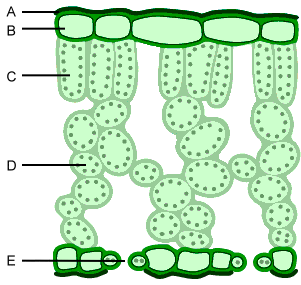
What is letter "D" pointing to?
a)
upper epidermis
b)
palisade mesophyll
c)
spongy mesophyll
d)
bundle sheath
100 %

