
Font size
 Worksheets
alkanes
Total questions: 35
Worksheet time: 3585secs
Which is the structures with IUPAC nomenclature
2,2,4-trimethylpentane
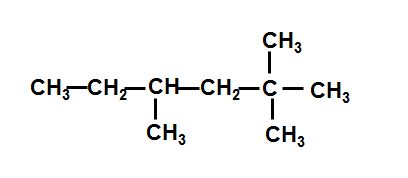
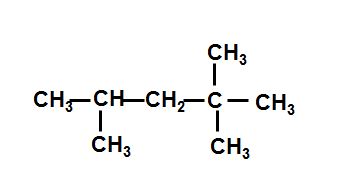
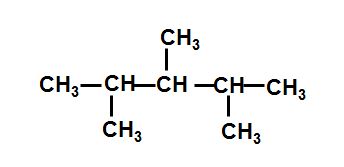
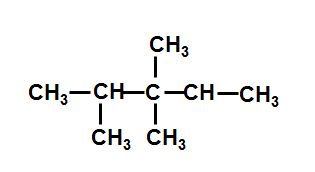
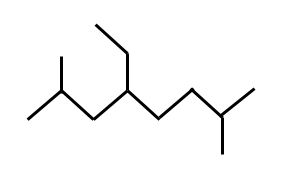
Give IUPAC nomenclature for this compound
2,7-dimethyl-5-ethyloctane
5-ethyl-2,7-dimethyloctane
2,7-dimethyl-3-ethyloctane
4-ethyl-2,7-dimethyloctane
Which correctly represents an incomplete combustion of pentane?
C5H12 + 8O2 ⟶ 5CO2 + 6H2O
C5H12 + 8O2 ⟶ 4CO + CO2 + 6H2O
C5H12 + 6O2 ⟶ 4CO + CO2 + 6H2O
C5H12 + 5O2 ⟶ 4CO + CO2 + 4H2O + 2H2
The boiling points of alkane molecules increase as their molecular sizes increase.
True
False

Name the following alkane:
2-methylpentane
1-methylhexane
1,1-dimethylpentane
1,2-dimethylbutane
Which of the following products may be formed from the cracking of heavy oil fraction?
(1) CO
(2) C2H4
(3) C8H18
(1) and (2) only
(1) and (3) only
(2) and (3) only
(1), (2) and (3)
C10H22 -----> C6H14 + 2 X
Which of the following concerning the above process and X is correct?
fractional distillation and an alkane
fractional distillation and an alkene
cracking and an alkane
cracking and an alkene
Which of the following statements concerning the compounds C2H4, C3H6 and C4H10 is correct?
They belong to the same homologous series.
They are unsaturated hydrocarbons.
They are gases at room temperature and pressure.
They have the same physical properties.
What process is used to separate crude oil in hydrocarbons with different chain lengths?
distillation
fractional distillation
cracking
polymerisation
Where in the fractionating column are shorter chain hydrocarbon molecules obtained?
At the top
At the bottom
Fractional distillation separates crude oil based on the different __________ of the molecules in the mixture
melting point
boiling point
freezing point
chemical reactivity
Molecules collected at the bottom of the fractionating column tend to be...
more viscous, less flammable and less volatile
less viscous, more flammable and more volatile
more viscous, more flammable and less volatile
less viscous, less flammable and more volatile
Molecules collected at the top of the fractionating column tend to be...
more viscous, less flammable and less volatile
less viscous, more flammable and more volatile
more viscous, more flammable and less volatile
less viscous, less flammable and more volatile
What are the 2 products of complete combustion?
carbon dioxide + hydrogen
carbon dioxide + water
carbon monoxide + water
carbon monoxide + hydrogen
What is the term given to the process by which longer chain hydrocarbons are broken down into shorter length alkanes and alkenes?
fractional distillation
evaporation
cracking
polymerisation
C10H22 --> C5H12 + C3H6 + ?
C2H4
C3H4
CO2
CH4
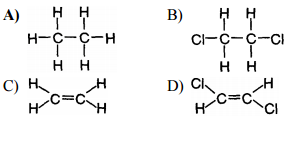
When sulfur dioxide is absorbed in desulfurisation
CaO + SO2 --> CaSO3 which of the answers is FALSE?
It is a redox reaction
it is an acid base reaction
the product can be sold to make plasterboard
sulfur comes from fossil fuels

Select 2 correct responses That the 2 equations represent
Thermal cracking
Alkenes are produced
uses a zeolite catalyst
Cyclic alkanes are produced

The cracking to produce the above requires (2 ticks)
A zeolite catalyst
Temperatures of 450 C
Pressure 7000 kPa
Hydrogen gas

Moles of oxygen for complete combustion
4
4.5
8
8.5
Which two gases are removed by a catalytic converter?
Carbon dioxide
Carbon monoxide
Nitrogen oxide
Nitrogen
Which 2 gases are produced by a catalytic converter?
Nitrogen
Carbon monoxide
Carbon dioxide
Nitrogen oxide
Which is not present in a catalytic converter?
Platinum
Palladium
Rhodium
Silver
How is nitrogen dioxide created?
When nitrogen and oxygen react in air
When nitrogen and oxygen react under higher temp and pressure in engine.
They are present in fossil fuel
They are always present in air
Which statements about cracking are correct?
cracking makes shorter chain alkanes as demand exceeds yield from fractional distillation.
cracking makes shorter chain alkanes as yield exceeds demand from fractional distillation.
catalytic cracking makes ethene
thermal cracking makes ethene
Which equations are correct for the thermal cracking of C14H30?
C14H30(l) ---> C7H6(l) + C3H6(l) + 2CH2=CH2
C14H30(l) ---> C11H24(l) + CH2=CH2
C13H28(l) ---> C7H6(l) + C3H6(l) + 2CH2=CH2
C14H30(l) ---> C12H26(l) + CH2=CH2
What is the catalyst used for catalytic cracking?
Zeotherm
Zeomite
Zeology
Zeolite
Which 2 are the correct statements about cracking?
Thermal cracking is carried out at a slight pressure and 400 - 900oC
Thermal cracking is carried out at a 7000 kPa pressure and 400 - 900oC
Catalytic cracking needs temperatures of 400-900oC
Catalytic cracking makes a greater yield of branched and cyclic alkanes
2 correct equations for the incomplete combustion of methane are
2CH4(g) + 4O2(g) -->2CO2(g) + 4H2O(g)
2CH4(g) + 3O2(g) -->2CO(g) + 4H2O(g)
CH4(g) + 2O2(g) -->2CO(g) + 4H2O(g)
CH4(g) + O2(g) -->C(s) + 2H2O(g)
Which polluting gases are created under the high temperature and pressures in an internal combustion engine (in a car)
carbon monoxide
nitrogen oxides (NOx)
sulfur dioxide
nitrogen
When oil is refined sulfur containing compounds are removed to stop formation of sulfur dioxide. Which 2 statements are correct?
CaO(s) + SO2(g) --> CaSO3(s) oxidation reaction
CaO(s) + SO2(g) --> CaSO3(s) acid base reaction
2CaSO3(s) + O2(g) ---> 2CaSO4(s) oxidation
2CaSO3(s) + O2(g) ---> 2CaSO4(s) acid base reaction
Alkanes in crude oil are separated by fractional distillation. Which 2 statements are true?
As the carbon atoms increase boiling points increase because there are more bonds to break
As the carbon atoms increase boiling points increase because there are more Van der Waals forces between molecules
The top of the fractionating column is hotter than the bottom. Lighter molecules condense off at the top
The bottom of the fractionating column is hotter than the top. Lighter molecules condense off at the top
Which is the correct equation for the reaction which occurs in a 2 way catalytic converter?
CO2 (g) + N2 (g)--> CO (g) + 2NO (g)
CO2 (g) + N2 (g)--> CO (g) + NO (g)
2CO (g) + 2NO (g) --> 2CO2 (g) + N2 (g)
CO (g) + 2NO2 (g) --> CO2 (g) + N2 (g)

