
NEW
Font size
 Worksheets
Electric Forces Review
Total questions: 18
Worksheet time: 18mins
Coulomb's Law states that the electric force is directly proportional to the product of the two charges and inversely proportional to the distance between them. True or False?
True
False
not enough information
When you walk across a carpet in socks, they pick up charges. Later, there aren't any charges in your socks. what probably happened to the charges?
The charges disappeared.
The charges switched signs.
The charges transferred to another object.
The charges broke apart into smaller particles.
You have 2 circular objects, and each has a positive charge near each other, but not touching. Which statement describes the force that is exerted on the objects due to their electric charge?
There is a force pushing both objects to the left.
There is a force pulling the objects toward each other.
There is a force pushing the objects away from each other.
There is no force on the objects due to their electric charge.
You have two pairs of charged objects interacting with each other. The first pair (A and B) are 10 cm apart. A has a +1 charge and B has a -1 charge.
Pair C and D are 17cm apart. C has a +1 charge, and D has a -1 charge.
Which of these statements is true?
There are no electric forces because the charges in each pair of objects cancel.
The electric force between A and B is smaller than the electric force between C and D.
The electric force between A and B is greater than the force between C and D.
The electric force between A and B is identical in magnitude to the electric force between C and D.

In a stable atom the amount of electrons is equal to
neutrons
protons
atomic mass
neutrons + protons
What variable do "newtons" represent?
Electrostatic Charge
Force
Distance
Mass

The graph shows the relationship between the force of interaction and the magnitude of charge. What type of relationship is this?
Direct
Indirect
Inverse
Reverse

The image shows two charged particles with a force of 2.4 N. What would you predict the force of interaction would be when the magnitude of charge on q2 doubles?
9.6 N
4.8 N
1.2 N
.6 N
The process of transferring charge between objects by touching or rubbing
charging by induction
static discharge
charging by conduction
charging by convection
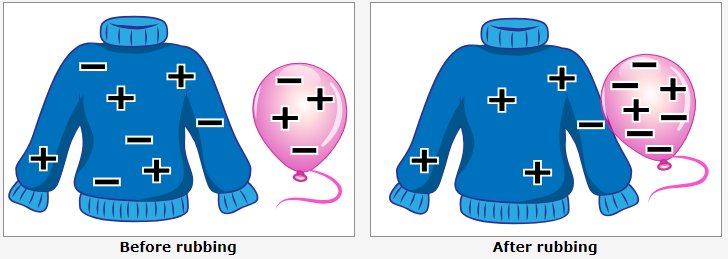
Before the balloons and sweaters are rubbed together, both objects are __________ charged. After they are rubbed together the sweater is __________ charged and the balloon is ___________ charged
negative/positive/negative
neutral/positive/negative
positive/negative/neutral
neutral/negative/positive
Which picture correctly shows how the atoms in an insulator polarize when a positively-charged plate is brought nearby?


A neutral electroscope is charged by bringing a negative rod next to it, then touching it.
A
B
C
D
E
If electric charges rearrange so that there is 30 J more electric potential energy than before, ---.
30 J of work must have been done on the charges
the charges released 30 J of energy
30 J of electric energy turned into some other form of energy
there must be an electric potential difference of 30 V
Two oppositely-charged particles start out 12 m from each other, and later they are 8 m from each other. The electric potential energy ---.
went down
went up
did not change
might have gone up or down depending on the size of the electric charges

