
 Worksheets
Unit 5: Early Republic
Total questions: 48
Worksheet time: 28mins
After losing reelection in 1800, Adams’ administration filled the courts with Federalist judges. Why did they do this?
Jefferson was planning to remove all Federalist judges from the courts.
Adams was angry over Jefferson’s campaign against him.
Appointing justices that serve life terms would allow Federalist laws and policies to continue.
Adams hoped the Supreme Court would overturn the election results.
The Congress shall have Power...To make all Laws which shall be necessary and proper for carrying into Execution the foregoing Powers, and all other Powers vested by this Constitution in the Government of the United States, or in any Department or Officer thereof.U.S. Constitution - Article 1, Section 8, Clause 18 (known as the Elastic Clause)
Alexander Hamilton used the above clause to justify:
establishing the Bank of the U.S.
writing the Kentucky and Virginia Resolutions
supporting John Adams for reelection in 1800
creating the Democratic-Republican Party
Which problem did George Washington encounter when he became president?
The Articles of Confederation needed to be replaced with a stronger constitution.
Great Britain was refusing to trade with the United States.
Southern states were threatening to secede from the Union.
The United States had large debts from the American Revolution.
Use the visual below to answer question 5.
The Whiskey Rebellion
The Bank of the United States
The Alien and Sedition Acts
Marbury v. Madison
The list provides examples of -
issues leading to the ratification of the first constitutional amendments
topics discussed during the Second Constitutional Convention
domestic issues faced by the leaders of the new republic
weaknesses of the government under the Articles of Confederation
After the War of 1812, thousands of settlers and immigrants moved to the western frontiers of the United States in search of farming and business opportunities. In response, the government began building roads. This transportation network was intended to -
establish federal control over industry
promote the free-enterprise system
discourage the organization of new territories
prevent border disputes between states
Use the visual below to answer the question
limited government interference in business
prices determined by supply and demand
private owners receive the profits
Which type of economy is best described by these characteristics?
free enterprise
mercantilism
subsistence farming
socialism
American political parties developed during the late 18th century partly as a result over a disagreement on -
the idea of neutrality
the court system
the power of the President
how to interpret the Constitution
Federalists and Democratic-Republicans emerged as separate political parties partly as a result of disagreements over what?
whether to enforce the Monroe Doctrine
whether to approve the Declaration of Independence
how the nation should admit new states
how the nation should develop economically
Which of the following is an example of Democratic-Republican ideals in our government?
reducing the size of the federal government
proposing amendments to Congress
sending ambassadors to improve relations with Great Britain
appointing opposing political leaders in administrative positions
“Educate and inform the whole mass of the people...They are the only sure reliance for the preservation of our liberty.”
- Thomas Jefferson (Democratic-Republican)
“The people are turbulent and changing, they seldom judge or determine right.”
- Alexander Hamilton (Federalist)
The above quotes reflect the differences over which issue:
industry or agriculture as the primary economy
national or state as the more powerful government
foreign relations with European countries
limiting or expanding voting rights
The War of 1812 was a result of American conflicts with both the -
French and the Native Americans
French and the British
British and the Native Americans
British and the Spanish
How did the disruption in Atlantic shipping prior to and during the War of 1812 significantly affect the U.S economy?
Cotton sales from southern states to Europe increased.
Imports of raw materials increased in the Northeast.
Americans emigrated to Europe to find manufacturing jobs.
American industries expanded to provide replacements for foreign goods.
Use the visual below to answer question 17.
Fought 2 weeks after the Treaty of Ghent signed
Overwhelming American victory
Source of pride for U.S.
Made Andrew Jackson national hero
Which event is described in the above box?
Battle of Fort McHenry
Battle of New Orleans
Battle of Lake Champlain
Battle of Lake Erie
“It is our true policy to steer clear of permanent alliances with any portion of the foreign world; so far as we are now at liberty to do it; for let me not be understood as capable of patronizing infidelity to existing engagements.” -President George Washington, Farewell Address 1796
President Washington was offering this advice because he believed -
the United States should break its agreements with France
the United States should seek alliances with other nations
the United States should avoid alliances with foreign nations
the destiny of the United States was to rule other countries
One similarity on the foreign policies of Presidents George Washington, Thomas Jefferson, and James Monroe was that they -
sought to avoid involvement in European political struggles
favored France over England
sought colonies in other parts of the world
came to the defense of Latin American nations
President Adams’ reaction to the XYZ Affair demonstrated his belief in:
maintaining U.S. neutrality with foreign countries
supporting France in its wars with Britain
building an industrial economy for the U.S.
the role that common people should play in the government
The Embargo Acts and the War of 1812 were similar in that both events dealt with a conflict involving the…
British impressment of American sailors
launch of a protective tariff on British imports
emergence of manufacturing in the South
decisions of the U.S. Supreme Court
John Marshall used his position as chief justice to:
uphold federal power over the states
punish political enemies of the Federalist Party
appoint other Federalist judges to lower courts
write laws more favorable to his party
The decision in Marbury v. Madison was significant in U.S. history because it -
confirmed the power of Congress to regulate interstate commerce
reinforced federal authority over native american affairs
established the practice of judicial review by the Supreme Court
upheld the power of the Electoral College to choose the vice president
The decision in Gibbons v. Ogden (1824) addressed which of the following issues?
the Supreme Court’s right to declare Congressional act unconstitutional
the issue of congressional privileges
the regulation of interstate commerce
the right of states to tax a federal property
Which Supreme Court ruling strengthened the power of the Federal Government by declaring a state tax on the national bank is unconstitutional?
Gibbons v. Ogden
Dred Scott v. Sanford
Marbury v. Madison
McCulloch v. Maryland


Which of the following is the best example of an early U.S. struggle to define the domestic authority of the central government?
The XYZ affair
The War of 1812
The Barbary Wars
The Whiskey Rebellion
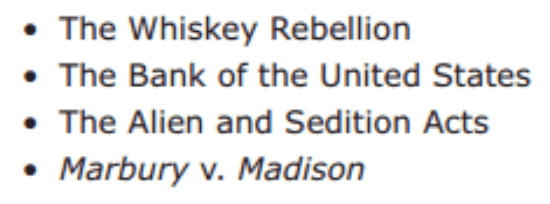
This list provides examples of -
topics discussed during the Second Constitutional Convention
domestic issues faced by the leaders of the new republic
weakness of the government under the Articles of Confederation
issues leading to the ratification of the first constitutional amendments
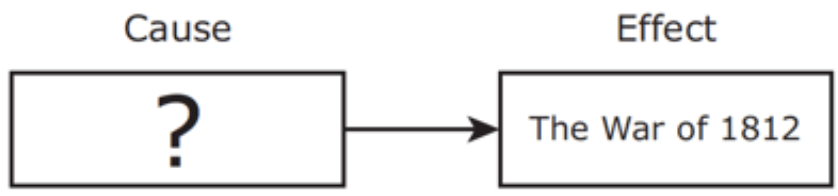
Which action completes this graphic organizer?
French naval attacks on U.S. harbors
British invasion of countries allied with the U.S.
French embargoes on trade with the U.S.
British impressment of U.S. sailors

Which of the following is the source of this statement on foreign policy?
George Washington's Farewell Address
The Monroe Doctrine
Abraham Lincolns first inaugural address
The Federalists Papers
In Marbury v. Madison, the Supreme court established a principle that would eventually be used by all courts to -
strike down any law that the court deems unconstititional
decided the outcome of contested election results
overturn any impeachment that the court deems unsupported by evidence
mediate disputes related to commerce between states


Which statement is most clearly supported by the info in the graph above?
The Embargo Act immediately increased trade with Europe
France and Great Britain seized American ships for their cargo
American trade policies were affected by events in Europe
The US government encouraged trade between nations at war

How did the disruption in Atlantic shipping prior to and during the War of 1812 significantly affect the US economy?
American industries expanded to provide replacements for foreign goods
Imports of raw materials increased in the Northeast
Americans emigrated to Europe to find manufacturing jobs
Cotton sales from southern states to Europe increased

The decision in Gibbons v. Ogden (1824) addressed which of the following issues?
The regulation of interstate commerce
The Supreme Court’s right to declare Congressional acts unconstitutional
The issue of congressional privileges
The right of states to tax a federal property
Which Supreme Court ruling strengthened the power of the Federal Government by declaring a state tax on the national bank is unconstitutional?
Marbury v. Madison (1803)
Dred Scott v. Sanford (1857)
McCulloch v. Maryland (1819)
Gibbons v. Ogden (1824)

The newspaper headline, “Segregation in Public Schools Ended by Court” follows the precedent set in the case of:
Gibbons v. Ogden (1824)
McCulloch v. Maryland (1819)
Marbury v. Madison (1803)
Miranda v. Arizona (1966)

Which of the answers below best completes the diagram above?
Monroe Doctrine
Washington’s Farewell Address
Articles of Confederation
XYZ Affair



