wayground logo

Free Printable Worksheets

Font size

S
M
L
XL
Worksheets

US History WWII

Total questions: 35

Worksheet time: 19mins

Name
Class
Date
1.
US legislation that allowed the US to remain neutral but loan and "sell" ammunition and machinery/equipment to countries when it was in the best interest of the US.
a)
neutrality
b)
militirism
c)
lend lease program
d)
imperialism
2.
This day will live in infamy
a)
December 7, 1941
b)
April 7, 1861
c)
December 25
d)
February 15, 2018
3.

What event changed the role of the US and led to us declaring war and sending troops into battle?

a)

attack on Pearl Harbor

b)

Lend-Lease Act

c)

Operation Torch

4.

Who transmitted code messages for the allies during WWII?

a)

women

b)

Navajo

c)

African Americans

5.

The Munich Pact incorporated this policy

a)

Isolationism

b)

Neurality

c)

Appeasement

6.

What is Genocide?

a)

prejudice, racism, hatred against Jews

b)

systematic attempt to eliminate an entire race

c)

organized attack on Jewish homes and businesses

7.

This was a military tactic used by the US in the Pacific Theatre

a)

Blitzkreig

b)

Island-hopping

c)

Trench warfare

8.

This was a major reason for dropping the atomic bomb on Japan

a)

promote US Isolationism

b)

destroy Japan's industrial centers and save American lives

c)

Scare Hitler

9.

What was the purpose of rationing?

a)

increase supply of natural resources

b)

cause a shortage of crops

c)

provide supplies to the troops

10.
How are dictators able  to rise to power after countries suffer hardships? 
a)
People want strong leaders to solve their problems.
b)
Dictators promise freedom. 
c)
Dictators allow everyone to vote. 
d)
Dictators promise to end fascism.
11.
In which WWII event did Japan use the strategy of surprise attack to bomb the United States? 
a)
D-Day on the shores of France
b)
Pearl Harbor
c)
Invasion of Poland
d)
V-E Day
12.
Victory in Europe (V-E Day) was a result of ________________.
a)
Japan surrendering
b)
The atomic bombings
c)
Germany surrendering
d)
the signing of the Treaty of Versailles
13.
Why were natural resources, like gasoline, scarce during WWII?
a)
The U.S. government did not want to spend money on natural  resources.
b)
The U.S. had all the  natural resources it needed.
c)
Natural resources were scarce because they were needed for the  war effort. 
d)
Americans were greedy and did not want to share the natural resources. 
14.
What did allied forces do on D-Day, June 6, 1944?
a)
They sent thousands of troops to Berlin.
b)
They stormed the beaches of Normandy, France.
c)
The fought the Nazi troops in Russia.
d)
They took control of many Japanese islands.
15.
Which famous WWII leader was the dictator of the  Soviet Union that had an alliance with Germany at the beginning of the war but later joined forces with the allied powers.
a)
Benito Mussolini
b)
Adolf Hitler
c)
Winston Churchill
d)
Joseph Stalin
16.
Which WWII leader was the fascist dictator of Italy, believed  in nationalism, and was an Axis ally?
a)
Joseph Stalin
b)
Benito Mussolini 
c)
Winston Churchill
d)
Adolf Hitler
17.
What strategy did the United States develop to help defeat Japan?
a)
island hopping
b)
total war
c)
Anaconda plan
d)
blockade
18.
What role did women  take during WWII?
a)
house wives that took care of the house and  children
b)
drove tanks and fought in the war
c)
created black out curtains for everyone 
d)
filled many traditionally male jobs
19.
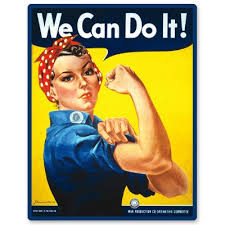
Who was Rosie the  Riveter?
a)
The first woman to work in a factory during WWII
b)
a representation of American women that went to work during WWII
c)
A pretty girl used for make-up advertisements
d)
A famous pilot
20.
Why was Germany's economy struggling after WWI?
a)
The Treaty of Versailles punished Germany for WWI
b)
Other countries were using imperialism to take over the economies of other governments, including Germany's
c)
Hitler was keeping his own people in a state of poverty in order to control them
d)
America was punishing Germany for playing such a major role in WWI
21.
In what way did the Treaty of Versailles establish conditions that led to the outbreak of WWII?
a)
It called for the dissolving of the League of Nations, thus removing an organization for resolving future conflicts
b)
It gave Germany too much power by letting Germany keep the Alsace-Lorraine region of France
c)
It weakened the Allied countries by making France, England, and Russia reduce the size of their armies
d)
It imposed harsh reparation payments on Germany, which led to economic and political instability
22.
Why was President Franklin Roosevelt hesitant to get involved in World War II?
a)
He considered Germany and Japan strong allies of the United States
b)
He wanted to maintain the U.S. foreign policy of isolationism
c)
He was opposed to the Lend-Lease Act
d)
He had supported the Japanese invasion of China in 1937
23.

The term appeasement refers to ---

a)

giving in to an aggressor to avoid war

b)

depending on allies to fight for you

c)

disarming to show your unwillingness to fight

d)

standing up for one's beliefs

24.

Who was the commander of the Pacific during World War II?

a)

Douglas MacArthur

b)

Dwight D. Eisenhower

c)

George Patton

d)

Harry Truman

25.

What was the Allied strategy in the Pacific known as?

a)

island-hopping

b)

island-jumping

c)

appeasement

d)

rationing

26.

Where did the largest land-sea-air invasion in world history take place?

a)

Hiroshima, Japan

b)

Normandy, France

c)

Nagasaki, Japan

d)

Berlin, Germany

27.

Which battle was the turning point of the war in the Pacific?

a)

Battle of Singapore

b)

Battle of the Coral Sea

c)

Battle of Guadalcanal

d)

Battle of Midway

28.

What did allied forces do on D-Day, June 6, 1944 that was a major turning point in WWII?

a)

They sent thousands of troops to Berlin.

b)

They stormed the beaches of Normandy, France.

c)

The fought the Nazi troops in Russia.

d)

They took control of many Japanese islands.

29.

The project code named the Manhattan Project was hiding what?

a)

The U.S. building Nuclear Weapons

b)

Internment Camps built to hold minorities

c)

Secret plant building new airplanes

d)

New submarine technology

30.
What did American women do during World War II that helped them gain respect during the war and afterwards? 
a)
They protested against the war. 
b)
They served on submarines. 
c)
They flew bombers over Germany. 
d)
They worked in wartime defense industries.
31.

Who is this a image of and what did she a symbol of .....

a)

June the Fighter symbol of women's suffrage

b)

Susan the solider symbol of women working on airplanes

c)

Rosie the Riveter symbol of women working in factories during the war.

32.

What is the intent of this propaganda poster

a)

Hitler is extremely powerful right now and if Americans do not help Britain, Hitler will destroy America.

b)

America would rather stay neutral than make money by selling weapons.

c)

Americans will not go into war unless someone attacks them.

33.
Who were the Tuskegee Airmen?
a)
African American pilots who flew successful missions during WWI
b)
A group of Civil Rights Activists
c)
Hitler's elite army pilots
d)
African American pilots who flew successful missions over Italy
34.
Who was the commander of the Allied Forces during WWII?
a)
FDR
b)
Dwight D. Eisenhower
c)
Adolf Hitler
d)
Joseph Stalin
35.
What WWII activity does this image reflect?
a)
joining the military
b)
donating blood
c)
participating in scrap drives
d)
buying savings bonds