
 Worksheets
Electric Circuits_2
Total questions: 25
Worksheet time: 8mins
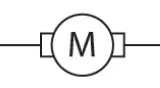
What does this electrical symbol represent?
battery
motor
resistor
switch
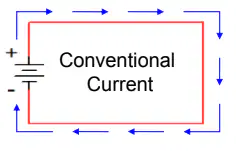
Electrical current flows (Conventional Current):
from negative(-) side of the battery,through the circuit, and back to the
positive(+) side of the battery
from positive(+)
side of the battery, through the
circuit, and back to the negative(-) side of the battery
0ut of each of each of the two terminals of the power

What does this electrical symbol represent?
power supply
multimeter
open switch
closed Switch

What is this electrical symbol?
power supply
multimeter
open switch
closed switch
The rate at which electrical energy is transferred by an electrical circuit; measured in watts (W)
Current
Voltage
Resistance
Power

The positively charged (red) electrode.
Anode
Cathode
Polarity
Power

The negatively charged (black/blue) electrode.
Anode
Cathode
Polarity
Power

A representation of the elements of a system using abstract, graphic symbols rather than realistic pictures. (A technical drawing.)
Breadboard
Insulator
Schematic
Conductor
A device for making and breaking the connection in an electric circuit.
Cathode
Potentiometer
LED
Switch
Which figure is the correct set up for measuring voltage? (Select one)

Open Switch

Closed Switch

What is the multimeter measuring in this image?
Amps
Volts
Ohms
Watts

The property of having poles or being polar. Batteries have positive (+) and negative (-) poles
Anode
Cathode
Diode
Polarity
The rate of electron flow. (Measured in Amps)
Current
Voltage
Resistor
Power
The pressure from an electrical circuit's power source that pushes charged electrons through a electrical loop. (Measured in Volts)
Current
Voltage
Resistor
Power
A passive electrical component to create resistance in the flow of electric current. (Measured in Ohms)
Current
Voltage
Resistor
Power
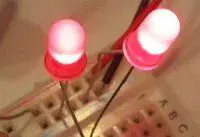
Light-emitting diode. A semiconductor diode that glows when a voltage is applied.
Resistor
Diode
LED
Potentiometer

What kind of circuit is this?
Series
Parallel
Consecutive
Prepositional

Which of the two circuits would have the brightest bulbs?
A (series circuit)
B (parallel circuit)

What on the phone charger acts as an insulator?
the metal plugs
the plastic around the cord

Why are metals useful for making electrical wire?
Metals do not bend.
Metals are insulators.
Metals hold much heat.
Metals are conductors.

What is the purpose of a resistor?
To slow down the electrical current.
To act as a switch.
To increase the voltage.
To create light and heat.

What is a multimeter?
a tool used to estimate distance current travels
a tool used to measure electrictal circuits
a tool used to find a correct location
a tool used to measure luminosity
Which color wire is used for ground wire? (-) (cathode)
red
black
green
yellow
Which color wire is used for live wire? (+) (anode)
red
black
green
yellow

What kind of circuit is this?
Series
Parallel
Consecutive
Prepositional

