
 Worksheets
Alternating Current
Total questions: 40
Worksheet time: 29mins
AC stands for
Air-condition
Direct Current
Alternating Current
Alternating Voltage
The electricity in our house is
AC
DC
BC
AD
An electric current that continually reverses direction over time is known as a(n)
direct current
alternating current
simple current
An electric current flowing in one direction only
voltage
parallel current
direct current
electric current
Quantity of charge can be measured in
time (s)
Ampere (A)
coulombs (C)
Joule (J)
Electric currents passing through wires will produce a(n)
solenoid
magnet
magnetic field
insulator
Moving a permanent magnet through a coil of wire will
demagnetize the magnet
the wire will become an electromagnet
the magnet will become electrified
a current will be generated in the wire
Battery is
AC source
DC source
none of the above
all of the above
In a circuit containing resistance only, the voltage and current are ____________________ with one
another.
together
within range
in phase
full rotation
The current in an inductive circuit _____.
is faster than the voltage
is the same as the voltage
lags the voltage
counteracts the voltage
When frequency decreases, capacitive reactance _____.
increases
decreases
remains the same
may increase or decrease
Which of the following is true of the current in a capacitive circuit?
It leads the voltage.
It lags the voltage.
It is the same as the voltage.
It counteracts the voltage.
Inductive reactance increases as the _____.
frequency increases
frequency decreases
impedance increases
impedance decreases
Which one of the below AC parameters show the effective Dc value?
Peak Value
RMS value
Peak to peak value
Frequency
A sine wave has a peak value of 354 V, What is the RMS value?
250 V
500 V
354 V
200V

What is the Peak voltage of the signal shown on the multimeter?
1000 V
1414 V
1500 V
707 V
The r.m.s value of an alternating current is given by steady (D.C) current which when flowing through a given circuit for a given time produces
the more heat than produced by A.C when flowing through the sam circuit
the less heat than produced by A.C when flowing through the sam circuit
the same heat than produced by A.C when flowing through the same circuit
What does RC stand for?
Remote Control
Radio Control
Resistor Capacitor
Rotary Club
The opposition to AC current flow presented by capacitors and inductors is called:
Resistance
Reactance
Impedance
Reluctance
The unit of inductive reactance is :
Ohm
Ampere
Farad
Henry
Which one of the following statements is true?
In a capacitor, current lags voltage by 90°
In a resistor, voltage lags current by 90°
In a capacitor, voltage lags current by 90°
In a resistor, current lags voltage by 90°
In the case of an inductor
voltage lags the current by 900
voltage leads the current by 900
voltage leads the current by 600
voltage leads the current by 450
The current in an inductive circuit _____.
is faster than the voltage
is the same as the voltage
lags the voltage
counteracts the voltage

An electric current that has constant magnitude and direction over time is known as a(n)
direct current
alternating current
simple current

Which activity will produce the highest current?
Move the magnet bar into the coil while the coil remains stationery
Move the coil into the magnet bar while the magnet remains stationery
Move the coil and magnet towards each other
Move the coil and magnet away from each other

Which action will increase the deflection of the galvanometer pointer?
The magnetic pole is reversed
The number of turns of coils is increased
The coil is made from insulated wire
The magnet is slowly pushed into the coil
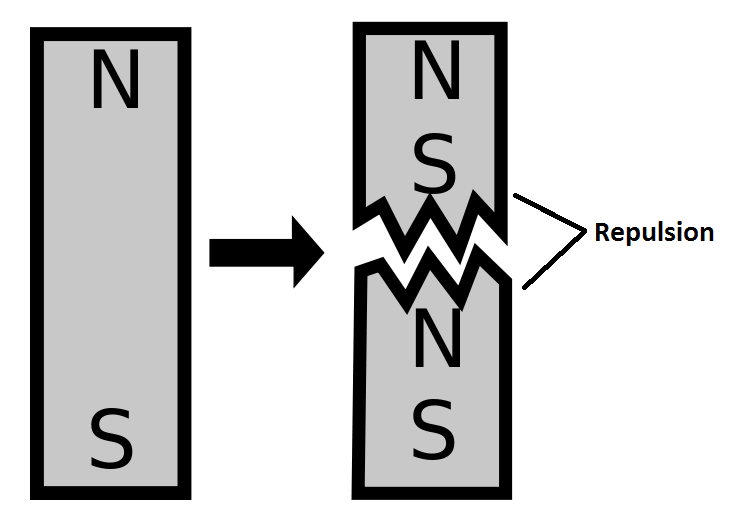
If you break a bar magnet in half, each half...
contains one magnetic pole.
becomes a bar magnet with two poles.
becomes unmagnetized.
is only temporarily magnetized.

What type of current is being produced?
Alternating
Direct

