wayground logo

Free Printable Worksheets

Font size

S
M
L
XL
Worksheets

Unit 6 St. 14-16

Total questions: 71

Worksheet time: 51mins

Name
Class
Date
1.
Which of the following would have been unacceptable based on the Roosevelt Corollary? 
a)
The United States annexing foreign territories 
b)
Foreign nations trading in the Pacific 
c)
European nations occupying a South American country to collect debt payments 
d)
The United States making agreements with Latin America 
2.
How did imperialists feel about the idea of the United States annexing territory in the late nineteenth century? 
a)
They supported the idea 
b)
They opposed the idea 
c)
They did not care because they were concerned about other issues 
d)
They supported annexing the Philippines, but opposed the idea of claiming Cuba 
3.
“The president has firmly established that any further attempts to colonize this hemisphere shall be viewed by the United States as an act of aggression. I commend his resolve and hope that this nation is willing to take all the steps necessary to uphold this position.” This quote is expressing support for which of the following?
a)
The Roosevelt Corollary 
b)
The Zimmerman Telegram 
c)
The 14 Points 
d)
The Monroe Doctrine 
4.
Which of the following would an isolationist support? 
a)
Staying out of the WWI 
b)
Sending US troops to fight in Europe 
c)
The Zimmerman telegram 
d)
The League of Nations 
5.
What would be the best heading for the following list? 
- Unrestricted submarine Warfare 
- Zimmerman Telegram - Sinking of passenger ships - The Lusitania
a)
Reasons Europe went to war 
b)
Reasons the US entered WWI 
c)
Reasons for the Spanish-American War 
d)
Reasons Congress Passed the Chinese Exclusion Act 
6.
An African American who moved from rural Georgia to New York City in 1919 would have been part of ...
a)
an anti-imperialism movement 
b)
an isolationist movement 
c)
the Great Migration 
d)
the NAACP 
7.
What impact did the 18th amendment have on prohibition and the temperance movement? 
a)
It raised the prices of alcohol 
b)
It legalized the purchase and sale of alcohol 
c)
It lowered the drinking age to 18 
d)
It made the purchase and sell of alcohol illegal 
8.
Woodrow Wilson encouraged European countries to pursue peace at all costs in...
a)
The Treaty of Versailles
b)
The Monroe Doctrine
c)
The Roosevelt Corollary
d)
The 14 Points
9.
Which of the following NOT is a main idea of the Treaty of Versailles?
a)
Germany must reduce their military strength.
b)
Establishing the League of Nations
c)
Germany must pay reparations to European countries
d)
The United States will stay out of European affairs
10.
The political cartoon is demonstrating: 
a)
The checkpoint process immigrants at Ellis Island endured. 
b)
The fear of immigrants entering the US, killing Americans and blowing up the Statue of Liberty. 
c)
The Eastern European immigrants bringing their way of life to America. 
d)
The Red Scare and the fear of allowing revolutionaries into America from Eastern Europe. 
11.
Which BEST defines the Harlem Renaissance? 
a)
The renovation of the turn of the century buildings in Harlem, New York. 
b)
Citizens fears concerning the social changes of the 1920s. 
c)
A time period of African American achievement in literature and music. 
d)
A time period of interest in southern African American culture. 
12.
What was Henry Ford’s impact on the automobile industry? 
a)
He was the first person to invent the automobile 
b)
He sold automobiles at extremely high prices so only the wealthy could afford them 
c)
He was the first to perfect and successfully market the automobile through mass production using an assembly line 
d)
He hired craftsmen to intricately design and build each individual automobile by themselves, thus increasing the value 
13.
The invention of the radio and movies (talkies) 
a)
Increased cultural awareness 
b)
Increased knowledge of world and national events 
c)
Increased the popularity of music and sports 
d)
All of the above 
14.
The political cartoon is demonstrating: 
a)
President Roosevelt’s love of the outdoors and his desire to conserve resources in the Caribbean Sea. 
b)
President Roosevelt’s leadership during the battle of San Juan Hill as the Rough Riders defeat the Spanish. 
c)
The artist’s interpretation of Roosevelt’s Big Stick Diplomacy modeled after the phrase “Walk softly and carry a big stick.” 
d)
The artist’s interpretation of Roosevelt’s love of wading and model boats 
15.
Tin Pan Alley was named for 
a)
The creative process of banging tin pans together to keep time during composition of songs 
b)
The sounds of cheap pianos tinkling throughout the area as composers banged out their songs 
c)
The rust coloring of the buildings near Harlem 
d)
The use of ten pans to mix paint colors for landscape pictures such as “God Bless America” 
16.
The political cartoon is demonstrating: 
a)
The threat posed by Communism to American businesses
b)
The interference of the Pullman Strike with the railroad industry
c)
The dangers of walking on train tracks and not paying attention while driving.
d)
How American Industry will run over everyone, even the poor man.
17.
What is the 'dream deferred' that Langston Hughes refers to in his poem?
a)
His day dream which was just interrupted
b)
His dream of fame and fortune
c)
The 'American Dream' being denied to African Americans
d)
A dream he had last night about running
18.
Where did immigrants first stop when they came to San Francisco in the early 1900's? 
a)
Coney Island
b)
Ellis Island
c)
Angel Island
d)
Alcatraz Island
19.
Which of the following were often blamed for poverty, crime, overcrowding, and violence?
a)
Labor unions
b)
Americans
c)
Women
d)
Immigrants
20.

One reason for building the Panama Canal was to help ships travel from the Atlantic Ocean to the Pacific Ocean in less time to get to America's new territories.

a)

True

b)

False

21.

Most Americans did not care about the rebellion and conditions in Cuba until William Randolph Hurst used yellow journalism to create concern.

a)

True

b)

Falsi

22.

Some of the problems workers faced while building the Panama Canal were

a)

disease spread by mosquitoes, the need to excavate vast areas, rain and mudslides

b)

the people of Panama did not want them there and sabotaged the effort

c)

soldiers had to guard them

d)

drought conditions that made the soil hard so that it was hard to dig

23.

Who invented the assembly line, which made cars affordable?

a)

Henry Ford

b)

Orville and Wilbur Wright

c)

George Washington Carver

d)

Thomas Edison

24.

Why was the assembly line an important technology advance?

a)

It made manufacturing products faster and made them less expensive and more available.

b)

It made the work harder to accomplish.

c)

It made the products less available to consumers.

d)

It made the products more expensive.

25.

When Henry Ford made the Model T available to a wide range of people, the effect was that people could live farther from work and thes was the beginning of suburbs.

a)

True

b)

False

26.

The Triple Entente included

a)

Germany, Bulgaria, and Italy

b)

Germany, Austria-Hungary, and the Ottoman Empire

c)

Britain, France, and Russia

d)

Britain, France, and the US

27.

What was the name of President Wilson's plan for peace?

a)

Zimmerman Telegram

b)

Sussex Pledge

c)

Treaty of Versailles

d)

Fourteen Points

28.

Which event sparked the beginning of WWI?

a)

the Zimmerman telegram

b)

assassination of Archduke Ferdinand

c)

sinking of the Lusitania

d)

Militarism, Alliances, Imperialism, Nationalism

29.

What was the ruling in Schenck v. US?

a)

separate but equal is okay

b)

free speech can be limited with "clear and present danger"

c)

right to bear arms could be limited for immigrants

d)

Sedition Act was unconstitutional

30.

What country had to admit guilt for WWI according to the Treaty of Versailles?

a)

Germany

b)

Russia

c)

Austria-Hungary

d)

Italy

31.

The Triple Alliance included

a)

Germany, Austria-Hungary, and Italy

b)

Germany, Austria-Hungary, and Russia

c)

Britain, France, and Russia

d)

Britain, France, US

32.

Which country was encouraged to attack the US in the Zimmerman Telegram?

a)

Germany

b)

Italy

c)

Mexico

d)

Russia

33.

Which legislation silenced criticism of the war at home?

a)

Committee on Public Information

b)

Espionage and Sedition Acts

c)

The Red Scare

d)

Palmer Raids

34.

What group took power in Russia during WWI and established a communist regime?

a)

Bolsheviks

b)

Serbs

c)

Slovenes

d)

Bosnians

35.

What is a method of citizens loaning money to the government to pay for war?

a)

propaganda

b)

sussex pledge

c)

espionage

d)

war bonds

36.

What was the name of the peace-keeping organization proposed by Wilson?

a)

Fourteen Points

b)

League of Nations

c)

United Nations

d)

Sussex Pledge

37.

What was the name of the area between the trenches that contained barbed wire and land mines?

a)

no man's land

b)

danger zone

c)

ground zero

38.

What is the name for information designed to influence opinion?

a)

yellow journalism

b)

media

c)

muckraking

d)

propaganda

39.

Which of the following countries was not one of the Allies?

a)

Germany

b)

Great Britain

c)

USA

d)

France

40.
What is nationalism?
a)
Love for one's country and desire to have that country independent.
b)
When nations want to control all countries.
c)
The battle between countries over unclaimed territories
d)
The process of becoming a nation and world power.
41.
What is an alliance?
a)
An agreement between nations to defend one another.
b)
An agreement between nations to trade with one another.
c)
When nation's pick teams to fight against.
d)
Groups of countries that finished nationalism.
42.
Which of the following is not a part of the Central Powers?
a)
Turkey
b)
Austria Hungary
c)
France
d)
Germany
43.
What is isolationism?
a)
The choice to remain neutral on foreign affairs
b)
When countries decide to defend each other.
c)
When countries agree to not fight in wars.
d)
The answer is not present.
44.
What is a U-boat?
a)
A German Battle Ship
b)
An American Passenger Ship
c)
A German Submarine
d)
A French Aircraft
45.
Which of the following is not a weapon used in World War 1?
a)
Poisonous Gas
b)
Atomic Bomb
c)
Tanks
d)
Torpedo
46.
Which of the following is not a reason the US joined WW1?
a)
Attack on American-owned Trade Ships
b)
Sinking of the Lusitania
c)
Zimmerman Telegram
d)
Yellow Journalism
47.
What is the purpose of a war garden?
a)
To grow poison for the war.
b)
People thought food would help win the war. 
c)
This was the only way to eat since men in the war couldn't hunt.
d)
It was a symbol of hope for people who had family members in the war. 
48.
What was the purpose of the League of Nations?
a)
Prevent all future wars.
b)
To establish stronger Alliances
c)
To punish nations that did not follow rules.
d)
To help the United States become a World Power. 
49.
What does the Treaty of Versailles have to do with WW1?
a)
Used to help France Defeat Germany?
b)
It Eliminated the need for Alliances
c)
It Ended World War One
d)
It was a way to allow countries to fight fair.
50.
When did the Harlem Renaissance take place?
a)
The end of WW1 and the 1930's
b)
1930's-1940's
c)
1900's-1920's
d)
1910's-1920's
51.
What type of music was popularized during the Harlem Renaissance?
a)
Jazz
b)
Hip Hop
c)
Country
d)
Rock
52.
Places where people went to drink illegal alcohol and listen to Jazz were called:
a)
Night clubs
b)
Speakeasies
c)
Public houses
d)
Dive bars
53.

Who was Louis Armstrong?

a)

famous African American artist

b)

famous African American painter

c)

famous African American musician

54.
One of the most famous American poets of all-time, he infused jazz and blues rhythms into much of his work.
a)
Duke Ellington
b)
Cab Calloway
c)
Louis Armstrong
d)
Langston Hughes
55.
What was the impact of the Harlem Renaissance? 
a)
promoted the growth of New York cities
b)
promoted culture identity of African Americans 
c)
it fought discrimination in southern cities
d)
it established programs such as the NAACP
56.
What is the Great Migration?
a)
The Great Migration was a large movement of birds from the north to the south to be warm for the winter.
b)
The Great Migration was the name of the time period after WWI.
c)
The Great Migration is the mass movement of African Americans from the south in the early 1900s.
57.

18th Amendment

a)

Prohibits Women's Suffrage

b)

Prohibits Alcohol

c)

Prohibits Child Labor

d)

Prohibits immigrants from entering the country

58.

19th Amendment

a)

Prohibition

b)

Grants Citizenship

c)

Raises Voting Age to 21

d)

Women's Suffrage

59.

21st Amendment

a)

Repeals 19th Amendment

b)

Repeals 18th Amendment

c)

Repeals 15th Amendment

d)

Repeals 17th Amendment

60.

This foreign policy idea promotes staying out of world affairs.

a)

Imperialism

b)

Isolationism

c)

Globalism

d)

Communism

61.

This type of foreign policy encourages stronger nations to extend their influence over weaker ones.

a)

Imperialism

b)

Isolationism

c)

Globalism

d)

Communism

62.

Why did Secretary of State William Seward buy the territory of Alaska?

a)

He saw England in North America as a strategic threat.

b)

He saw France in North America as a strategic threat.

c)

He saw Russia in North America as a strategic threat.

d)

He saw Germany in North America as a strategic threat.

63.

Why did America annex Hawaii in 1898?

a)

Beautiful beaches

b)

Sugar Cane plantations

c)

It's location in the Pacific Ocean

d)

Tourism benifits

64.

How did many Americans justify imperialism?

a)

We were spreading democracy

b)

We were spreading Christianity

c)

We were providing loans

d)

We were providing educational opportunities

65.

These events lead the U.S. into war with Spain in 1898.

a)

America annexing Hawaii

b)

Spain annexing Puerto Rico

c)

Cuban people being placed into concentration camps

d)

The U.S.S. Maine sinking

66.

Theodore Roosevelt commanded a cavalry unit in Cuba known as the

a)

Rough Rollers

b)

Rough Riders

c)

Rough Company

d)

Rough Racers

67.

These types of exaggerated news stories helped push the U.S. into war with Spain.

a)

Red Journalism

b)

Orange Journalism

c)

Yellow Journalism

d)

Green Journalism

68.

After the Spanish-American War, the U.S. annexed which former Spanish territories?

a)

Cuba

b)

Columbia

c)

Puerto Rico

d)

Philippine Islands

69.

How did America end up getting the land it needed to build the Panama Canal?

a)

We supported a revolution in Columbia.

b)

We supported a revolution in Cuba

c)

We supported a revolution in Croatia

d)

We supported a revolution in Cambodia

70.

Which imperial power colonized Cuba?

a)

France

b)

Spain

c)

Colombia

d)

Mexico

71.
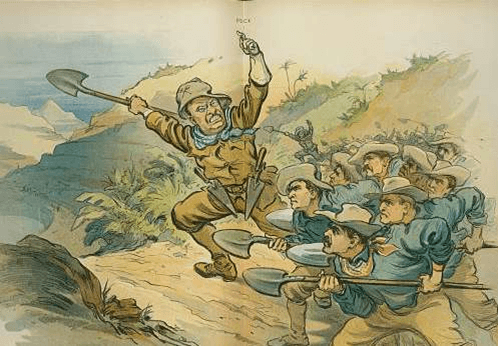
The following political cartoon refers to the construction of what by Teddy Roosevelt?
a)
Naval Base at Guantanamo Bay
b)
Suez Canal
c)
Panama Canal
d)
Washington Monument