wayground logo

Free Printable Worksheets

Font size

S
M
L
XL
Worksheets

Unit 3 Part 2 Test Review

Total questions: 54

Worksheet time: 32mins

Name
Class
Date
1.

What keeps the planets in orbit around the sun?

a)

gravity

b)

friction

c)

density

d)

distance

2.

When will the forces of gravity between two objects be the GREATEST?

a)

when the masses of both objects are small and the objects are far apart

b)

when the masses of both objects are large and the objects are close together

c)

when the masses of both objects are small and the objects are close together

d)

when the masses of both objects are large and the objects are far apart

3.

When will the gravity between two objects be the LEAST?

a)

when the masses of both objects is small and the objects are close together

b)

when the masses of both objects is small and the objects are far apart

c)

when the masses of both objects is large and the objects are close together

d)

when the masses of both objects is large and the objects are far apart

4.
As mass increases, what happens to gravitational force?
a)
increases
b)
decreases
c)
stays the same
d)
i don't know
5.
As the distance between 2 objects increases, what happens to gravitational force?
a)
increases
b)
decreases
c)
stays the same
d)
i don't know
6.

The surface of the sun is called ______________________.

a)

photosphere

b)

chromosphere

c)

sunspots

d)

flares

7.

__________________ are darker,cooler areas on the sun's photosphere.

a)

corona

b)

sunspots

c)

flares

d)

solar wind

8.

Which is the outer layer of the sun's atmosphere?

a)

solar wind

b)

corona

c)

sunspots

d)

chromosphere

9.

Which is the layer of the sun made of hydrogen and helium, about 1500 kilometer thick?

a)

photosphere

b)

chromosphere

c)

prominences

d)

sunspots

10.
What is the sun mostly made up of
a)
Helium
b)
Core
c)
Carbon
d)
Hydrogen
11.
What is this
a)
Prominice
b)
sun spot
c)
core
d)
Earth
12.
What happens during nuclear fusion
a)
Hydrogen reacts with Oxygen to create fire.
b)
Hydrogen atoms are forced together to create Helium
c)
Uranium and Plutonium split apart and release radiation.
d)
Helium atoms break down to make hydrogen
13.
Where does nuclear fusion occur?
a)
Space
b)
Radiation Zone
c)
Photosphere
d)
The Core
14.
What are the inner planets composed of?
a)
gases and ice
b)
rock and ice
c)
gases and rock
d)
rock
15.
Orbit the sun
a)
Inner planets
b)
Outer planets
c)
Both
16.
Small diameter
a)
Inner planets
b)
Outer planets
c)
Both
d)
Jupiter
17.
Shorter revolutions
a)
Inner planets
b)
Outer planets
c)
Both
d)
Neptune
18.
Very few moons
a)
Inner planets
b)
Outer planets
c)
Both
d)
Mercury
19.
Lots of rings
a)
Inner planets
b)
Outer planets
c)
Both
d)
Mars
20.
Solid, rocky surface
a)
Inner planets
b)
Outer planets
c)
Both
d)
Saturn
21.
All of the following planets have rings, EXCEPT--
a)
Saturn
b)
Venus
c)
Uranus
d)
Neptune
22.
All of the outer planets--
a)
have many moons
b)
are small
c)
have a short orbit around the Sun
d)
are rocky
23.
Which of the following separates the outer planets from the inner planets?
a)
Asteroid Belt
b)
Great Red Spot
c)
Kuiper Belt
24.

Which term describes the composition of the outer planets?

a)

rocky

b)

solid

c)

water

d)

gaseous

25.

Why do the inner planets have longer days than the outer planets?

a)

Inner planets are closer to the sun.

b)

Outer planets are larger.

c)

Outer planets are farther from the sun.

d)

Inner planets are denser & rotate slower.

26.

Why do the outer planets have longer years than the inner planets?

a)

The outer planets rotate faster than the inner planets.

b)

The outer planets are farther from the sun.

c)

The inner planets are denser and rotate slower.

d)

Outer planets are made of gas.

27.

Why don't the outer planets have a separate atmosphere?

a)

Because they are so large.

b)

Because the planet's composition is the same as the atmosphere.

c)

Because of all the moons revolving around the planets cause the atmosphere to mix with the planet.

d)

Because they rotate so fast, the atmosphere blends in with the planet.

28.

Which group of planets have shorter days?

a)

inner

b)

outer

29.
Phases of the moon in which the moon appears to be getting larger are referred to as _.
a)
waxing
b)
waning
c)
new
d)
eclipse
30.

If Katherine wanted to represent a solar eclipse, at what position should she place the Moon?

a)

A

b)

B

c)

C

d)

D

31.
 True or False: The moon does not produce its own light.
a)
True
b)
False
32.

Which moon phase is shown in this diagram?

a)

new moon

b)

1st quarter

c)

full moon

d)

3rd quarter

33.

Name the phase of the moon for letter a

a)

First Quarter

b)

Third Quarter

c)

Waxing Gibbous

d)

Waning Gibbous

34.
About how long does it take the moon to make one complete cycle around the earth?
a)
65 days
b)
8 days
c)
365 days
d)
28 days
35.

Why does the moon appear to shine?

a)

Because it reflects it's on light

b)

Because it makes it's own light

c)

Because it reflects light from the sun

d)

Because it reflects light from Earth

36.

A satellite is defined as something that orbits a planet. How many NATURAL satellite(s) does Earth have?

a)

Five

b)

Sixteen

c)

One

d)

Three

37.

We always see the same side of the moon because?

a)

We can only look at night

b)

We have low power telescopes

c)

The moon rotates and revolves at roughly the same rate the Earth does

d)

We don't know where to look

38.
What are the reasons for the season?
a)
Earth's tilt & rotation
b)
Earth's tilt & revolution
c)
Earth's rotation & rovolution
d)
Earth's tilt & resolution
39.
What causes there to be longer number of hours of light during the summer
a)
Earth tilt's away from the sun in summer
b)
Earth's revolves slower in summer
c)
Earth tilts toward the sun in summer
d)
Earth is closer to the sun
40.
Which season is taking place in the Southern Hemisphere in Position 1?
a)
Winter
b)
Spring
c)
Summer
d)
Fall
41.
Which season is taking place in the Northern Hemisphere in Position 2?
a)
Winter
b)
Spring
c)
Summer
d)
Fall
42.
Which season is taking place in the Northern Hemisphere in Position 3?
a)
Winter
b)
Spring
c)
Summer
d)
Fall
43.
Which season is taking place in the Northern Hemisphere in Position 4?
a)
Winter
b)
Spring
c)
Summer
d)
Fall
44.
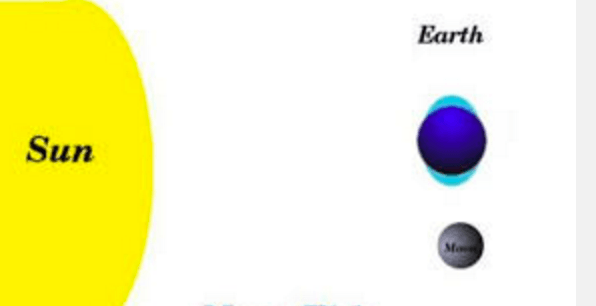
What type of tides would this arrangement of earth-moon-sun create?
a)
neap tide
b)
spring tide
c)
new moon tide
d)
full moon tide
45.
Wha type of tide would this arrangement of earth-moon-sun create?
a)
full moon tide
b)
new moon tide
c)
neap tide
d)
spring tide
46.
Which phase of the moon is represented in this diagram?
a)
new moon
b)
first quarter
c)
full moon
d)
last quarter/third quarter
47.
What causes tides?
a)
gravity
b)
wind
c)
spring
d)
neap
48.
Why does the moon's gravitational pull have more of effect on tides than the sun's gravitational pull?
a)
they are the same
b)
the moon is larger than the sun
c)
tides are not caused by the moon
d)
the moon is closer to the Earth than the sun
49.
For a solar eclipse to occur, what has to happen?
a)
The sun must be directly between Earth and the moon.
b)
The moon must be directly between Earth and the Sun.
c)
Earth must be directly between the Sun and the moon.
50.
A solar eclipse only happens during a ________ moon.
a)
New
b)
Cresent
c)
Gibbous
d)
Full
51.
What is the order during a lunar eclipse
a)
sun, moon, earth
b)
sun, earth, moon
52.
During which part of the lunar cycle can a lunar eclipse occur?
a)
New Moon
b)
First Quarter
c)
Full Moon
d)
Third Quarter
53.
In thinking about a solar eclipse, what does the ball in the diagram represent?
a)
the Earth
b)
the Moon
c)
the Sun
54.
In thinking about a lunar eclipse, what does the ball in the diagram represent?
a)
the Earth
b)
the Moon
c)
the Sun