
 Worksheets
Light Unit
Total questions: 40
Worksheet time: 25mins
Drops of water can form a rainbow when a light shines on them. Which claim does this observation support?
light can travel through space
white light is made of all the colors of light
Only some materials let light pass through
The color or an object depends on the light it reflects
In a straight line
Energy is the ability to make something ______________
move
happen
change
all of the above

Which of the claims below is best supported by the evidence in the picture?
The glass contains different colors of light.
The glass changes the light into different forms of energy.
White light contains different colors or light.
White light changes into different forms of energy when it bends.

John, Lily, and Zack each hold a different glass over their faces. How has the piece of glass that will make an opaque window?
Zack
Lily
John
None
An object is visible if you can see it. What must be true about all visible objects?
They are all electric
They are made of solid materials
They either give off light or reflect light
They must take in light when it strikes them
Riley wrote, "White light is made up of many colors or white light called a rainbow". Which term would be most appropriate to replace the underlined word.
absorption
magnetism
spectrum
reflection
Which statement is true about the colors of the spectrum?
Each color represents a different brightness
Each color represents a different amount of energy
Each color represents a different distance from the light source
Which color of light is seen in the rainbow?
black
brown
white
blue
Which object reflects light in order to be seen?
candle flame
flashlight
Moon
Sun
What happens when white light passes though a prism?
The light turns black
The white light is refracted
The white light becomes visible
The white light splits into 7 different colors
What would happen if Earth was moved farther away from the Sun?
The Sun would be brighter
The Sun would give off more light
The Sun would give off less light
The Sun would appear less bright
How is light best classified?
form of brightness
form of energy
form of matter
forms of intensity
Why is air described as transparent?
All light is able to pass through air.
Some light is able to pass through air
Most light can pass through air
No light can pass through air
A hiker observes that during the day, plants and trees appear green, but at night she must use a flashlight to see the plants and trees. Which statement supports the hikers observation?
The sun gives off it's light only during the day
Humans only see objects that create their own light
Objects are visible during the day by absorbing sunlight
Objects that do not create their own light become visible by reflecting light from another source

Which bulb will be the brightest is someone stands in the middle of the circles?
bulb 1
bulb 2
bulb 3
bulb 4
You see a pencil even though it is not giving off it's own light. Which behavior explains how you can see the pencil?
reflection
refraction
absorption
scattering

A student uses a flashlight to make shadow puppets on the wall. Why are the shadows formed on the wall?
The student's hands are opaque.
The student's hands are transparent
The flashlight reflects the light from the students hands
The flashlight absorbs light reflected by the students hands
When you look an object, how do you see it?
The light comes to our eyes and then goes to the object.
An image of the object comes to our eyes.
Our eyes see the light that reflects off it
Our eyes just see the object.
A student is studying the properties of light and plans an investigation to record the similarities and differences between an object and it's reflected images. Which tool must the student use in this investigation?
glass block
magnifying glass
mirror
prism
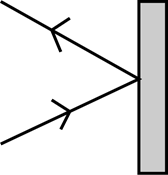
In the illustration, the light ray striking the object is-

A student wants to conduct a scientific investigation to learn more about the reflection of light. Which activity should the student complete demonstrate only reflection?
stand in front of a mirror
shine a light on different colored objects
place a straw in a glass of water
examine the brightness of light bulbs
What happens when light strikes a basketball?
All light is absorbed
All light is reflected
The color of the ball is absorbed, and the rest is reflected
the color of the ball is reflected, and the rest is absorbed


A student examines the text in a book, first without a magnifying glass and then with a magnifying glass. He observes that the text appears larger with the magnifying glass. Why do the letters appear larger through the magnifying glass?
Upon striking the magnifying glass the light is absorbed
Upon striking the magnifying glass, light is reflected
Upon striking the magnifying glass, light is refracted
Upon striking the magnifying glass, light is transmitted

Which scientific observations about the room is qualitative observation?
Each window is 48 inches
The curtains are made from an opaque material
There are 2 windows
The chair is refracting the light toward the window
Which material is opaque?
wax paper
glass jar
door
frosted glass
Which material is translucent?
door
shirt
wax paper
window
Which material is transparent?
metal
frosted glass
wax paper
air

Why does the fish appear to be in a different location than it actually is?
light travels in a straight line through the water
light is reflected by the water
light is refracted by the water
light is unable to pass through water


Smooth and shiny surfaces can _____________ light.
reflect
refract
absorb
Which term is defined as the ability to make something move, change, or happen?
Rainbows
Energy
brightness
spectrum
Bill is in a completely dark room and there is a box nearby. There is no light at all. Bill would:
Not be able to see the box at all
Just be able to see the box
See the box quite easily

This model shows several phases of the moon. What does this model demonstrate?
the moon creates its own light
the moon reflects sunlight
the moon is equally as bright as the sun
the moon absorbs all light

What is the name of the optical tool used to separate light into different colors?
Prism
telescope
magnifying glass
convex lens

