
 Worksheets
Plate Tectonics
Total questions: 46
Worksheet time: 39mins
Name
Class
Date
1.

What are the puzzle pieces of the Earth's surface called?
a)
Tectonic plates
b)
Puzzles
c)
Earthquakes
2.

What is the outermost layer of the Earth called?
a)
Core
b)
Mantle
c)
Crust
3.
Lava that is still deep inside the earth is called ____________________________.
a)
lava
b)
magma
c)
volcano
d)
earthquake
4.

This famous fault in California has a lot of earthquakes!
a)
New Madrid
b)
Denali Fault
c)
Ramapo Seismic Zone
d)
San Andreas Fault
5.

What type of boundary is shown in the diagram?
a)
Divergent
b)
Convergent
c)
Transform
6.

What type of boundary is shown in the diagram?
a)
Divergent
b)
Convergent
c)
Slide/Transform
7.

What type of boundary is shown in the diagram?
a)
Divergent
b)
Convergent
c)
Slide/Transform
8.
A plate boundary where two plates move away from each other is called
a)
Divergent Boundary
b)
Convergent Boundary
c)
Transform Boundary
d)
Subduction
9.
Scientists hypothesize that a super continent existed 200 million years ago. This continent is called
a)
America
b)
Super Earth
c)
Pangaea
d)
Eurasia
10.
A Plate Boundary where two plates move toward each other is called
a)
Convergent Boundary
b)
Divergent Boundary
c)
Transform Boundary
d)
Subduction
11.
What is the difference between the lithosphere and asthenosphere that makes up the mantle?
a)
The lithosphere is ismade of dense solid meal whle the asthenosphere is made of liquid molten metal
b)
The lithosphere is a mixture of gasses while the asthenosphere is made of solid rock
c)
The lithosphere is molten rock that moves while the asthenosphere is ridid and thin
d)
The lithosphere is made of solid rock while the asthenosphere is more flexible hot rock that moves.
12.
Convergent Plate Movement can create
a)
Rifts
b)
Mountains
c)
Ocean Ridges
d)
Radiation
13.
A Plate Boundary where two plates move toward each other is called
a)
Convergent Boundary
b)
Divergent Boundary
c)
Transform Boundary
d)
Subduction
14.
_______________ Currents within the mantle cause the earth's plates to move and shift & molten material rises and falls due to density and gravity
a)
Convection
b)
Radiation
c)
Conduction
d)
Wind
15.
Divergent Plate movement can create
a)
Convection Currents
b)
Conduction
c)
Mountains
d)
Rifts and ocean ridges
16.
When pressure builds between two tectonic plates, it can suddenly release causing a (an) ______________________
a)
Earthquake
b)
Volcano
c)
Convection Current
d)
Gravitational Pull
17.
A German scientist Alfred Wegener was the first to hypothesize that ...........
a)
Continents were once joined
b)
The sea floor is spreading
c)
Continents are moving
d)
The Earth's magnetic pole flips
18.
Pangaea was an ancient supercontinent made up of...
a)
America, Greenland, and Europe.
b)
Antarctica, India, and America.
c)
all of Earth’s continents.
d)
South Africa, India, Australia, and South America.
19.
Evidence used by Wegener to supported his idea of continental drift included
a)
Ocean rocks and sediments
b)
Ocean floor topography
c)
Magnetic isochron patterns
d)
Climatic data
20.
One of the fossils Wegener used to support his hypothesis of continental drift was
a)
Glossopteris
b)
Trilobite
c)
insects in tree amber
d)
ammonite molds
21.
Peer scientists reviewing Wegener’s hypothesis of continental drift rejected his notion because
a)
His evidence was too few to make a valid conclusion
b)
He did not explain how continents move and what moves them
c)
His evidence was not clear in showing how continents were joined
d)
He lied by including false evidence
22.
Where are most divergent boundaries located?
a)
Along the middle of most ocean floors
b)
Along the margins of most continents
c)
Across the middle of many continents
d)
All the above options are correct
23.
The Himalayan mountains have some of the highest peaks like Mt. Everest, on which type of convergent boundary are they located?
a)
Oceanic/Continental
b)
Oceanic/Oceanic
c)
Continental/Continental
d)
None of the above
24.
What type of features are associated with a divergent boundary?
a)
Rift valleys
b)
Volcanic mountains
c)
Fold mountains
d)
Fault block mountains
25.
The mechanism that moves continents is based on heat energy moving by
a)
Radiation in the core
b)
Conduction in the lithosphere
c)
Convection in the Asthenosphere
d)
None of these options is true
26.
The San Andréa fault in California is one example of a...
a)
Divergent boundary
b)
Convergent boundary
c)
Transform boundary
d)
All of the above
27.
The type of plate boundary where two plates come together is a .....
a)
Convergent Boundary
b)
Divergent Boundary
c)
Transform Boundary
d)
Plate Boundary
28.
Which of the following causes Earth's tectonic plates to move?
a)
Energy from the Sun
b)
Magnetic Pole Reversal
c)
Convection currents in the mantle
d)
Faults in Mountain Ranges
29.
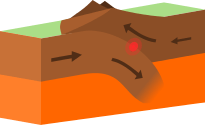
What type of plate boundary is this?
a)
Plate
b)
Divergent
c)
Convergent
d)
Transform
30.
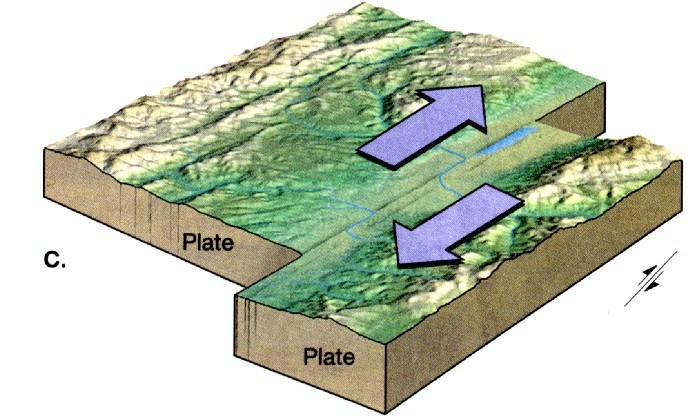
What type of plate boundary is this?
a)
Transform
b)
Convergent
c)
Divergent
d)
Plate
31.
A divergent boundary occurs when plates ....
a)
Pull apart
b)
Come together
c)
Slide past each other
d)
subducting
32.
Oceanic Trenches are formed by _______ plate boundaries
a)
Convergent
b)
Transform
c)
Plate
d)
Divergent
33.
Islands can form from magma which is pushed up at a __________ plate boundary
a)
Divergent
b)
Convergent
c)
Transform
34.
How is it possible for new crust to be formed without increasing the surface area of the Earth?
a)
Crust is destroyed at the same time it is created
b)
New crust is underwater where it sinks
c)
New crust breaks more easily than old crust
35.
Mountains are created when....
a)
Two continental plates collide
b)
Two oceanic plates pull apart
c)
An Oceanic plate subducts under a Continental Plate
d)
Two continental plates pull apart
36.
The Great Rift Valley in Africa and the Mid-Ocean Ridge were all created by this boundary
a)
Divergent
b)
Convergent
c)
Reform
d)
Transform
37.
What are the two types of crust
a)
continental and oceanic
b)
ocean and upper
c)
lower and upper
d)
pizza and subway
38.
Transform boundaries are most likely to produce what phenomenon?
a)
volcanoes
b)
deep sea trenches
c)
underwater mountain ranges
d)
earthquakes
39.
When an oceanic plate and a continental plate collide, which one will subduct?
a)
oceanic
b)
continental
c)
neither
40.
The area where two tectonic plates meet.
a)
mantle
b)
focus
c)
plate boundary
d)
convection
41.
A subduction zone is formed...
a)
when one tectonic plate sinks below another
b)
at every type of convergent plate boundary
c)
at every type of divergent plate boundary
d)
at transform boundaries
42.
What does the theory of continental drift state?
a)
The continents were once joined in a super-continent and have moved over time
b)
Continents are stationary and do not move
c)
The Earth is broken into lithospheric plates that move due to convection currents
d)
none of the above
43.

What is represented by the picture?
a)
Sea-floor spreading
b)
Pangea
c)
How the continents are arranged today
d)
Volcanoes
44.
What forms when an oceanic plate and a continental plate converge?
a)
Trench
b)
Ocean
c)
Continent
d)
Mountains
45.
True or False : Sea-floor Spreading adds new material to the ocean floor?
a)
True
b)
False
46.
What happens when Subduction occurs?
a)
Parts of the crust fall into the mantle
b)
Parts of the crust fall into the core
c)
Parts of the crust fall into space
d)
None of the Above
100 %

