
 Worksheets
CH. 11 ~ Great Depression & New Deal SS.912.A.5.11 & 5.12}
Total questions: 74
Worksheet time: 2hrs 28mins

New Deal Agency that provided jobs for the development of the American infrastructure
Largest New Deal program; employed millions
Tennessee Valley Authority (TVA)
New Deal
Works Progress Administration (WPA)
Dust Bowl

New Deal Agency that investigated modern farming practices
Created a network of dams and power plants to supply electricity
Tennessee Valley Authority (TVA)
New Deal
Dawes Plan
Bonus Expeditionary Force

New Deal program that provided retirement benefits and unemployment insurance for American taxpayers
One of the longest running programs of the New Deal
Dawes Plan
Neutrality Act
Volstead Act
Social Security

Act regulating trade with foreign countries to encourage U.S. industries during the Depression
Implemented protectionist trade policies; Raised tariffs on over 20,000 imported goods
Prohibition
Smoot-Hawley Tariff
Volstead Act
Dawes Plan

Form of civil-disobedience; used by unions to occupy companies they were on strike against
Strategy used in 1936-37 against General Motors to drawn attention to their demands; GM was forced to negotiate
Sit-Down Strike
Prohibition
NAACP
Communists

FDR’s programs for national recovery from the Great Depression
Reforms – remedies to problems: FDIC, SEC, Social Security Act
Relief – short-terms actions to assist people: CCC, WPA, PWA
Recovery – restore incentives to
New Deal
Big Four
Four Point Treaty
Dawes Plan

New Deal Law designed to promote recovery and reform in industry
Encouraged collective bargaining for unions
Set up maximum work hours and minimum wages Outlawed child labor
FDIC
National Recovery Act (NRA)
Four Point Treaty
Big Four

1935 – foundational statute of the U.S. labor law
Guarantees basic rights for employees to organize into trade unions, bargain collectively for better terms and working conditions and strike if necessary
National Labor Relations Act
National Recovery Act (NRA)
Red Scare
New Deal

Estimate of total value of all the final products and services produced in a given time period in a country
National Labor Relations Act
Gross National Product
Teapot Dome
Red Scare

New Deal program created in 1933 to maintain public confidence and create stability in the financial system
Insures deposits in U.S. banks in the event of bank failures
Promotes and holds financial institutions responsible for sound banking practices
Prohibition
NRA
CCC
FDIC

Caused by drought,overproduction and mismanagement of farmlands
Contributing factor to the economic decline of the 1930s
After losing everything, many migrated to California seeking a new life
FDIC
Negro Improvement Association
Great Depression
Dust Bowl

Employed young men to preserve natural resources and areas with goal of conservation for future generations
One of FDR’s New Deal programs designed to put the country back to work
Civilian Conservation Corps (CCC)
Sit-Down Strike
New Deal
Black Tuesday

1932 - Facing the financial crisis caused by the Great Depression, WWI veterans ask Congress to pay their retirement bonuses early
Congress did not approve; angry veterans marched on Washington D.C. in protest; Hoover called the army
Bonus Expeditionary Force
Civil Conservation Corps (CCC)
Great Depression
Teapot Dome

The fourth and last day of the Stock Market Crash of 1929
The New York Stock Exchange collapsed completely
Many lost everything; contributed to the Great Depression
Prohibiton
Jazz Age
Black Tuesday
Great Depression

Established parity; the policy of Congress to balance supply and demand for farm commodities giving farmers purchasing power
Controlled the supply of seven “basic crops” – corn, wheat, cotton, rice, peanuts, tobacco and milk
Volstead Act
Agricultural Adjustment Act (AAA)
Dawes Plan
Bonus Expeditionary Force

Formally the National Prohibition Act; enacted in 1919
Provided support to enforce the Eighteenth Amendment; prohibiting the manufacture and sale of alcoholic beverages
Prohibition Act
Volstead Act
Rosewood Incident
Teapot Dome

A nationalist organization founded in 1914 by Marcus Garvey
Worked for the advancement of people of African descent around the world
“One God! One Aim! One Destiny!; worked to help relocate some African-American to African settlements
NAACP
BLU
Negro Improvement Association
TPT

Civilized Indian tribes from Georgia and Florida that joined together for protection
Lived in Northern Florida, when Americans attacked, they retreated into the Everglades
Many were forced to move to Oklahoma reservations on the disgraceful Trail of Tears when U.S. wanted their homelands
Seminole Indians
Creek Indians
Apalachee Indians
Timucua Indians

Unemployment is the number of people without.....
money
children
jobs
food

Which event occurred on Black Tuesday?
many factories closed
many banks closed
many people lost their homes
the stock market crashed

What was the "New Deal" of the 1930s?
a government program that gave free land to homesteaders
a government program that helped women get the vote
a government program that spread civil rights throughout the country
a government program designed to help people during the depression
The Great Depression was an economic slowdown in the 1920s and 1930s. Which of the following was one cause of the Great Depression in the United States?
the end of the gold rush
the crash of the stock market
the ending of World War II
the high price of oil


Which New Deal program provide jobs for over 8.5 million and worked to develop public buildings and roads?
Civilian Conservation Corps
Works Progress Administration
Tennessee Valley Authority
Works Progress Authority
Which New Deal program was responsible for supporting farmers and supplying electricity to rural areas?
Civilian Conservation Corps
Works Progress Administration
Tennessee Valley Authority
Works Progress Authority
Which event eventually ended the Great Depression?
The New Deal
Creation of the TVA
World War 2
The publication of Gone With the Wind
The Depression had deep root in the economy of the 1920s, including overproduction, high tariffs, missteps by the Federal Reserve, and
The uneven distribution of income.
An inadequate money supply.
Deficit spending by the government.
Excessive reliance on export sales.

The general attitude of the public leading up to the Black Tuesday was that
A sense of economic unity was needed to keep investors optimistic.
The events leading to the stock market crash were completely unknown.
No one believed that the warning signs would result in a crash in the stock market.
The stock market crash was predicted in advance but nothing was done to prevent it.

According to this graph, approximately how many banks declined from 1926 to 1940?
15,000
8,000
12,000
9,000

This photo illustrates the bank failures that occurred in the early 1930's because
Customers withdrew their money from the banks all at once.
The government refused to intervene in the banks’ dealings.
Too many people opened accounts without making deposits.
They overextended credit to people who could not repay the debt.
Stock market crash weakened the nation’s banks because
Banks had invested their deposits in the stock market.
Investors no longer had money to deposit banks.
Banks depended on their stock for operating funds.
Investors could no longer afford to take out loans from banks.

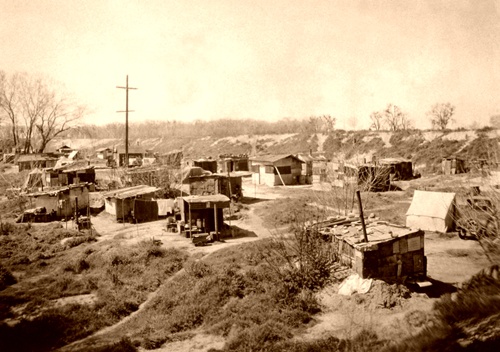
During the Depression, newly homeless people put up communities of shacks that they called
Hobo Towns
Hoovervilles
Bonus Armies
Okie Towns

Farmers on the Great Plains began to lose their crops during the Depression because ______ and eventually abandon their farms. Many fled west to California and became know as "Okies" (many coming from Oklahoma).
The soil lost its fertility.
Frequent rains eroded the soil.
A fungus depleted the soil of nutrients.
A terrible drought dried the soil. The strong winds of the Great Plains then swept the dust eastwards creating the "Dust Bowl"
As creditors foreclosed on nearly one million farms between 1930 and 1934, some farmers destroyed their crops in a desperate attempt to
Retaliate against their creditors.
Raise prices be reducing supply.
Call public attention to their plight.
Find ways to feed their families.
On May 1, 1930, President Herbert Hoover addressed the annual dinner of the United States Chamber of Commerce.
While the crash only took place six months ago, I am convinced we have now passed the worst and with continued unity of effort we shall rapidly recover. There is one certainty in the future of a people of the resources, intelligence, and character often people of the United States
– That is Prosperity.
Based on these Beliefs, what actions did President Hoover take in response to the Great Depression?
He ordered emergency federal relief payments to the unemployed.
He gave all Americans $100,000 a year.
He introduced a large number of public works projects to increase employment.
He offered limited federal assistance directed primarily to businesses and banks.
President Herbert Hoover did not want the government to create as many new jobs as the millions of unemployed people needed because that would require
Much lower unemployment.
Increased government regulation.
Reform of federal taxes.
Increased government spending.
In 1932 President Hoover asked Congress to set up the Reconstruction Finance Corporation in order to allow the government to
Expand the money supply.
Make loans to businesses.
Provide relief to the unemployed.
Create jobs in public works.

President Herbert Hoover hoped that increasing government funding for public works projects would
Reduce the budget deficit.
Spur the construction industry.
Provide jobs lost from demobilization
Help reduce farm foreclosures.

Thousands of World War I veterans came to Washington, D.C., in 1932 to lobby Congress to
Give bonus payments to all families.
Pass legislation giving veterans their promised bonuses earlier to help them during the recession.
Provide public work jobs for unemployed veterans.
Provide military jobs for family members of veterans.

Based on the chart, which statement describes the economic condition of American farm workers during the 1920's?
The entry of more women into the workforce meant fewer women were available for farm work.
Overproduction reduced crop prices kept farm workers' from enjoying the general prosperity of the times.
Subsidies and other government programs allowed farm worker's incomes to match those in other industries.
Higher prices for farm products resulted in a higher standard of living for all farm workers.

The diagram provides details about the Great Depression.
Which phrase completes the diagram?
War in Europe
Agricultural Drought
Overproduction of Goods
Introduction of New Technologies

The graph shows the unemployment rate in the U.S. between 1930 and 1945.
Based on the graph, what conclusion can be made about government policies in the 1930's?
President Hoover's policies were more effective than the New Deal in dealing with the Depression.
By 1938, the New Deal had successfully brought unemployment back down to pre-Depression levels.
New Deal policies failed to improve the economy because of the interference of the Supreme Court.
Despite Roosevelt's New Deal policies, the unemployment rate remained high throughout the 1930's.

What factor resulting from hurricanes in the 1920's is missing from the graphic?
Cattle Industry fails
Cigar Industry fails
Land prices increased
Housing boom ends
Which economic factor contributed most directly to the start of the Great Depression?
low worker productivity
high income taxes
decreasing tariff rates
buying stocks on margin
What was a guiding principle of the New Deal economic policies?
Pro-business tax breaks would solve the problems associated with urban poverty.
Antitrust legislation would destroy the free market economy of the United States
Rugged individualism must be allowed to solve social inequality.
Government must assume more responsibility for helping the poor.
President Franklin D. Roosevelt believed that declaring a bank holiday and creating the Federal Deposit Insurance Corporation (FDIC) would help the nation’s banking system by
restoring public confidence in the banks (FDIC)
reducing government regulation of banks
restricting foreign investments
granting tax relief to individuals

Evaluate the Political Cartoon. Which statement about President Franklin D. Roosevelt’s plans for a second term most accurately expresses the main idea of the cartoon?
Congress will give President Roosevelt a free hand to lead the nation.
The American people will trust Congress to control President Roosevelt.
President Roosevelt will seek direction from the people.
The Great Depression will no longer be a serious concern.

The political cartoon depicts President Franklin Roosevelt in 1934. Based on the cartoon, how did President Roosevelt want to ease the Great Depression?
by expanding the role of government in citizens’ lives
by expanding the authority of legislative representatives
by regulating the stock purchases by individual investors
by restricting the spending by government on domestic projects
Which of the following compounded the devastation caused by the Great Depression?
the beginning of WWII
the Red Scare and infiltration of communistic ideas
influenza epidemic and poor healthcare
Midwestern drought and Dust Bowl
Use the quotation below and your knowledge of U.S. history to answer the following question.
“Little by little the American federation is transforming itself into a union, marked by the growth in importance of the role of the federal capital. In the beginning the U.S. had only a small federal bureaucracy. Today, the central administration is powerful and rich.
--Andre Maurois in “This Was America”
Author Andre Maurois traveled through the U.S. in the 1930's and observed a growing unity in the American people.
How did the New Deal help bring Americans closer together?
The New Deal involved the federal government trying to fix a national problem.
New Deal jobs and public works programs gave people something to agree upon.
President Roosevelt, who designed the New Deal, was elected four times.
The New Deal encouraged the spread of popular culture through radio and movies.
Which statement best describes the American economy in the late 1920's?
High Tariffs stimulated international trade.
Only the wealthiest Americans had access to credit.
Mass production was not equally matched by consumption.
Unemployment was higher than ever before in American History.
How did the plans of Presidents Herbert Hoover and Franklin D. Roosevelt compare for dealing with the Great Depression?
Hoover gave emergency loans to banks and businesses while Roosevelt opposed such programs.
Both Presidents believed the federal government should provide direct payments to the unemployed.
Hoover increased federal spending on public works projects like Hoover Dam while Roosevelt opposed such projects.
Roosevelt proposed that the federal government provide direct employment to the needy while Hoover relied more on local government and private charities.
The excerpt is from President Franklin D. Roosevelt's First Inaugural Address in 1933.
"I shall ask the Congress for the one remaining instrument to meet the crisis - broad power to wage a war against the emergency as great as the power that would be given to me if we were in fact invaded by a foreign foe."
Based on this excerpt, what could be inferred about the direction that Roosevelt planned to take the executive branch of the federal government?
He planned to increase its size and power to deal with the Depression.
He planned to maintain its size in relationship to the other two branches.

It took the Great Depression and the New Deal to create the Florida State Park System. One of the New Deal's work programs was responsible for:
*Constructing dams for flood control, reforestation and landscaping
*Constructing facilities in all 8 original state parks
*Fighting wildfires and creating wildfire breaks
*Excavating sediment from caverns and establishing tourist routes for visitors.
Which New Deal program was responsible for these accomplishments?
The National Park Service
The Civilian Conservation Corps {CCC}
The National Geographic Service
The Florida Keys and Beach Preservation Act
How did popular attitudes towards the federal government shift during the Great Depression?
Voters grew distrustful of the federal government because they felt it favored the wealthy.
Americans came to expect the federal government to help them solve their economic problems.

The political cartoon on the left depicts President Franklin Roosevelt in 1937.
Based on the cartoon, what was the reaction to President Roosevelt's "court-packing" plan?
The public wanted President Roosevelt to act more quickly to save New Deal Programs.
Congress handed Roosevelt his first major defeat by upholding the separation of powers.

Which New Deal agency constructed a series of dams that produced hydro-electricity?
The Tennessee Valley Authority (TVA)
The National Labor Relations Board (NLRB)
How were the books The Grapes of Wrath and The Wizard of OZ similar works?
Both were artistic responses to the hardships of the Depression
Both described the struggles of the "okies" after moving to California.


These were a series of radio addresses given by President Roosevelt
Hooverville
GNP
Fireside chats
Black Tuesday

"If jobs are not available, the government must create jobs for those who are unemployed."
Which Depression-Era President would have said this?


What happened to the farmers of the Great Plains who were affected by the Dust Bowl?
They became migrant workers hopping to find work on the farms in California.
They became migrant workers hopping to find work on the farms in Georgia.
They became migrant workers hopping to find work on the farms in Texas.
They became migrant workers hopping to find work on the farms in New York.



