wayground logo

Free Printable Worksheets

NEW

Font size

S
M
L
XL
Worksheets

2.2 Gas Exchange in Plants

Total questions: 22

Worksheet time: 13mins
Name
Class
Date
1.
The leaf has a shiny, waxy cuticle around it to
a)
increase the rate of photosynthesis
b)
attract more light
c)
control water loss
d)
stop carbon dioxide and oxygen gases escaping
2.
Most of the chloroplast cells are found in the
a)
upper epidermis
b)
pallisade mesophyll layer
c)
lower epidermis
d)
stomata
3.
The water needed for photosynthesis comes into the leaves through the
a)
upper epidermis
b)
stomata
c)
guard cells
d)
xylem cells
4.
The important gases, carbon dioxide and oxygen, enter and leave the leaf through the
a)
upper epidermis
b)
phloem
c)
stomata
d)
guard cells
5.
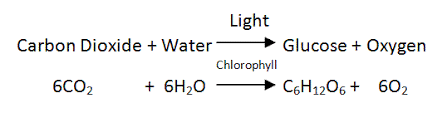
The reactants needed for photosynthesis to occur are:
a)
carbon dioxide & water
b)
carbon dioxide & oxygen
c)
oxygen & water
d)
carbon dioxide, oxygen & water
6.
The role of the guard cell is to
a)
help control the temperature of the plant
b)
control how much water enters the leaf
c)
control how much glucose is stored
d)
control the movement of water vapour & gases 
7.
Plants need to take in oxygen gas for respiration
a)
only at night 
b)
only during the day
c)
both during the day & the night
8.
Which structures open and close stomata to allow gas exchange but prevent water loss in leaves?
a)
Epidermis
b)
Vascular tissue
c)
Guard cells
d)
Spongy mesophyll
9.

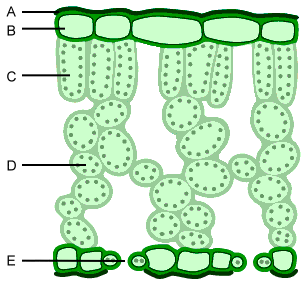
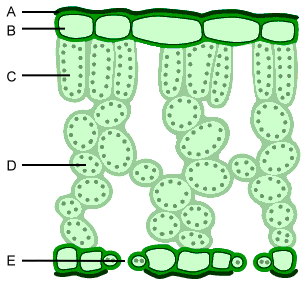
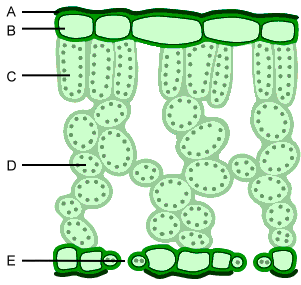
What is letter "A" pointing to?

a)

cuticle

b)

upper epidermis

c)

lower epidermis

d)

palisade mesophyll

10.

What is letter "D" pointing to?

a)

upper epidermis

b)

palisade mesophyll

c)

spongy mesophyll

d)

bundle sheath

11.

Which of the following is pointing to the "guard cell"?

a)

B

b)

C

c)

D

d)

E

12.

Which part of the leaf consists of xylem and phloem?

a)

vascular bundle

b)

bundle sheath

c)

palisade mesophyll

d)

spongy mesophyll

13.

The outermost layer of CELLS of the leaf is the

a)

cuticle

b)

epidermis

c)

spongy mesophyll

d)

bundle sheath

14.

This layer of cells is where photosynthesis occurs within the leaf; there are air spaces within this layer

a)

spongy mesophyll

b)

palisade mesophyll

c)

chloroplast

d)

upper epidermis

15.

The cell organelle where photosynthesis occurs in plant cells is the

a)

chloroplast

b)

mitochondrion

c)

vacuole

d)

nucleus

16.

The majority of the stomata of a leaf can usually be found within the

a)

guard cells

b)

upper epidermis

c)

lower epidermis

d)

cuticle

17.

A plant that grows only on or in water.

a)

pondweed

b)

salamander

c)

wetlands

d)

hydrophyte

18.

Plants with spines and waxy leaves are well suited for life in which environment?

a)

Desert

b)

Temperate forest

c)

Grassland

d)

Tropical Rainfroest

19.
What part of the plant absorbs oxygen
a)
stem
b)
roots
c)
leaves
d)
flower
20.
Deserts are hot and dry so an example of a plant adaptation here is... 
a)
long and deep root systems to absorb ground water 
b)
plants grow on each other to reach sunlight 
c)
dark in color to absorb sunlight 
d)
grow on each other to protect from wind 
21.

How do xerophytes reduce water loss?

a)

Pitted/sunken stomata

b)

Hairs to trap moisture

c)

Curled leaves with thick cuticle to trap moisture

d)

All of the above

22.

How are hydrophytes adapted to on water?

a)

Most stomata on upper epidermis

b)

Most stomata on lower epidermis

c)

No stomata at all

d)

Stomata in equal numbers on upper and lower epidermis