
Font size
 Worksheets
Reviewing SEE Unit 1 "Asteroids from Above"
Total questions: 23
Worksheet time: 23mins

Kepler's First Law states
objects attract other objects with a force that is directly proportional to the product of their masses
the square of the ratio of the periods of any two planets revolving around the Sun is equal to the cube of the ratio of their average distance from the Sun
An imaginary line joining a planet and the sun sweeps out an equal area of space in equal amounts of time.
Planets move about the Sun in an elliptical orbit with the Sun at one of the foci.

Kepler's Third Law states
objects attract other objects with a force that is directly proportional to the product of their masses
the square of the ratio of the periods of any two planets revolving around the Sun is equal to the cube of the ratio of their average distance from the Sun
An imaginary line joining a planet and the sun sweeps out an equal area of space in equal amounts of time.
Planets move about the Sun in an elliptical orbit with the Sun at one of the foci.

Which of the following most accurately describes the movement of the Earth around the Sun?
The Earth moves at a constant speed around the Sun.
The Earth moves faster when it is closest to the Sun.
The Earth moves slowest when it is closest to the Sun.
The Earth's speed varies dependent upon the phase of the moon.

Planets orbit the Sun in a shape called a(n) -
circle
ellipse
focus
perihelion
When a planet orbits the Sun, one of the foci of the elliptical orbit is ________, while the other is ______________.
its moon, the Sun
the perihelion, the Sun
the Sun, its moon
the Sun, empty space
empty space, its moon
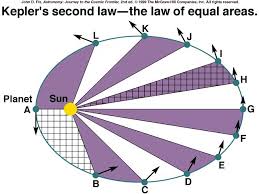
Where is the planet moving faster in its orbit?
Position A to B
Position B to C
Position H to I
Position I to J

What is true about the area between points A, B and the Sun, and the area between points H, I and the Sun?
The area between A, B and the Sun is larger.
The area between H, I and the Sun is larger.
Both areas are equal in size
There is not enough information to determine the areas.
What has an eccentricity of zero?
a straight line
a squished ellipse
a perfect circle
an oval
What are the two factors that influence the force of gravity between two objects the most?
Mass and weight
Weight and gravity
Mass and distance
Weight and distance
Select the two terms describe the time it takes for Earth to complete one circle around the sun:
Rotation
Revolution
Period
Barycenter
Gravity


The greater a planet's semi-major axis, the greater its __________. (Hint: Kepler's 3rd Law)
semi-minor axis
focus
orbital period
gravity
According to Kepler's first law, the paths of the planets are circular in shape.
True
False
Which of those have highly elliptical orbits?
Planets
Satellites
Comets
Gravity on our moon is less than the gravity on earth because -
a. moon's mass is less
b. moon's mass is more
c. moon's mass is equal to Earth
d. moon has no mass
If two objects decrease their distance, it _________ the gravitational pull between the two objects
increases
decreases
has no effect on
eliminates
If one of two objects decreases its mass, it _________ the gravitational pull between the two objects
increases
decreases
has no effect on
eliminates
According to Newton's law of gravitation, the Earth and the Moon are gravitationally attracted to each other. The more massive Earth attracts the Moon with...
a stronger force than the Moon attracts the Earth.
a weaker force than the Moon attracts the Earth.
the same force as the Moon attracts the Earth.
a force that is sometimes stronger and other times weaker than the Moon attracts the Earth.

