wayground logo

Free Printable Worksheets

NEW

Font size

S
M
L
XL
Worksheets

U6 - Ancient China Review

Total questions: 63

Worksheet time: 40mins

Name
Class
Date
1.
Which of these would Confucius have valued most highly?
a)
riches
b)
respect
c)
freedom
d)
creativity
2.
Which phrase below best completes the following questions?  "I am a follower of Confucius.  I am the oldest of 3 children in my family.  My younger sister and brother have to obey me.  In return, I ..."
a)
may do whatever I want.
b)
can punish them harshly.
c)
have to grant their wishes.
d)
must set a good example.
3.

If you were a farmer, what would Confucius say that you should do?

a)

Plan to rise to a higher status.

b)

Behave properly for your role.

c)

try to outwit those around you.

d)

Relax and stop working so hard.

4.
Daoists taught that people could gain happiness by
a)
serving in government jobs
b)
reading the ancient texts
c)
living in harmony with nature
d)
working hard to become healthy
5.

What was the Legalist view of people?

a)

People are naturally curious.

b)

People are motivated by love.

c)

People want to do what is right.

d)

People are basically selfish.

6.

Hanfeize, whose teachings were the basis for Legalism, wrote that rulers should emphasize

a)

strict laws and harsh punishments

b)

trade and manufacturing

c)

scholarship and ideas

d)

honesty and trust

7.

What did Hanfeizi say that rulers MUST do to avoid being overthrown?

a)

be popular through good deeds

b)

let people do as they want

c)

exercise absolute power

d)

earn the mandate of heaven

8.
People gain happiness and peace by living in harmony with nature is a goal for
a)
Confucianism
b)
Daoism
c)
Legalism
9.

The philosophy that emphasizes respect of elders and fulfilling the role in your relationships is

a)

Legalism

b)

Daoism

c)

Confucianism

10.
This philosophy believes that most people are selfish and that if left to themselves, people will pursue their own self interest. The main goal is to create peace and order. 
a)
Confucianism
b)
Daoism
c)
Legalism
11.

Which group of people belong in the middle section of the diagram?

a)

Merchants

b)

Farmers

c)

Aristocrats

d)

Servants

12.

What happened during the warring states period?

a)

large Chinese states fought for power.

b)

Dozens of clan leaders set up military bases.

c)

The Zhou army won control of the state by force.

d)

China fought to protect the state from invaders from the north.

13.

The goal of Confucianism could be achieved by being kind, honest, wise, faithful, and respectful.

a)

True

b)

False

14.

The goal of Daoism could be achieved by living simple lives.

a)

True

b)

False

15.

The goal of Legalism could be reached by establishing strict laws and enforcing them with rewards and punishments.

a)

True

b)

False

16.

A method used in a government of Confucianism was...

a)

everyone must respect their elders who set a positive example

b)

people meditating to live in harmony with nature

c)

citizens live under strict laws and consequences

d)

all of the above

17.

The Chinese followed what process for selecting new leaders (emperors)?

a)

The Eightfold Path

b)

PFRBM 5

c)

The Four Noble Truths

d)

The Dynastic Cycle

18.

What is a dynasty or dynastic rule?

a)

A line of rulers from the same family

b)

The idea that rulers are selected by heaven

c)

A gross-colored dye

d)

A really bad way to die

19.

How did the Silk Road get its name?

a)

It was a road made of silk

b)

It was a very easy, yellow path to travel in Oz

c)

It was a trade route where silk was the main good traded

d)

It was a trade route only used by Japanese merchants

20.

The act of buying and selling goods is known as what?

a)

Trade

b)

Dynasty

c)

Merchants

d)

Daoism

21.

According to Confucianism, society worked well when

a)

those in authority were kind, honest, wise, and faithful.

b)

people respected and obeyed those who were above them in status.

c)

people followed basic rules in their relationships with others.

d)

all of the above

22.

Along what river did China's earliest civilizations develop?

a)

Yangtze

b)

Huang He (Yellow)

c)

Indus

d)

Nile

23.

What was the natural border of China that was a desert?

a)

Sahara

b)

Death Valley

c)

Gobi

d)

Oz

24.

Which of these is NOT one of the three main religions/philosophies in Ancient China?

a)

Confucianism

b)

Zhouism

c)

Daoism

d)

Legalism

25.

______________________ believed that people were bad by nature, needed to be controlled, needed strict laws and responded to fear.

a)

Confucius

b)

Buddhists

c)

Legalists

d)

Daoists

26.

What was built to keep invaders out?

a)

The Silk Road

b)

Ziggurats

c)

The temple at Oz

d)

The Great Wall

27.

Confucius was a well known _________________.

a)

Leader of a dynasty

b)

Philosopher

c)

King

d)

Scientist

28.

(221-207 BCE) The first unified dynasty of China that used Legalism as its base of belief.

a)

Shang Dynasty

b)

Han Dynasty

c)

Qin Dynasty

d)

Mandate of Heaven

29.
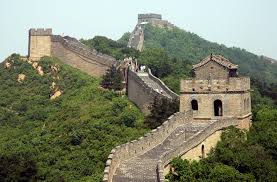
What is the purpose of the structure pictured here?
a)
It is a temple
b)
To protect China's northern border
c)
To protect China's Southern border
d)
To protect China from India 
30.
How did geography affect the development of Chinese culture?
a)
Long coastlines made access to trade possible.
b)
Flat land made travel easy.
c)
Great Wall of China made travel along the top easier for traders.
d)
Tall mountains and deserts isolated China from other nations.
31.
Early civilizations like Mesopotamia, Egypt, India and China have one thing in common.....
a)
each civilization flourished despite harsh desert conditions
b)
we know little about them due to catastrophic natural disasters
c)
they were founded along rivers and fertile valleys
d)
their coastal locations allowed them to trade with the Roman Empire
32.

The symbol is known as "Yin and Yang." It is an important symbol in

a)

Confucianism

b)

Daoism

c)

Buddhism

d)

Hinduism

33.
The requirements to pass an exam to work in government
a)
Hammurabi's Code
b)
Civil Service
c)
Vedas
d)
Torah
34.

Who was the Emperor of the Qin Dynasty?

a)

Qin Shi Huangdi

b)

Confucius

c)

Lao Tsu

d)

IDK

35.

The right of a Chinese Dynasty to rule with the blessings of the gods (divine right to rule) is called...

a)

The Mandate of Heaven

b)

The Dynastic Cycle

c)

The Heavenly Commandments

d)

The Oracle Bones

36.
What was the natural border of China that was an ocean?
a)
Atlantic Ocean
b)
Pacific Ocean
c)
Arctic Ocean
d)
Indian Ocean
37.
What did Emperor Qin build that allowed no one to leave, or invade, for thousands of years?
a)
a statue of himself
b)
a fortress
c)
The Great Wall
d)
a model of a dinosaur
38.
What was the natural border of China that was a desert?
a)
Sahara
b)
Gobi
c)
Death Valley
d)
Antarctica
39.
What was the natural border of China that was a mountain range?
a)
Rocky Mountains
b)
Himalayan Mountains
c)
Appalachian Mountains
d)
Sierra-Nevada Mountains
40.
Confucius a very famous ____________, in Ancient China
a)
emperor
b)
philosopher
c)
army leader
d)
god
41.
What were the four main dynasties of Ancient China?
a)
Shang, Zhou, Qin, Han
b)
Hand, Mouth, Foot, Head
c)
Shoe, Chin, Hand, Shang
d)
Tavs, Lodas, Kohlmann, Hoeft
42.
What is contribution from the Ancient Chinese?
a)
wheelbarrow
b)
fireworks
c)
gunpowder
d)
All of them
43.
What is a contribution from Ancient China?
a)
silk
b)
spices
c)
bronze
d)
all of them
44.

During the Zhou Dynasty, the only enemy that really poised a problem was _______________.

a)

India

b)

Arabia

c)

Mongolia

d)

The Roman Empire

45.

The Chinese wanted to keep out the Mongolians so they built large mounds of dirt and rock as barriers. These were the very beginnings of the what?

a)

The Pyramids

b)

The Temple in Jerusalem

c)

The Great Wall of China

d)

Buddhist Stupas

46.

What tool helped increase food production in Ancient China?

a)
b)
c)
47.

Name the two great rivers of Ancient China

a)

Tigris and Euphrates

b)

Yellow and Yangtze

c)

Indus and Ganges

d)

Nile and Jordan

48.

Where is China located?

a)

Asia

b)

Africa

c)

India

d)

North America

e)

South America

49.
A symbol in a writing system based on pictures
a)
ideograph
b)
pictograph
c)
bureaucracy
d)
currency
50.
The Shang and Zhou kings used the Mandate of ______ to prove that God had chosen them to rule.
a)
Gods
b)
Heaven
c)
Kings
d)
Men
51.
Chinese philosophy developed by Hanfeizi; taught that humans are naturally evil and therefore need to be ruled by harsh laws
a)
Confucianism
b)
Daoism
c)
Legalism
d)
Mandate of Heaven
52.
What were oracle bones used for?
a)
Cooking
b)
Telling stories
c)
Building the Great Wall of China
d)
Asking for advice from the gods
53.
What is the central idea of Daoism
a)
Duty to community
b)
Living in harmony with nature
c)
Enforcing laws with harsh punishments
d)
Humans are naturally evil
54.
The responsibility children have to respect, obey, and care for their parents is
a)
pictograph
b)
cultural diffusion
c)
ideograph
d)
filial piety
55.
A system of beliefs based on the teachings of Confucius
a)
Buddhism
b)
Legalism
c)
Daoism
d)
Confucianism
56.
Which one of these achievements was Shi Huangdi responsible for?
a)
Standardized writing, measurement and currency
b)
Built the Great Pyramids
c)
Founded Islam
d)
Founded Christianity
57.
Buddhism spreading from India along the Silk Road is an example of
a)
Christianity
b)
cultural diffusion
c)
Legalism
d)
filial piety
58.
How was Chinese civilization affected by mountains and deserts?
a)
They became wealthy.
b)
They were isolated from other civilizations.
c)
They made it easier to travel.
d)
They made China easy to be attacked.
59.
Trade route that stretched from western China to southern Asia
a)
filial piety
b)
Silk Road
c)
Great Wall
d)
Anyang
60.

Along which river in China did the first cities develop?

a)

Yellow River

b)

Nile River

c)

Tigris River

d)

Gobi River

61.

What are deposits of yellow silt that make the soil fertile?

a)

Delta

b)

Yangtze

c)

Loess

d)

Terrace Farming

62.

Created by Wu Di, this changed the day-to-day running of government and increased the importance of education.

a)

Confucianism

b)

Terrace Farming

c)

Feudalism

d)

Civil Service

63.

What is the class system where the king provides land to nobles for military support, and peasants paid nobles for using the land to farm?

a)

Monarchy

b)

Feudalism

c)

Legalism

d)

Beyonce