
 Worksheets
Transformations
Total questions: 80
Worksheet time: 2hrs 6mins

Identify the transformation from ABCD to A'B'C'D'.
Translation <2,0>
Reflection across the x-axis
Reflection across the y-axis
90o counter clockwise rotation
Translation <-2,0>

Identify the transformation from ABC to A'B'C'.
(x+8, y+4)
(x-8, y-4)
(x+4, y+8)
(x-4, y-8)
None of the above

Identify the transformation from ABC to A'B'C'.
90o clockwise rotation
90o counter clockwise rotation
Reflection across the y-axis
Reflection across the x-axis
Translation (x, y-2)

Identify the transformation from ABCD to A'B'C'D'.
Translation (x-7,y)
Reflection across the y-axis
Reflection across the x-axis
90o counter clockwise Rotation
Translation (x+7,y)

Which rule would result in a clockwise rotation of 90° about the origin?
(x, y) → (y, -x)
(x, y) → (y,x)
(x, y) → (x, -y)
(x, y) → (-x,-y)
(x, y) → (-y,-x)

Which rule would result in a translation of 2 units left and 3 units up?
(x, y) → (2x, 3y)
(x, y) → (x - 2, y + 3)
(x, y) → (3x, 2y)
(x, y) → (x + 2, y - 3)
(x, y) → (-2x, -3y)

What is the rule for the dilation pictured below?
(x, y) → (½x, ½y)
(x, y) → (x + 2, y + 2)
(x, y) → (x + ½, y + ½)
(x, y) → (2x, 3y)
(x, y) → (2x, 2y)

Identify the transformation from C to D. Check ALL that apply
90o Clockwise Rotation
180o Rotation
270o Clockwise Rotation
270o Counter-Clockwise Rotation
90o Counter-Clockwise Rotation
The point Z(4, -2) is rotated 180 degrees about the origin. What is the image of Z?
Z'(2, 4)
Z'(-4, 2)
Z'(-2, -4)
Z'(-4, -2)
Z'(-2, 4)

An office supply store sells index cards in two different sizes. The large size is an enlargement of the small size. Both sizes are shown. Find the scale factor of the enlargement.
2
3
1/2
1/3
Not enough information
Name the image of C(6, -4) under a rotation 90 degrees counterclockwise about the origin.
C'(4, 6)
C'(-4, -6)
C'(6, 4)
C'(-6, -4)
(-6,4)
Given C(2, 9), under which reflection is C'(-2, 9)?
reflected in the x-axis
reflected in the y-axis
reflected in the line x = 2
reflected in the line y = x
reflected in the line y = -x
Two objects that are the same shape but not the same size are _______.
Congruent
Vertical
Similar
Complementary
Dilation
When you translate, (x+4,y) will move _____.
4 units right
4 units left
4 units up
4 units down
the figures x values are 4x larger

Identify the transformation.
Reflection across y-axis
90 Rotation counter clockwise
Translation 5 units left, 1 unit up.
Translation 5 units right, 1 unit down
Reflection across the y-axis with a translation 3 units right, and 1 unit down.
The point that is to be transformed is called the:
Pre-Image
Image
Post-Image
Transformation
Mapping

What Transformation is visible?
Reflection
Translation
Dilation
Rotation
Expansion

What Transformation is visible?
Reflection
Rotation
Dilation
Translation
Not enough information

How was B translated to B' if B' is at (4, -2)?
Reflected over the y-axis
Translated 2 units to the left and 6 units down
Translated 2 units to the right and 6 units down
Translated 2 units to the right
Reflected over the x-axis
The point (8, 12) was dilated to become point (2, 3). What was the scale factor?
½
¼
4
2
1/6

Square ABCD is reflected about side BC. Which of the following statements are true?
BC is parallel to AA'
Vertex B is the midpoint of AA'.
The length of CD' is twice the length of DD'
Vertex C and C' are located at 2 different points.
CB is parallel to the points of reflections

What is the lowest degree of rotation greater than 0° that will carry the hexagon onto itself?
90 degrees
180 degrees
270 degrees
360 degrees
None of these rotations would create the original hexagon
Which figure when rotated 90 degrees will carry onto itself
square
hexagon
rectangle
triangle
pentagon

Reflect Point C over the y-axis:
(-3, 2)
(3,2)
(-2,3)
(3,0)
(3,-2)

Which pair have a line of reflection of x = -2?
A & B
B & C
G & H
E & F
F & D
Which pair have a line of reflection of x = -3?
A & B
B & C
G & H
E & F
D & F
Which of the following is NOT a reflection?
A & B
B & C
G & H
E & F
A & E
Describe the translation from A to D.
(6, -6)
<6, -6>
<-6, 6)
(x - 6, y + 6)
(x - 6, y - 6)
Identify both ways to translate from B to C.
(4, 0)
<4, 0>
<-4, 0>
(x + 4, y)
(x, y+4)
Describe the transformation from C to H.
translation <2, -10>
rotation 90° CW
rotation 180°
reflection across x-axis
translation <1, -7>
Describe the transformation from E to H. Check all that apply
rotation 270° Counter-Clockwise
rotation 270° Clockwise
rotation 90° Counter-Clockwise
reflection across y-axis
rotation 90° Clockwise

Which of the following describes the sequence of transformations shown?
Reflect across the x-axis and then rotate 90 degrees clockwise around the origin
Rotate 90 degrees clockwise around the origin and then translate down.
Reflect across the x-axis and then reflect across the y-axis.
Translate up and then rotate 90 degrees counter-clockwise about the origin.
Reflect across the x-axis and then rotate 90 degrees counter-clockwise around the origin
(-3, -1) -- Reflect across the line y=x and translate down 1.
(-1, -4)
(-1, -2)
(3, 0)
(-2, -3)
(-1,-3)
(6, -4) -- Dilate by 1/2 and reflect across the origin.
(-3, 2)
(-3, -2)
(12, -8)
(-12, 8)
(2, -3)

Choose the correct transformations
rotate 90 degrees counter-clockwise around the origin, and then reflect over the x-axis
right 1, down 4, and then reflection over the y-axis
right 6, and then reflection over the x-axis
reflection over the line y=x, and then translate up 4, right 2
reflect over the x-axis, and then left 6

Choose the correct transformations
rotate 90 degrees counter-clockwise around the origin, and then reflect over the x-axis
right 1, down 4, and then reflection over the y-axis
right 6, and then reflection over the x-axis
reflection over the line y=x, and then translate up 4, right 2
reflect over the y axis, and then left 1 and up 4
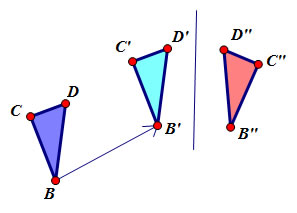
What sequence of transformations will get you from shape BCD to shape B"C"D" in two steps?
Rotation, then Rotation
Rotation, then Dilation
Reflection, then Rotation
Translation, then Reflection
Dilation, then Reflection

Choose the correct transformations
rotate 90 degrees counter-clockwise around the origin, and then reflect over the x-axis
right 1, down 4, and then reflection over the y-axis
right 6, and then reflection over the x-axis
reflection over the line y=x, and then translate up 4, right 2
rotate 90 degrees clockwise around the origin, and then reflect over the y-axis

Name the series of transformations that maps ABC onto DEF
reflect over x then translate left 6 up 1
reflect over y then translate down 6 left 1
translate right 6 down 1, then reflect over x
rotate 90 clockwise then reflect over y
rotate 180 degrees, then left 2 and down 1
(2, 6) -- Translate up 3, left 1 and rotate 180°
(-1, -7)
(1, -7)
(5, 5)
(-5, -5)
(1, -7)

Write a rule for the translation.
(x -1, y + 2)
(x -2, y + 1)
(x +2, y - 1)
(x +1, y - 2)
Not enough information to write a rule.

Identify the transformation from ABC to A'B'C'.
90o clockwise rotation
90o counter clockwise rotation
Reflection across the y-axis
Reflection across the x-axis
Translation down 2 units

Identify the transformation from ABCD to A'B'C'D'.
Translation (x,y) -->(x-7,y)
Reflection across the y-axis
Reflection across the x-axis
90o counter clockwise Rotation
Translation (x,y) --> (x+7, y)

Identify the transformation from A to D.
90o Clockwise Rotation
180o Rotation
270o Clockwise Rotation
Y-Axis Reflection
X-Axis Reflection

Which rule would dilate shows a scale factor of 4
(x, y) → (y, x)
(x, y) → (x + 4, y + 4)
(x, y) → (x - 4, y -4)
(x, y) → (4x, 4y)
(x, y) → (1/4x, 1/4y)

What is the rule for the dilation pictured below?
(x, y) → (½x, ½y)
(x, y) → (x + 2, y + 2)
(x, y) → (2x, 2y)
(x, y) → (2x, 3y)
(x, y) → (1/3x, 1/3y)
A triangle has vertices with coordinates (2,0), (3, -1) and (-2,-5). If the triangle is dilated by a scale factor of 3 with the origin as the center of dilation, what are the coordinates of the vertices of the image?
(5,3), (6,2), (1,-2)
(6,0), (9,-3), (-6,-15)
(2/3,0), (1,-1/3), (-2/3,-5/3)
(-1,-3), (0,-4), (-5,-8)
Not enough information

What is the sequence of transformations?
Reflect over the y then reflect over the x
Reflect over the x then reflect over the y
Translate 4 units then rotate 90˚
Rotate 90˚ then reflect over the x
Rotation of 180 degrees
Which of the following describes the sequence of transformations shown?
Reflect across the x-axis and then rotate -90 (clockwise) around the origin
Rotate -90 (clockwise) degrees around the origin and then translate down.
Reflect across the x-axis and then reflect across the y-axis.
Translate up and then rotate 90 (counterclockwise) degrees about the origin.
Y-Axis reflection and then a x-axis reflection.

What types of transformations happened to get from shape 1 to shape 3, choose ALL that apply.
Rotation
Translation
Reflection
Dilation
Non-Rigid Transformation

Dilate Point B by a scale factor of 1/2
(1.5,-4)
(-1.5,1)
(-1,-1.5)
(-2,-2)
(-6,4)
Choose the correct transformations
rotate 90 degrees counter-clockwise around the origin, and then reflect over the x-axis
right 1, down 4, and then reflection over the y-axis
right 6, and then reflection over the x-axis
reflection over the line y=x, and then translate up 4, right 2
reflection over the y-axis, and then (x,y) --> (x-1, y+4)

Describe the transformations that map ABC onto A"B"C"
translate 5 up and 1 left then reflect over y
translate 5 down and 1 left, then reflect over y
reflect over y=x then translate left 8
reflect over x then rotate 90 clockwise
reflect over the x-axis then translate 4 to the right

Choose the correct scale factor:
2
3
1/3
1/2
Not enough Information
What is an isometry?
A transformation that changes the preimage size.
A transformation that translates the image.
A transformation that preserves the preimage shape and size, such as, a reflection, translation, and rotation.
A transformation that morphs the preimage to a new shape.

What is the rule for the following reflection?
Reflection across y = −2
Reflection across x = −2
Reflection across x = 2
Reflection across y = 2
Reflection across y = x

Identify the smallest angle of rotation that maps the image to itself.
180°
360°
90°
No rotational symmetry
72°
The rule for dilation is
(x, y) --> _
(kx, ky)
(x, -y)
(-x, y)
(x+a, y+b)
(-x,-y)
The rule for reflection over the x-axis is
(x, y) --> _
(-x, y)
(x, -y)
(y, x)
(-y, -x)
(-x,-y)
The rule for rotation of 90 degrees counterclockwise is
(x, y) --> _
(y, -x)
(-y, x)
(x, -y)
(-x, y)
(-x,-y)
The rule for rotation of 180 degrees is
(x, y) --> _
(-y, x)
(-x, -y)
(y, -x)
(-y, -x)
(-x, y)
Which rule describes the action of the coordinates when a figure is reflected over the line y = x?
(x, y)→(-y, -x)
(x, y)→(-x, y)
(x, y)→(-x, -y)
(x, y)→(y, x)
(x, y)→(-y, x)
Which rule describes the action of the coordinates when a figure is reflected over the line y = -x?
(x, y)→(y, x)
(x, y)→(-y, -x)
(x, y)→(-x, -y)
(x, y)→(y, -x)
(x, y)→(-y, x)
A transformation that does not change the size or shape of a pre-image (pre-image and image are congruent) is called
Rigid Motion Transformation
Dilation
Non-Isometric
Non- Rigid Motion Transformation
Similar Figure Transformation
Which is NOT an Isometry?
Relection
Dilation
Rotation
Translation
Not Enough Information

Identify the smallest angle of rotation that maps the image to itself.
90°
180°
45°
60°
30°
A rigid motion creates figures that are ____________.
congruent
different sizes
similar
larger
dilated figures
A rigid motion ...
preserves size and location
preserves shape and location
preserves size and shape
makes the figure larger
preserves shape and the size is different by a scale factor

What are the series of rigid motions that would map ∆ABC onto ∆A''B''C''?
a reflection followed by a rotation
a reflection followed by a translation
a translation followed by a rotation
a translation followed by a reflection
a rotation followed by a translation

Which of the following transformation will map the regular pentagon onto itself, choose ALL that apply?
x axis reflection
y axis reflection
90 degree rotation
180 degree rotation
72 degree rotation around the orgin
Which of the following transformation will map the regular pentagon onto itself?
reflection across blue line
reflection across green line
108 degree rotation about the origin
216 degree rotation about the origin
None of the transformation map onto the original penatgon

Which transformation will map the rectangle onto itself?
90 degree rotation about (-2,1)
540 degree rotation about (-2,1)
reflection across the y-axis
reflection across the blue line
reflection across the x-axis

Which of the following transformations will NOT map the regular hexagon onto itself?
270 degree rotation about the origin
x axis reflection
y axis reflection
180 degree rotation about the origin
120 degree rotation about the origin

Which transformation will map the parallelogram onto itself?
reflection x axis
reflection y axis
refection across the green line
reflection over the line y=x
none of these above

Select each answer choice that will map the regular polygon onto itself?
36 degree rotation
90 degree rotation
180 degree rotation
252 degree rotation
270 degree rotation

When performing 2 reflections over non-parallel lines (as shown in the diagram) what is the resultant transformation?
1 Reflection
1 Rotation
1 Translation
1 Dilation
Not enough information
Which transformation will map an image onto itself?
A translation 3 units right and 3 units up
A rotation 360o clockwise
A reflection over the y-axis followed by a translation 3 units down
A dilation followed by a 90o clockwise rotation
Not enough information, a figure has to be given!
Which pair of transformations is the same as a reflection across the y-axis
a rotation 90 degrees counter-clockwise and a reflection across the x-axis
a rotation 90 degrees clockwise and a reflection across the y- axis
a rotation of 180 degrees and a reflection across the x-axis
a rotation of 180 degrees and a reflection across the y-axis
a reflection across the line y=x and then a reflection across the line y=-x
Which description of a figure and its image match the transformation described by (x,y)→(x,3y)
The figure and it image are similar and the image has been translated 3 units up.
The figure and its image are similar and the image has been translated 3 units to the right.
The figure and its image are congruent and the image has been stretched horizontally.
The figure and its image are are neither similar nor congruent, and the image has been stretched horizontally.
The figure and its image are neither similar nor congruent, and the image has been stretched vertically.
Which transformation or set of transformations will map a point (x,y) onto the point (2x+1, 2y)
a dilation with a scale factor of 2 through the origin followed by a translation of right 1 unit
a dilation with a scale factor of 2 through the origin followed by a translation of up 1 unit
a dilation of scale factor 2 through the point (1,0)
a dilation of scale factor 2 through the point (0,1)
a dilation of scale factor 1 through the point (2,2)

