
 Worksheets
Plate Tectonics Exam Review
Total questions: 40
Worksheet time: 3hrs 20mins
Who first proposed the theory of continental drift?
Galileo Galilei
Albert Einstein
Alfred Wegner
Harry Hess
Which of these is evidence of plate tectonics?
Same fossils of non-swimming speciesare found on either side of the atlantic ocean
Folded Rocks in Mountain Ranges
Similar rock formations on each side of Atlantic Ocean
All of these are evidence
What kind of movement created the Himalaya Mountains?
Hot spots
divergent plate boundaries in the ocean
convergent boundaries between two continental plates
convergent plate boundaries between two oceanic plates
Process by which new ocean crust forms.
Seafloor spreading
Continental drift
Mid-ocean ridge
Rift
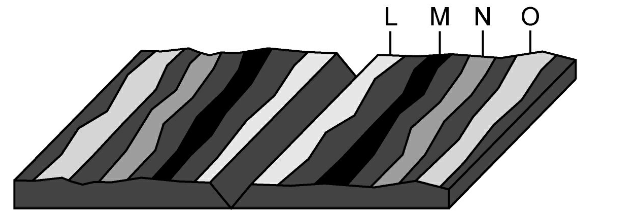

Which layer of the Earth is a liquid?
Stiffer Mantle
Inner Core
Crust
Outer Core
At a depth of 2,500km, the inferred pressure within the Earth is approximately
1.2 million atmospheres
4500 atmospheres
4 million atmospheres
800 atmospheres
What is the inferred temperature at the center of Earth's core?
500 C
120 C
6500 C
3500 C
Which two types of evidence have scientists used to learn about Earth's interior?
maps and satellites
minerals and elements
rock samples and seismic waves
drills and maps
What happens at the boundary where a continental plate and an oceanic plate collide?
The two plates are moving
Mountains develop on edge of the oceanic plate
The continental plate slips under the oceanic plate
The oceanic plate is forced down under the continental plate
Why does the oceanic crust sink beneath the continental crust at a subduction boundary?
The oceanic crust is hotter
The oceanic crust has a greater density
The oceanic crust has a lighter density
The oceanic crust has more magnetic composition

This trench is located in the western Pacific Ocean and it was said to be the deepest natural trench in the world.
Philippine Trench
Mariana Trench
Pacific Trench
Atlantic Trench
How is tsunami formed?
When denser plate is subducted
When strong earthquakes are generated at the continental plate
When strong earthquakes are generated at the ocean floor
When continental plate is collided with another continental plate
Subduction does not occur at which convergent plate boundary?
Oceanic - Oceanic
Oceanic - Continental
Continental - Continental

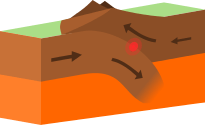
The plate boundary shown here is most similar to the plate boundary between
The pacific plate and the Indian Australian Plate
The Pacific Plate and South American Plate
South American Plate and African Plate
Cocos Plate and Nazca Plate
How many million years ago did pangaea begin to break up?
59 million years ago
13.8 billion years ago
200 million years ago
400 million years ago
Which two tectonic plates could form an island arc at the boundary?
nazca plate and pacific plate
Eurasian plate and Indian-Australian Plate
Pacific plate and North American Plate
Fiji Plate and Indian-Australian Plate
A convergent plate boundary between a continental plate and an oceanic plate could result in
Seafloor spreading
An ocean trench
Mirror image magnetic polarity
Increasing distance between the continents
Why is Japan more susceptible to tsunamis than Long Island?
Japan is located near a convergent plate boundary
Japan is in the Eastern hemisphere
Long Island is further north than Japan
Japan is surrounded by water
Convection currents, which cause the crustal plates to move, occur in the
Lithosphere
Inner core
Stiffer mantle
Asthenosphere

At the center of this diagram, the convection currents cause the crustal plates to move
Towards each other
Away from each other
sliding past one another
Which of the following would be classified as an Island Arc?
Hawaii
Peru-Chile Trench
San Andreas Fault
Aleutian Islands

Which location is least likely to experience a major Earthquake?
A
B
C
D
A chain of volcanic mountains formed as magma rises through the seafloor can be found at
A
B
C
D
What would be the name of the feature formed at location B?
Rift
Mid Ocean Ridge
Folded Mountain
Trench

