
NEW
Font size
 Worksheets
Imperialism Eval Review
Total questions: 25
Worksheet time: 35mins
The view that a nations most "fit" to survive had the right to dominate others
Dominator
Survivalist
Social Darwinism
Winner
About how much of Africa was controlled by European nations?
60%
70%
80%
90%
Which country was the only African country to remain independent during the Scramble for Africa?
Ethiopia
Egypt
Eritrea
Suez

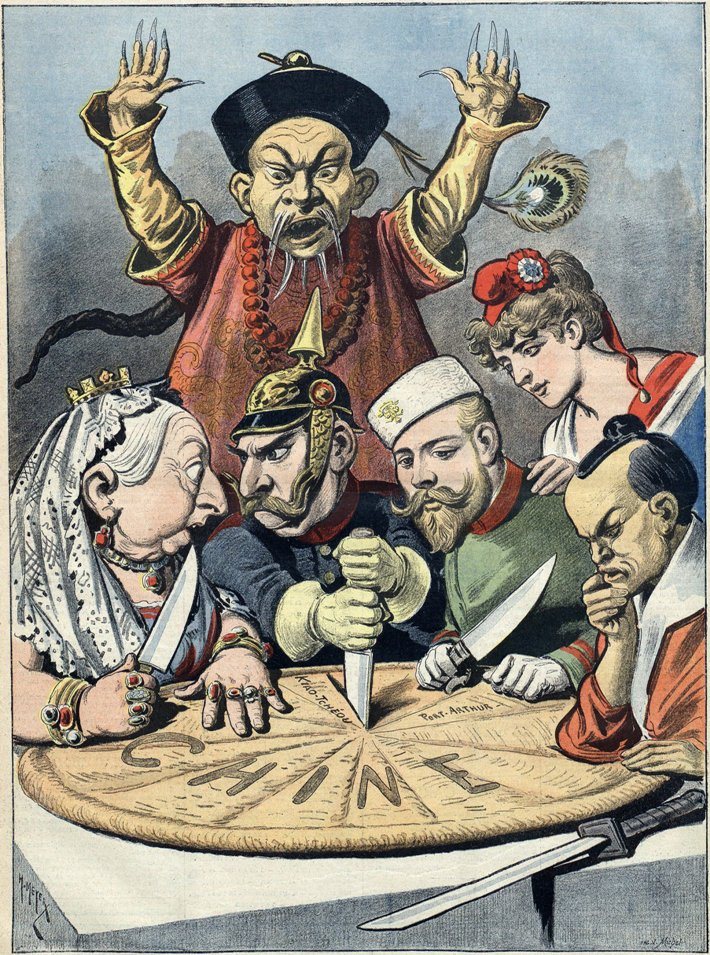
What vocabulary term is associated with this image?
Berlin Conference
Boxer Rebellion
Sepoy Mutiny
Spheres of Influence
What was the significance of the Suez Canal?
It was a military fort along the sea that gave an advantage to the country who owned the area surrounding it
It allowed empires to conquer more colonies
It provided a shorter passage for trade to India and China
It was a secret trade route that helped Africans escape colonization
Why did King Leopold decide to invest in taking over the Congo in Africa?
Because they had an immense amount of gold there
Because he saw the opportunity to make money in the rubber trade
Because there were plenty of slaves he can take to work in Belgium
Because it was the only available colony left in Africa
Which of the following is true about the Boxer Rebellion?
The rebellion took place in Japan.
The Boxers were trying to keep Christianity in China.
The Boxers were unhappy with foreign influence in China.
The Boxers were able to drive out the foreigners from China.
Which of the following best describes the relationship between the Industrial Revolution and Imperialism?
the industrial revolution created an increased demand for raw materials, which led Europeans to conquer new lands in search for them in the late 1800s
the industrial revolution created an access of raw materials, which led Europeans to trade raw materials with new nations in the late 1800s
the industrial revolution led to decreased trade with Africa, which led Europeans to go to war with many African nations in the late 1800s
Europeans conquered new lands in the late 1800s, which led to a growth in factories in the industrial revolution
The Suez Canal connects which two bodies of water?
Pacific Ocean and Arctic Ocean
Mediterranean Sea and Red Sea
Atlantic Ocean and Indian Ocean
Atlantic Ocean and Pacific Ocean

Countries want to use imperialism to gain colonies for all of the following reasons except
gain new resources
show their power
learn about other cultures
spreading their greatness
Europeans wanted to civilize the African people.
Nationalism in European nations led to imperialism because
the nations wanted fueling stations for their naval ships.
the people of Africa and Asia were poor and in need of help.
the countries of Europe were competing to become the most powerful
because the Europeans wanted a market for goods made in factories
a non-industrialized nation which has its own government which is controlled by an imperial government
Protectorate
Colony
Suez Canal
Panama Canal
If a colony was run by _______________, local elites were removed from power and replaced with a new set of officials from the mother country.
divine rule
colonial rule
indirect rule
direct rule
A group of countries under a single authority is known as
empire
colony
"mother country
alliance
This was often viewed as as extreme form of patriotism
Nationalism
Militarism
Self-Determination
Jingoism

