wayground logo

Free Printable Worksheets

NEW

Font size

S
M
L
XL
Worksheets

Biomolecules & Enzymes Quiz Prep

Total questions: 45

Worksheet time: 41mins

Name
Class
Date
1.

Enzymes are made primarily of?

a)

proteins

b)

carbohydrates

c)

fatty acids

d)

nucleic acids

2.

Nucleic acids are formed by the linking of a series of?

a)

amino acids

b)

fatty acids

c)

glycerol

d)

nucleotides

3.

Long chains of amino acids are found in?

a)

proteins

b)

carbohydrates

c)

lipids

d)

nucleic acids

4.

Sugars are the smaller units that are used to make?

a)

carbohydrates

b)

lipids

c)

proteins

d)

nucleotides

5.

Lipids are made of smaller units called?

a)

disaccharides

b)

amino acids

c)

fatty acids

d)

plasmids

6.

How are the functions of a carbohydrate and a lipid similar?

a)

Both are a source of energy

b)

Both are replicated during meiosis.

c)

Both lower the activation energy of reactions.

d)

Both dissolve nutrients in the digestive system.

7.

1: Nucleic acids - linked to make up nucleotides

2: Protein molecules - linked to make up amino acids

3: Amino acids - linked to make up proteins

4: Nitrogenous bases - linked to make up proteins.


Which row provides correct information?

a)

1

b)

2

c)

3

d)

4

8.
What is the monomer (building block) of a protein?
a)
amino acids
b)
nucleotide
c)
fatty acid
d)
monosaccharide
9.
Which biomolecule does starch belong to?
a)
carbohydrates
b)
lipids
c)
nucleic acids
d)
proteins
10.
Which biomolecule is the main source of energy for all living things?
a)
proteins
b)
nucleic acids
c)
lipids
d)
carbohydrates
11.
Which of the following is a carbohydrate (monosaccharide)?
a)
A
b)
B
c)
C
d)
D
12.
Which of the following is a protein (amino acid)?
a)
A
b)
B
c)
C
d)
D
13.
Which of the following is a lipid (fatty acid)?
a)
A
b)
B
c)
C
d)
D
14.
Which of the following is a nucleic acid (nucleotide)?
a)
A
b)
B
c)
C
d)
D
15.
Which biomolecule builds muscle?
a)
carbohydrates
b)
lipids
c)
proteins
d)
nucleic acids
16.
What is a polymer?
a)
a large molecule made up of subunits (pieces)
b)
building blocks
c)
a small molecule made up of a single piece
d)
none of the above
17.
Which biomolecule contains more energy per gram?
a)
lipids
b)
carbohydrates
c)
both
d)
neither
18.
What is the name of the structure the red arrow is pointing to?
a)
substrate
b)
chromosome
c)
enzyme
d)
cell
19.
Why does the shape of an enzyme determine its function?
a)
enzymes are specific to substrates (lock and key)
b)
enzymes can work with any substrate
c)
enzymes are activated by molecules
d)
enzymes are found everywhere
20.
Which biomolecule is responsible for insulation and long term energy storage?
a)
Protein
b)
Nucleic Acid
c)
Lipid
d)
Carbohydrate
21.
Which biomolecule includes sugars, cellulose and starch?
a)
Lipids
b)
Proteins
c)
Carbohydrates
d)
Nucleic Acid
22.
Which biomolecule contains fats, oils, and waxes?
a)
Proteins
b)
Nucleic Acid
c)
Lipids
d)
Carbohydrate
23.
Many monomers can be linked together to form ______________. 
a)
building blocks
b)
chemical reactions
c)
polymers
d)
energy
24.
Enzymes are considered to be 
a)
Lipids
b)
Carbohydrate
c)
Protein
d)
Nucleic Acid
25.
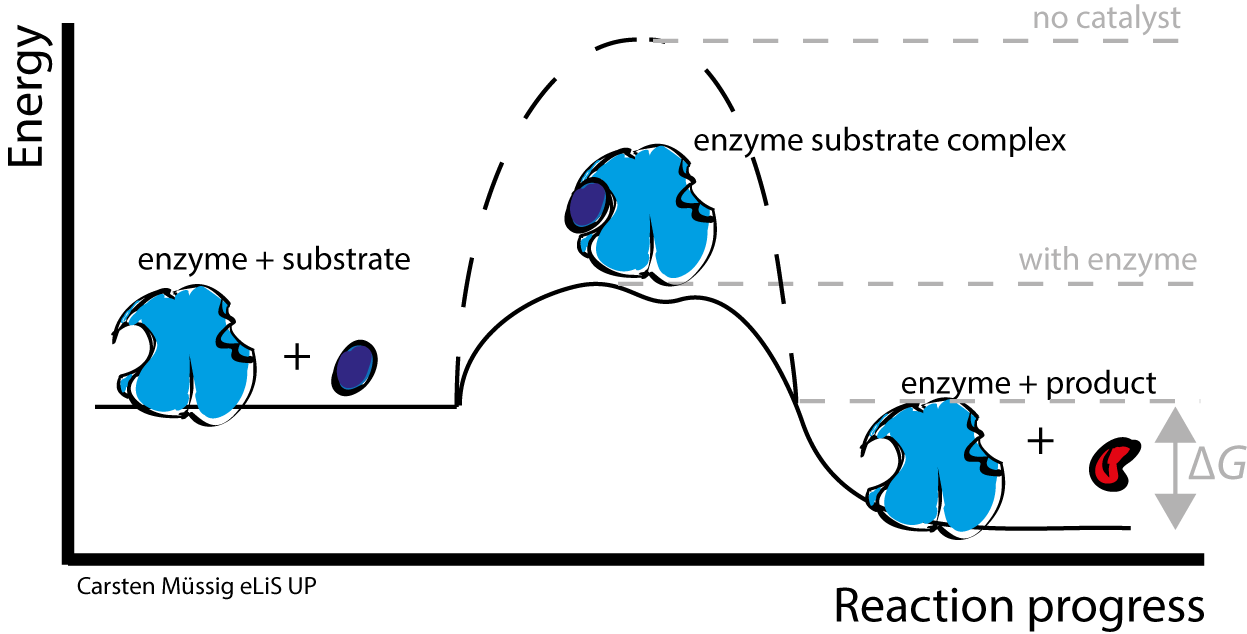
What is the purpose  of an enzyme?
a)
give permission for the reaction
b)
raise activation energy
c)
speed up reactions
d)
control how many reactions occur
26.
The enzyme known as ‘catalase’ is involved in the breakdown of hydrogen peroxide molecules into separate water and oxygen molecules. During this reaction, what happens to the ‘catalase’?
a)
The enzyme would become products: O2 and H20
b)
The enzyme would be fully used up and discarded.
c)
The enzyme would remain unchanged in any way.
d)
The enzyme would become a new type of enzyme.
27.
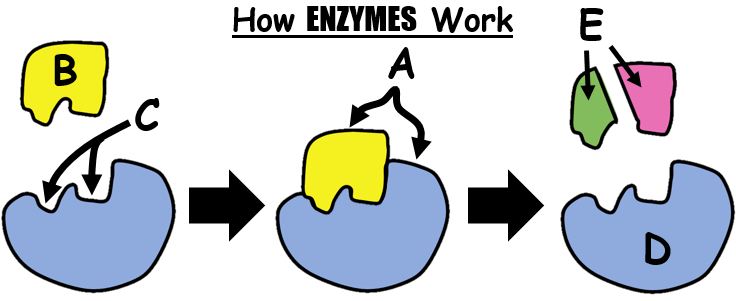
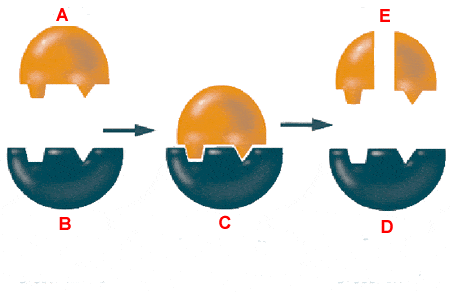
What is being represented by the letter A in the image?
a)
Substrate
b)
Enzyme
c)
Product
d)
Complex
28.
The part of the enzyme that the substrate bonds to is called the _____.
a)
active site
b)
activation energy
c)
bond site
d)
dehydration synthesis
29.
What makes an enzyme substrate specific?
a)
Size
b)
Shape
c)
Name
d)
Location it is found in
30.
Enzymes need certain environmental conditions in order to function properly.  What happens when enzymes are heated to a high temperature?
a)
they die
b)
they denature (change shape)
c)
they change their amino acid sequence
d)
they work better
31.
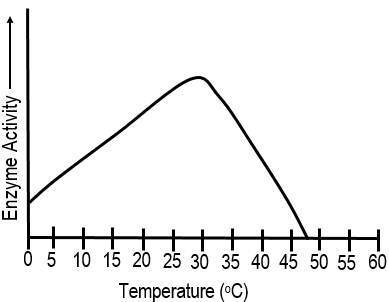
Based on the graph, what temperature does this enzyme work best? 
a)
15 C
b)
40 C
c)
30 C
d)
47 C
32.
Enzymes are capable of increasing the rate of a chemical reaction within a living cell.  Enzymes accomplish this through which of the following means?
a)
reducing the number of products   
b)
reducing the activation energy
c)
increasing the temperature of the cell
d)
increasing the concentration of reactants 
33.
What 3 letters do enzymes typically end in?
a)
-ose
b)
-ase
c)
-ese
d)
-tic
34.
After the enzyme and substrate bind together and perform the reaction, what does the substrate become?
a)
a substrate
b)
an enzyme
c)
a product
d)
an active site
35.
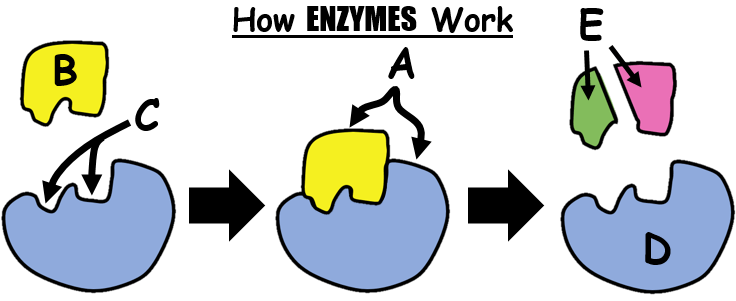
In the diagram, what is letter A? 
a)
product
b)
substrate
c)
enzyme-substrate complex
d)
active site
36.
Letter C...
a)
active site
b)
enzymes
c)
substrate
d)
products
37.

In a chemical reaction, ________ are what you have at the end

a)

Products

b)

Molecules

c)

Reactants

d)

Substances

38.
Chemical reactions always involve
a)
the breaking of bonds in reactants.
b)
the formation of new bonds in products.
c)
the breaking of bonds in reactants and the formation of new bonds in products.
d)
enzymes. 
39.
An enzyme speeds up a reaction by
a)
lowering the activation energy.
b)
raising the activation energy.
c)
releasing energy.
d)
absorbing energy.
40.
Enzymes catalyze reactions by ___________ Activation Energy.
a)
Increasing
b)
Decreasing
41.
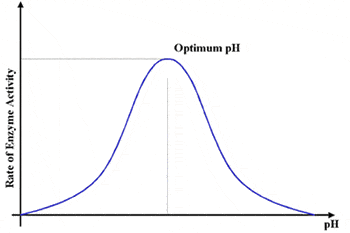
Which explanation best fits the graph for pH's effect on an enzyme?
a)
As the pH gets closer to neutral more H-Bonds are broken
b)
Larger numbers of H+ & OH- ions distort the active site
c)
There are more collisions between substrates and active sites near the optimal pH
d)
Low pHs cause more H-Bonds to happen near the active site
42.
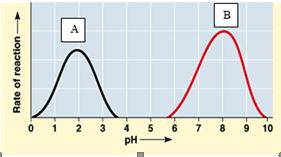
Which of the following conclusions can be drawn from this graph?
a)
The optimum pH of the enzyme is 6.6.
b)
The optimum pH of the enzyme is 5.8
c)
The enzyme’s activity increases as pH increases 5.0 to 9.0
d)
The enzyme’s activity is greater around pH of 8.0 .
43.
What is the optimal pH of enzyme A?
a)
8
b)
2
c)
5.7-10
d)
10
44.

Which substrate would this enzyme catalyze?

a)
b)
c)
d)
45.
The graph shows the relative rates of action of four enzymes, A, B, C, and D. Which enzyme shows the greatest change in its rate of action with the least change in pH?
a)
enzyme A 
b)
enzyme B 
c)
enzyme C
d)
enzyme D