Wayground logo

Free Printable Worksheets

Font size

S
M
L
XL
Worksheets

2nd Semester Mid-Term Review

Total questions: 43

Worksheet time: 22mins

Name
Class
Date
1.
Wrote “History of the Standard Oil Company,” in 1902. Showed how Rockefeller’s rise was based on ruthless business practices. 
a)
Ida B. Wells 
b)
Ida Tarbell 
c)
Susan B. Anthony 
d)
Elizabeth Cady Stanton 
2.
1906- Wrote The Jungle which exposed the conditions in the U.S. meat packing industry. (Helped pass the Pure Food and Drug Act) 
a)
Upton Sinclair 
b)
Lincoln Steffens 
c)
Jacob Riis 
d)
Frank Norris 
3.
Co-founder of Hull Houses- which was an all-purpose community center for poor immigrant people living in crowded city neighborhoods. 
a)
Jane Addams 
b)
Ida Tarbell 
c)
Frances Willard 
d)
Susan B Anthony 
4.
Photographed conditions of the urban poor in “How the Other Half Lives.” Examined the conditions of the poor in America’s cities. 
a)
Upton Sinclair 
b)
Lincoln Steffens 
c)
Jacob Riis 
d)
Frank Norris 
5.
The poll tax, literacy tests, and grandfather clause aimed to keep who from voting
a)
Poor white citizens
b)
Black citizens
c)
Native Americans
d)
Chinese immigrants
6.
Journalists who exposed practices of monopolies and big business
a)
Gump Mushers
b)
Muckrakers
c)
Scalawags
d)
Dirt Diggers
7.

These were any type of law that discriminated against people based on race.

a)

14th Amendment

b)

state laws

c)

federal laws

d)

Jim Crow laws

8.

What was the result of the case of Plessy vs. Ferguson?

a)

The Supreme Court ruled in favor of Plessy saying segregation was illegal.

b)

The Supreme Court never made a ruling.

c)

The Supreme Court ruled that segregation was legal.

d)

Plessy never took the case to the Supreme Court.

9.

The United States began to act as an "international police force" as a result of...

a)

The Roosevelt Corollary

b)

The Monroe Doctrine

c)

The Baseball Bat Doctrine

d)

The International Police Force Doctrine

10.

This was built by the United States to make trade much easier by cutting a route through Central America

a)

Erie Canal

b)

Panama Canal

c)

Cuban Canal

d)

Spanish Canal

11.
Which of the following defines the Monroe Doctrine?
a)
Europe was not allowed to imperialize the Americas
b)
America was the Police force for the Western Hemisphere
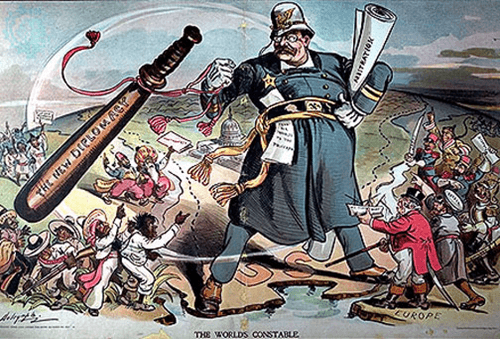
12.
Which aspect of Imperialism does this picture represent?
a)
Roosevelt Corollary
b)
Monroe Doctrine
c)
Influence of Naval Power Upon History
d)
Spanish American War
13.

What events lead America to join World War 1?

a)

Trench Warfare and Chemical Warfare

b)

The DeLome Letter and Assassination of Franz Ferdiand

c)

Sinking of the Lusitania and Zimmerman Note

14.
What was the goal of Woodrow Wilson's 14 points?
a)
to achieve world peace
b)
to punish germany
c)
to start WW2
d)
to reward Russia
15.
What was the point of the League of Nations according to Wilson?
a)
to grant independence to nations
b)
to resolve international disagreements
c)
to sue Germany
d)
establish new governments
16.

Why did the United States not join the League Nations?

a)

The US feared being forced to join an alliance with Europe

b)

The US felt the need to make an alliance with Canada

c)

The US feared the increase in the number of immigrants to America

d)

The US felt that peace was not possible in Southeast Asia

17.
One reason for US fears of communism in the 1920's was that
a)
millions of Bolsheviks were migrating to the US
b)
the Bolsheviks had taken over Russia during World War I
c)
a Bolshevik army was sailing to the US
d)
Bolshevik spies were found in the US government
18.
Nativism is
a)
the idea that Native Americans should have more land
b)
the distrust of immigrants by Americans
c)
a fear of radical ideas
d)
hatred of all people by Native Americans
19.
Which of the following statements best describes what happened on Black Tuesday?
a)
Stock prices fell and the stock market crashed.
b)
Bank runs forced many banks to close their doors.
c)
Federal troops attacked the Bonus Army marchers.
d)
The Supreme Court ruled that the NRA was unconstitutional.
20.

This is the process of taking money borrowed from the bank or a broker, and putting it into the stock market

a)

Buying on Margin

b)

Speculation

c)

Bankruptcy

d)

Overconsumption

21.
When the purchase of goods and services is at a lower level then the supply (not enough goods are being purchased by consumers)
a)
Underconsumption
b)
Overproduction 
c)
Speculation 
d)
Buying on Margin 
22.
Stock Market Speculation is...
a)
Borrowing more money than you can afford to pay back
b)
Buying stock with the hope that the worth of the stock will rise over time
c)
Buying stock that is high and hoping the value will fall
d)
Selling stock you already own without paying the full amount.
23.
Which President created the New Deal?
a)
Ellis Arnall
b)
Herbert Hoover
c)
Eugene Talmadge
d)
Franklin D. Roosevelt
24.
This program offered jobs to single young men building bridges, working on roads, parks, dams, etc.
a)
THe Civilian Conservation Corp
b)
The Cool Conservative Company
c)
The Creepy Cold Constitution
d)
The Civilian Coal Company
25.
What was the human impact of The Great Depression?
a)
People were homeless and hungry
b)
People generally owned their own home 
c)
People were optimistic about their current circumstances. 
d)
There was so much economic prosperity that Photographers took historical images of all the boisterousness. 
26.
Shanty towns (make-shift) towns were named after this person due to the people’s dissatisfaction of the amount of help they were given after the Stock Market Crash?
a)
Hoovervilles
b)
Shanty Villa 
c)
Bum Town
d)
Roosevelt RoadHouses 
27.
Many people lost their jobs during the Great Depression.  The national government responded with President Franklin Roosevelt's "New Deal," which
a)
provided programs to help people make money to provide for their needs. 
b)
helped reduce the national debt, providing more capital for businesses
c)
forced people to join the military forces to make money for their needs. 
d)
forced people to use charities to help them provide for their needs. 
28.
Roosevelt's fireside chats used what technology to spread his message?
a)
Television
b)
Radio
c)
Newspaper
d)
Instragram
29.
This was created to regulate the stock market and prevent a future stock market crash
a)
Securities and Exchange Committee
b)
Public Works Administration
c)
Works Progress Administration
d)
Agricultural Adjustment Act
30.
This was created to protect the money people had deposited in the bank
a)
Federal Deposit Insurance Corporation
b)
Securities and Exchange Committee
c)
Tennessee Valley Authority
d)
National Recovery Administration
31.
This was designed to provide assistance to the elderly, disabled, and poor
a)
Social Security
b)
Securities and Exchange Committee
c)
Wagner Act
d)
National Recovery Act
32.
Regulating the amount of goods a consumer can obtain
a)
Office of War Information
b)
Bataan Death March
c)
rationing
d)
war bonds
33.
Home project raising about one third of the nation’s vegetables during World War II
a)
anti-Semitism
b)
carpet bombing
c)
rationing
d)
victory gardens
34.
Rosie the Riveter encouraged women to...
a)
Stay at home for their children
b)
Work in factories
c)
Protest the war
35.
The Act that allowed the U.S. to give War supplies to Britain in early WW2?
a)
United Nations
b)
Lend-Lease Act
c)
Manhattan Act
d)
New Deal
36.

FDR signed an order to put more than 100,000 people with Japanese backgrounds in ____________________.

a)

schools

b)

reservations

c)

nature reserves

d)

internment camps

37.
Victory in Europe (V-E Day) was a result of ________________.
a)
Japan surrendering
b)
The atomic bombings
c)
Germany surrendering
d)
the signing of the Treaty of Versailles
38.
Why were natural resources, like gasoline, scarce during WWII?
a)
The U.S. government did not want to spend money on natural  resources.
b)
The U.S. had all the  natural resources it needed.
c)
Natural resources were scarce because they were needed for the  war effort. 
d)
Americans were greedy and did not want to share the natural resources. 
39.
What did allied forces do on D-Day, June 6, 1944?
a)
They sent thousands of troops to Berlin.
b)
They stormed the beaches of Normandy, France.
c)
The fought the Nazi troops in Russia.
d)
They took control of many Japanese islands.
40.
Which of the following is NOT true about the United States during World War II?
a)
The U.S. entered the war after the bombing of Pearl Harbor.
b)
Factories produced war goods and  natural resources were rationed. 
c)
Most women stayed home to raise children and tend to their husbands.
d)
The Tuskegee Airmen helped the allies defeat the Axis powers.
41.
What strategy did the United States develop to help defeat Japan?
a)
island hopping
b)
total war
c)
Anaconda plan
d)
blockade
42.
Which of the following events during WWII brought the United States into the war?
a)
Germany's invasion of Poland
b)
D-Day invasion of Normandy
c)
Nazi Germany's treatment of the Jewish people
d)
Japan's bombing of Pearl Harbor
43.
US legislation that allowed the US to remain neutral but loan and "sell" ammunition and machinery/equipment to countries when it was in the best interest of the US.
a)
neutrality
b)
militirism
c)
lend lease program
d)
imperialism