
 Worksheets
Science Review
Total questions: 44
Worksheet time: 2hrs 46mins

Flood water pounding against a canyon wall and wearing it down
weathering
erosion
deposition

Deltas forming at the mouths of rivers
physical weathering
chemical weathering
erosion
deposition


Mr. Reincke mixes sugar into water. After a minute, the sugar cannot be seen in the water. Mr. Reincke then heats the mixture until the water evaporates and the sugar is left at the bottom of the beaker. Which property of sugar is he demonstrating?
Density
Conductivity
Mass
Solubility

A father wears protective gloves to pull a metal pan out of the oven. Why are the protective gloves necessary?
The metal pan insulates thermal energy.
The metal pan creates thermal energy.
The metal pan conducts thermal energy.
The metal pan reduces thermal energy.

The picture below shows one way electrical energy is produced. What type of energy is used to create the electrical energy?
Light Energy
Sound Energy
Thermal Energy
Mechanical Energy

A prism bends light. Which of the following situations does light bend as well?
When light hits a piece of furniture
When light passes through outer space
When light moves from air to water.
When light bounces off a shiny object.

Why do batteries have a positive and negative side?
The battery has 2 sides just because.
The battery needs to form a complete circuit.
One side is for the switch, the other is for a light bulb.
One side is to turn it on, the other is to produce more power.

When the lamp is turned on and the bulb is lit, the circuit demonstrates which of the following?
A newly made paper boat ____________ in water.
sink
sink half
floats
None of these
Rahul has thrown a leaf and a coin in glass of water . Which will float ?
Both
only leaf
only coin
None

A bobber floats on the water because it is....
more dense than the water
less dense than the water
the same density as the water
to show you when you have a bite

Which illustration is an example of the spacing of particles in solids?
illustration A
illustration B
illustration C
illustration D

Gases have no definite shape or volume. Instead, they take the shape of their container. The particles of a gas spread out within the available space. Which diagram illustrates gas particles?
Diagram A illustrates gas particles.
Diagram B illustrates gas particles
Diagram C illustrates gas particles.
None of these illustrates gas particles.


travels in straight lines and reflects from the surface of the mirror
enters the mirror and changes direction when it is refracted by the back of the mirror
refracts in the glass of the mirror and is spread out all over the room
travels through air and does not change its direction in air
Which statement best describes the processes of weathering and erosion?
Weathering and erosion are directly responsible for depositing loose sediments on the bottom of the ocean, forming layers of sediment.
Weathering and erosion are directly responsible for the breakdown of any type of rock into smaller particles and the carrying away of the loose sediments.
Weathering and erosion are directly responsible for the amount of water in a river that transports sediments to the sea.
Weathering and erosion are directly responsible for the transportation, deposition, and compaction of loose sediments on the seafloor.
∎Plastic ball
∎Glass Marble
∎Metal paper clip
∎Wood block
Which two objects are most likely less dense than water?

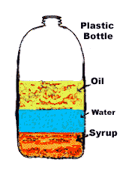
The diagram above shows one container with oil and water and another with oil and a cork. Which diagram below shows what most likely would happen if oil, water, and the cork were all put in the same container?


A cook uses the ingredients listed above. Which table below shows the physical properties of these ingredients when placed in hot water?


A student classifies the above objects shown based on their physical properties. Which property cannot be used to classify these objects into more than one group?
Magnatism
Mass
Electrical Conductivity
Solubility in water

A student is asked to design a sleeve for a cup that will insulate thermal energy and not feel hot to the touch when the cup is filled with liquid. The students has 4 materials to choose from. Which of these materials is least useful as an insulator?
cardboard
aluminum
rubber
plastic

A student builds a circuit made up of a battery, two light bulbs, and a switch. What will the student most likely observe in this circuit?
Light bulb 1 and light bulb 2 will both be on
Light bulb 1 will be off, but light bulb 2 will be on
Light bulb 1 and light bulb 2 will both be off
Light bulb 1 will be on, but light bulb 2 will be off

The diagram shows a series circuit with three lit bulbs. How many of the bulbs will remain lit if the wire is cut a the point shown by the arrow?
0
1
2
3

Which of these changes to the electric circuit shown above will cause the lightbulb to light up.
Straightening the wire so that the current can flow more easily
Adding a switch and more wire so that the current can flow more easily
Turning one battery so that its positive end connects to the other battery's negative end
Making the length of wire the same on both sides of the lightbulb
Example of a decomposer
fungi
mouse
plants
frogs



