wayground logo

Free Printable Worksheets

NEW

Font size

S
M
L
XL
Worksheets

SW4 CA REVIEW

Total questions: 20

Worksheet time: 36mins

Name
Class
Date
1.
 When an environment has reached its carrying capacity for a certain population, which of the following is true? 
a)
 Growth and immigration rate is equal to death and emigration rate. 
b)
 Growth and immigration rate is greater than death and emigration rate. 
c)
Growth and immigration rate is less than death and emigration rate. 
d)
Growth rate is exponential. 
2.
Data on the immigration and emigration of a fish species would be most helpful in determining which of the following?
a)
biological magnification
b)
interspecies competition
c)
population of the species
d)
predator-prey relationships
3.
How does the predator-prey relationship affect a population?
a)
The predators and prey are in competition with each other.
b)
Usually either the predator or the prey will become extinct.
c)
The relationship controls the population size of both species.
d)
The predator species usually has exponential growth.
4.
The number of pythons found throughout Everglades National Park hasincreased in recent years. These huge snakes are not native to Florida and are believed to have been released into the wild by pet owners. Wildlife biologists have initiated attempts to capture and remove these pythons. Which statement best explains the biologists' reasons for removing these pythons from the Everglades?
a)
The pythons could upset the territorial boundaries of native organisms.
b)
The pythons could adapt to overcome diseases common to native snakes.
c)
The pythons could prey on native organisms and cause native population to decline.
d)
The pythons could begin to interbreed with native snakes and produce a more successful species.
5.
The number of deaths compared to the total number of people in a population
a)
death rate
b)
doubling time
c)
population decline
d)
birth rate
6.
The number of births compared to the total number of people in a population
a)
death rate
b)
birth rate
c)
baby boom
d)
doubling time
7.
The growth of cities and surrounding areas
a)
migration
b)
urbanization
c)
emigration
d)
immigration
8.

One reason the world is growing so quickly is because...

a)

The world has infinite resources for everyone

b)

Birth rate is higher than death rate

c)

There are more and more places for people to live

d)

Death rate is higher than birth rate

9.

People leaving a country is called

a)

Immigration

b)

Emigration

c)

Mass migration

d)

Urbanization

10.

This population pyramid shows...

a)

Rapid growth

b)

Slow growth

c)

Negative growth

11.

This population pyramid shows...

a)

Rapid growth

b)

Slow growth

c)

Negative growth

12.

Countries with a rapidly growing population are..

a)

Developed

b)

Developing

13.
What growth pattern describes a population whose growth rate slows or stops following a period of exponential growth?
a)
logistic growth
b)
population growth
c)
exponential growth
d)
predator-prey cycle
14.
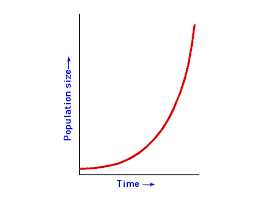
What type of growth is shown in the diagram?
a)
exponential growth
b)
logistic growth 
c)
predator-prey cycle
d)
boom-bust curve
15.
Largest number of individuals of a population that the environment can support...  
a)
carrying capacity
b)
population crash
c)
lag phase
d)
mutualism
16.
Nesting birds often space themselves evenly from other nests. This pattern is called
a)
clumped dispersion.
b)
uniform dispersion.
c)
random dispersion
d)
scatter dispersion
17.
Which of the following will increase the size of a population?
a)
emigration and births
b)
immigration and deaths
c)
immigration and births
d)
emigration and deaths
18.

What is the dispersion pattern of herding animals, birds that flock together, and fish that form schools?

a)

clumped

b)

random

c)

uniform

d)

unpredictable

19.
What is an invasive species?
a)
A native (naturally found) species which are added to an area. 
b)
A non-native (not naturally found) species added to an area. 
c)
A keystone species in an environment
d)
none of the above
20.

Invasive species alter the ecosystem by _____ in number quickly. This leads to _____ food for the native species.

a)

increasing, less

b)

increasing, more

c)

decreasing, less

d)

decreasing, more