wayground logo

Free Printable Worksheets

Font size

S
M
L
XL
Worksheets

Rxn Rates & Endo/Exo Rxn

Total questions: 20

Worksheet time: 59mins

Name
Class
Date
1.
Exothermic reactions...
a)
Absorb energy
b)
Release energy
c)
Release Color
d)
Absorb Color
2.
A substance that increases speed of chemical reaction without being being changed is called:
a)
Catalyst
b)
Acid
c)
Base
d)
pressure
3.

Grinding a tablet into powder increases the rate of reaction due to increased

a)

concentration

b)

surface area

c)

temperature

d)

reactants

4.
In an endothermic reaction the products have 
a)
more energy than the reactants
b)
less energy than the reactants
c)
the same energy as the reactants
d)
no energy
5.
In an exothermic reaction the products have
a)
more energy than the reactants
b)
the same energy as the reactants
c)
less energy than the reactants
d)
no energy
6.

If a chemical reaction is exothermic, the temperature would....

a)

Stay the same

b)

Increase

c)

Decrease

7.

What type of reaction is shown by the given equation?

NaHCO3 (s) + heat → NaHCO3 (l)

a)

Exothermic

b)

Endothermic

c)

impossible to determine without knowing the temperature change
8.
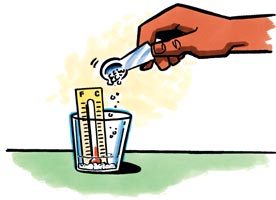
In an endothermic reaction, heat is ...
a)
taken in or absorbed
b)
given out or released 
9.
What type of reaction occurs in a hand warmer
a)
exothermic
b)
endothermic
10.
Exothermic reactions...
a)
Absorb energy
b)
Release energy
c)
Release Color
d)
Absorb Color
11.
Activation energy is required to start a chemical reaction. What is activation energy?
a)
The energy needed for a reaction to occur
b)
The minimum amount of energy needed for a reaction to potentially occur
c)
The energy added by a catalyst
d)
The energy possessed by the products
12.

Increasing the temperature of the reactants can do which of the following?

a)

Slow collision frequency thus increasing reaction rate

b)

Allow less effective collision between the particles thus increasing reaction rate

c)

Cause particles to lose speed thus decreasing reaction rate

d)

Increase collision between the particles thus increasing the rate

13.
Exposing more particles for collisions is an increase in 
a)
concentration
b)
surface area
c)
temperature
d)
catalyst
14.

Which of the following slows down the rate of a chemical reaction?

a)

placing the reactants in hot water

b)

placing the products in ice bath

c)

placing the reactants in a ice bath

d)

stirring the reactants with a stirring rod

15.
If more reactants are used in a chemical reaction, more products will be produced. This is because
a)
More reactants cause the reaction to heat up
b)
More reactants take up the same volume
c)
More reactants have more atoms to react to form more products
d)
Too many products can slow down the reaction
16.
In a chemical reaction, if the reactants are heated, the reaction usually happens
a)
Faster
b)
Slower
c)
At the same rate
d)
In a smaller volume
17.
Products will form faster if____________
a)
the particle size of the reactants are larger.
b)
temperature is decreased.
c)
concentration of the reactants are increased.
d)
the reaction is not stirred.
18.

Increasing the temperature of the reactants will do which of the following?

a)

slow collision frequency

b)

allow less effective collision between the particles

c)

neutralize the reaction

d)

increase collision between the particles thus increasing the rate
19.
You add more bodies into a "mosh pit" to hope for more collisions.  You have increased-
a)
temperature
b)
concentration
c)
pressure
d)
catalyst
20.

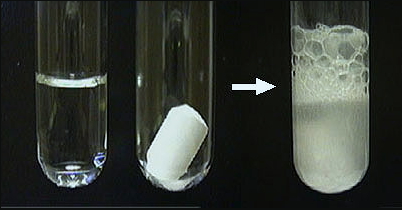
How could we make this reaction happen more quickly?

a)

Decrease the concentration of the acid

b)

crush the chalk to increase the surface area

c)

Put the test tube in an ice bath