wayground logo

Free Printable Worksheets

Font size

S
M
L
XL
Worksheets

Industrial Revolution / 2nd Great Awakening

Total questions: 103

Worksheet time: 52mins

Name
Class
Date
1.
Limited Naval Vessels on Great Lakes 
a)
Convention of 1818
b)
Rush-Bagot Treaty
c)
Missouri Compromise 
d)
Adams Onis Treaty 
2.
Two biggest issues that caused sectional divide
a)
Slavery and Factories  
b)
Tariffs and Tobacco 
c)
Slavery and Farming 
d)
Slavery and Tariffs 
3.
Missouri Compromise Maine became a 
a)
Free State 
b)
Slave State 
4.
ALL the following are true with regards to the Missouri Compromise EXCEPT 
a)
Written by Henry Clay 
b)
South of the 36 degrees 30 north would be Free
c)
Missouri would enter union a slave state 
d)
North of 36 degrees 30 North would be free territory 
5.

Which is NOT an element of Free Enterprise?

a)

Profits

b)

Controlled by central authority

c)

Competition

d)

Buy and sell freely

6.
Who started Factory system in the United States? 
a)
Francis Lowell 
b)
Eli Whitney 
c)
James Monroe 
d)
Henry Clay
7.
What does a census count? 
a)
Immigrants 
b)
Population 
c)
Jobs
d)
Growth of cities 
8.
Indiana is the...
a)
17th state
b)
18th state 
c)
19th state 
d)
20th state
9.
What state did the U.S. acquire with the Adams Onis Treaty 
a)
Florida 
b)
Missouri 
c)
Illinois 
d)
Kentucky 
10.
What piece of foreign policy informed European powers that they could no longer interfere in western affairs?
a)
Convention of 1818
b)
Rush Bagot 
c)
Adams Onis Treaty 
d)
Monroe Doctrine 
11.
Economic System controlled by a central administration
a)
Market Economy 
b)
Capitalist Economy 
c)
Command Economy 
d)
Mixed Economy 
12.
Wrote the Missouri Compromise 
a)
Francis Lowell
b)
John Calhoun 
c)
Henry Clay 
d)
James Monroe 
13.
Invented the Cotton Gin
a)
Eli Whitney 
b)
Henry Clay 
c)
Francis Lowell
d)
John Deere 
14.
Led to a canal boom in the United States thanks to the success New York had
a)
Central Canal 
b)
Erie Canal
c)
Wabash Canal 
d)
Ohio Canal 
15.
Steamboats and Railroads did all the following EXCEPT 
a)
Better relations with natives 
b)
Cities grew 
c)
Cut shipping costs 
d)
Made goods cheaper 
16.

ALL the following describe life for girls at the Lowell Mill EXCEPT...

a)

Work long hours

b)

Very dangerous

c)

Get raises fairly easily

d)

Very stressful and demanding job

17.
How did railroads impact the prices of goods & services?
a)
Made goods and services more expensive & harder to ship
b)
Made goods and services cheaper & easier to ship
c)
Gave people safer transportation
d)
Opened new land for exploring and settlements
18.
Railroads moved ___-_________ to factories.
a)
finished prodcuts
b)
raw materials
19.
Women were paid ____ than men for doing the same work.
a)
more
b)
less
20.
These workers gather together to try and argue for better working conditions & higher pay. 
a)
abolitionists
b)
temperance movement
c)
organized labor
21.
How did the Industrial Revolution change the way we create goods?
a)
we made fewer products
b)
we made better quality products
c)
we made products from home
d)
mass production & cheaper goods
22.
Because children worked in factories 
a)
they had less education
b)
they became sick an injured
c)
they worked for less pay
d)
all of the above
23.
What was the purpose of labor unions?
a)
Negotiate as a group for bigger factories
b)
Negotiate as a group for better working conditions
c)
Negotiate as a group for a political revolution
d)
Negotiate as a group for a social revolution
24.
The cotton gin was invented by _____, which helped separate seeds from cotton fiber.
a)
Eli Whitney
b)
Henry Ford
c)
Robert Fulton
d)
Edmund Cartwright
25.
Why did people move to cities during the Industrial Revolution?
a)
People were looking for work.
b)
People were looking for farms.
c)
People wanted to buy a house.
d)
People wanted to sell their crops.
26.
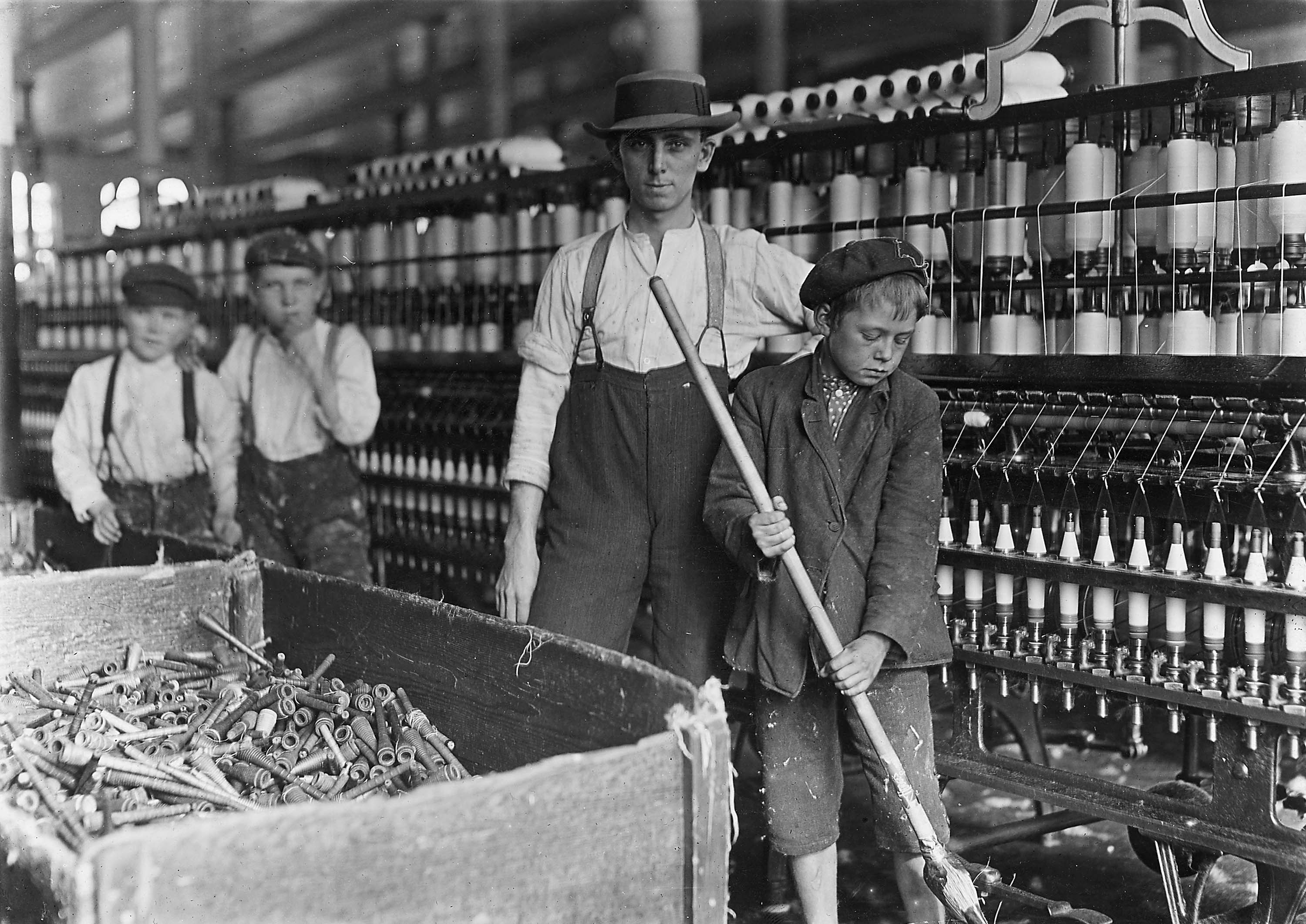
This picture shows which problem of the factory system?
a)
unsafe working conditions
b)
urbanization
c)
unfair wages for women
d)
child labor
27.
Where did the industrial revolution start?
a)
Russia
b)
Japan
c)
Britain
d)
America
28.
Using interchangeable parts for creating goods advanced the growth of industry because it-
a)
allowed the continuation of the domestic system
b)
permitted large quantities of goods to be mass produced at lower cost
c)
made it possible for unskilled workers to operate machines
d)
brought an end to the common abuse of factory workers
29.
Which of these did not improve the nation's system of trade in the 1800's?
a)
construction of canals
b)
use of steamboats
c)
completion of the railroad
d)
construction of toll roads
30.
Why were railroads so important during this time?
a)
they moved goods more quickly and less expensively over greater distances
b)
they were fun to ride on to go visit family in other states
c)
people could ride on railroads to get to their jobs in another city
31.
Which group settled in California and helped build the western half of the Transcontinental Railroad?
a)
Irish
b)
Chinese
c)
German
d)
Scandinavian
32.
What is the movement from rural to urban areas called?
a)
Moving
b)
colonization
c)
inflation
d)
urbanization
33.

Which one of the inventions from your chart changed the way cotton was processed?

a)

Cotton Gin

b)

Spinning Jenny

c)

Bessemer Steel Process

d)

Light Bulb

34.
Why did people move to the cities during the Industrial revolution?
a)
Jobs in factories
b)
Jobs on the farm
c)
Family
d)
Friends
35.
One of the most significant economic effects of the War of 1812 was--
a)
the decline of slavery in the North
b)
the development of American manufacturing
c)
the addition of two new amendments
d)
the reliance on cottage industry
36.
What was one major effect of the opening of the Erie Canal?
a)
the volume of trade in Southern ports increased
b)
the cost of shipping goods from the Midwest decreased
c)
the number of ships through northern ports decreased
d)
the cost of shipping goods in Eastern roads increased
37.
An economic system with minimal government interference is called
a)
Sedition
b)
command economy
c)
embargo
d)
free enterprise
38.
The change from individual production of goods to machine production is called
a)
urbanization
b)
industrialization
c)
agrarian societs
d)
nullification
39.

Before the United States adopted the factory system, most manufactured goods were imported from England and other European countries.

a)

True

b)

False

40.

The South focus was on Plantation style farms that grew?

a)

Cash Crops

b)

Food to feed the North

c)

Rubber

d)

Corn

41.

The West supplied the North with food from its farms and raw material from its?

a)

Railroads

b)

Oceans

c)

Mines

d)

Slave labor

42.

The North quickly separated itself from the other regions and quickly Industrialize, why didn't the North turn to large scale farming or mining like the South and West?

a)

Poor population growth, rich soil, and humid weather

b)

Cheap land and large numbers of slaves

c)

Poor soil, heavy immigration, and money

d)

Heavy immigration and abundance of land

43.

The Industrial Revolution lead to urbanization, immigration, and what?

a)

a decease of food production

b)

Rapid technological innovation

c)

a return to rural life

d)

Industrialization of the south

44.

Factories and the factory system in the North lead to....

a)

an increase of puppies

b)

an increase in farming

c)

an increase in slaves

d)

an increase in production levels

45.

What is given credit with giving a second life to the institution of slavery in the United States ?

a)

poor southern farmers

b)

heavy immgration

c)

Invention of the cotton gin

d)

Introduction of crop rotation and fertilizers

46.

Which factor promoted more immigration to the north than south during the 1800's

a)

Citizenship was easier in south

b)

the North had more industrialization

c)

Governments in north were less corrupt.

d)

a lack of natural harbors in the North

47.

How are Canals and Rivers similar?

a)

Both made travel slower

b)

Both served as inland water routes for moving goods.

c)

both made shipping goods more expensive

d)

Both were unusable in the winter months

48.

What would a transcendentalist most likely say about their beliefs?

a)

I follow a philosophy that teaches people to trust their emotions and intuition.

b)

I believe that all men are created equal.

c)

Education is our only political safety.

d)

I would rather be a rebel than a slave.

49.
What was the effect of the 2nd Great Awakening?
a)
The Second Great Awakening caused the start of many reform movements designed to remedy the evils of society.
b)
The 2nd Awakening caused many people to reconsider their beliefs and turn to philosophy for direction. 
c)
The Second Great awakening caused a great panic about the evils of alcohol in the world. 
d)
The Second Great Awakening created the conditions necessary to make the Southern United States consider abolition. 
50.

Who was a transcendentalist questioned society's rules and institutions?

a)

Mott

b)

Dix

c)

Thoreau

d)

Douglass

51.

Who dedicated their life to helping the imprisoned?

a)

Mott

b)

Dix

c)

Thoreau

d)

Douglass

52.
The Second Great Awakening was referring to what?
a)
revival of strong religious feelings
b)
when your mom comes in your room the second time
c)
return to a king
d)
return to law of the land
53.

True or False: During the early efforts to establish public schools, school aged girls benefitted the most from the changes that were made.

a)

True

b)

False

54.
What is an abolitionist?
a)
Someone who wants to abolish or end slavery.
b)
Someone who wants to end voting for slaves.
c)
Someone who doesn't want to work with slaves.
d)
Someone who wants to never wear jeans.
55.

Women were not allowed to vote, this made it hard for women to be

a)

abolitionists

b)

trancendentilists

c)

sufferagettes

d)

expansionists

56.

The North Star was a newspaper that spread news of slavery and was written by

a)

Harriet Tubman

b)

Harriet Beecher Stowe

c)

John Brown

d)

Frederick Douglass

57.

Both slaves and women were

a)

not paid for work.

b)

allowed to vote.

c)

denied rights.

d)

not allowed in schools.

58.

Who was one of the first female doctors who had a hard time getting into medical school because they were a woman?

a)

Blackwell

b)

Dix

c)

Sceneca

d)

Mott

59.

Who was NOT an organizer of the Seneca Falls Convention?

a)

Mott

b)

Stanton

c)

Dix

60.

Which of these was the model for the Seneca Falls Declaration of Sentiments?

a)

The Declaration of Independence

b)

Preamble to the U.S. Constitution

c)

Monroe Doctorine

d)

Bill of Rights

61.
Who was Elizabeth Cady Stanton ?
a)
She was a girl.
b)
She faught in the revolutionary war.
c)
She was the first woman president of the United States of America.
d)
She was abolitionist to slavery and a leading figure for early womens rights movement. She was also the president of National Woman Suffrage Accosiation for 20 years.
62.

What was the main goal of the abolitionist movement?

a)

to help Southerners catch runaway slaves

b)

to stop slavery from spreading into new U.S. territories

c)

to give slaves the right to vote

d)

to eliminate slavery in the United States

63.

What primary method did Harriet Tubman use to fight for the abolitionist cause?

a)

She led abolitionist conventions.

b)

She led slaves to freedom on the Underground Railroad.

c)

She told her story of slavery in a book.

d)

She wrote an abolitionist newspaper.

64.

What did abolitionists Elihu Embree, William Lloyd Garrison, and Frederick Douglass have in common?

a)

They all represented free states in Congress.

b)

They all published anti-slavery newspapers.

c)

They all represented slave states in Congress.

d)

They were all former slaves.

65.

How did Frederick Douglass emerge as an abolitionist leader?

a)

He was a businessman who refused to do business in the South as a protest against slavery.

b)

He was a politician who knew people in power and used his connections to fight against slavery.

c)

He was an escaped slave who told the story of his life first as a speaker and then as an author.

d)

He was a slaveowner who changed his mind about slavery and published the first anti-slavery newspaper in the United States.

66.

What was the main goal of the women’s suffrage movement?

a)

to give women the right to vote

b)

to elect a woman president

c)

to give women the right to own property

d)

to give African Americans the right to vote

67.

Which statement BEST describes the role the Seneca Falls Convention played in the women’s suffrage movement?

a)

It was the convention that expanded women’s suffrage to other countries.

b)

It was the convention that led to the Second Great Awakening.

c)

It was the convention that first organized a movement toward women’s suffrage in the United States.

d)

It was the convention that approved the 19th amendment.

68.

Which statement accurately describes the Second Great Awakening?

a)

It was a religious revival that emphasized quiet and unemotional worship of God.

b)

It was a religious revival that emphasized equality and individual piety.

c)

It was a religious revival that emphasized the Catholic faith.

d)

It was a religious revival that emphasized the power of God to decide a person’s fate.

69.

How did the Second Great Awakening affect society in the 19th century?

a)

The Second Great Awakening hurt movements focused on equality since this focus opposed church teachings.

b)

The Second Great Awakening discouraged involvement in society by emphasizing that a person’s relationship with God was the only thing that mattered.

c)

The Second Great Awakening encouraged obedience to governmental authority and playing the proper role in society since this was what God wanted.

d)

The Second Great Awakening helped ignite reform movements by encouraging good deeds and working to improve conditions in the world.

70.

This was a time of renewed vigor for religious feelings.

a)

Renaissance

b)

Enlightenment

c)

Second Great Awakening

d)

9/11

71.

To make a change

a)

Move

b)

Turn

c)

Reform

d)

Cut

72.

When did the Second Great Awakening start?

a)

1600's

b)

1800's

c)

1700's

d)

1900's

73.

a meeting usually conducted by a preacher to increase religious beliefs and emotions, or to make converts

a)

camp meeting

b)

revival

c)

reform

d)

piety

74.

outdoor religious meeting that could last for several days

a)

camp meeting

b)

revival

c)

reform

d)

piety

75.

Everyone could be saved is what idea?

a)

equalitarian

b)

hindu

c)

enlightenment

d)

banishment

76.

During the second great awakening, it was thought that

a)

Humans had no control over their fate.

b)

God did not decide a person's fate

c)

God did not care about humans

d)

Humans ignored God

77.

It was believed that good deeds mattered and people could make a difference during the Second Great Awakening

a)

True

b)

False

78.

A person who strongly favors ending slavery

a)

Abolitionist

b)

Suffrage

c)

Revival

d)

Reform

79.

What Caused Mormons to Migrate West?

a)

Famine

b)

Got Tired of their place

c)

Murder Of their Founder

d)

Church was located somewhere else

80.
Thoreau's "Civil Disobedience" was written in order to express _______________________ that Thoreau hoped his readers would adopt.
a)
political views
b)
religious views
c)
aphorisms
d)
paradoxes
81.
Where did the Transcendentalists believe that you could find God?
a)
Nature
b)
Church
c)
Inside yourself
d)
At the flagpole 
82.
Which was an important effect of the "Second Great Awakening"?
a)
Andrew Jackson was elected President
b)
President Jackson refused to renew the National Bank
c)
Protestant Evangelicals sought to end slavery and achieve other reforms
83.
Which best describes the contribution to American culture made by James Audubon?
a)
He was inspired by the beauty of the Catskill Mountains
b)
His novel ranks as one of the greatest books ever written
c)
His drawings mark the most important work on birds ever published
d)
He is blamed for the destruction of several species of American birds
84.
Where did Mormons migrate to ?
a)
Colorado
b)
California
c)
Utah
d)
Wyoming
85.
The Temperance Movement sought to eliminate -
a)
Juvenile Prisons
b)
Consumption of alcohol
c)
Child labor
86.
In the 1840s, Seneca Falls, New York, became the scene of an important convention for -
a)
women's rights
b)
labor union organization
c)
temperance reform
d)
prison reforms
87.
Which is the best description of the works of the Hudson River School?
a)
They excelled in portrait paintings
b)
They glorified the majesty of nature
c)
They introduced abstract painting
d)
Their themes involved meetings during the "Second Great Awakening"
88.
In what way did the ideas of the Declaration of Sentiments differ from the ideas found in the Declaration of Independence?
a)
The Declaration of Sentiments was written by Thomas Jefferson
b)
The Declaration of Independence granted voting rights to men and women
c)
The Declaration of Independence supported the idea of nullification
d)
The Declaration of Sentiments included the equality of men and women
89.
The Dred Scott decision had a major impact on life in the US because it -
a)
limited the power of the Supreme Court to rule on cases of race
b)
supported Congress' right to forbid slavery in the territories
c)
reopened the issue of slavery in the territories
d)
reaffirmed the President's right to serve more than two terms in office
90.
Which was an important effect of the "Second Great Awakening"?
a)
Andrew Jackson was elected President
b)
President Jackson refused to renew the National Bank
c)
Protestant Evangelicals sought to end slavery and achieve other reforms
d)
Congress supported the First Amendment separating Church and state
91.
The Declaration of Sentiments, adopted at the Seneca Falls Convention in 1848, was significant because it - 
a)
promoted the idea of equal rights for women
b)
demanded the immediate abolition of slavery
c)
called for the prohibition of alcoholic beverages
d)
asked government to restrict harmful business practices
92.
The Second Great Awakening centered around - 
a)
Politics
b)
Economics
c)
Religion 
93.

What reform group is associated with the Declaration of Sentiments?

a)

Temperance

b)

Education

c)

Abolition

d)

Women’s Rights

94.

Which reform group delivered their belief statement at the Seneca Falls Convention?

a)

Temperance

b)

Education

c)

Abolition

d)

Women’s Rights

95.

Which of the following documents did John L. O’Sullivan, write?

a)

Manifest Destiny

b)

Monroe Doctrine

c)

Declaration of Sentiments

d)

Fugitive Slave Act

96.

Nativists were

a)

Native Americans

b)

Southern plantation owners

c)

Americans opposed to immigration

d)

Naïve farmers

97.

Suffrage is another word

a)

Limiting alcohol consumption

b)

Limiting voting rights

c)

Encouraging alcohol consumption

d)

Expanding voting rights

98.

Abolition is applied to the abolishing of

a)

Alcohol

b)

Immigrants

c)

Labor unions

d)

Slavery

99.

Temperance is applied to the limiting of

a)

Alcohol

b)

Immigration

c)

Labor unions

d)

Slavery

100.

What do Frederick Douglass and Sojourner Truth have in common?

a)

They were both abolition reformers

b)

They were both temperance reformers

c)

They were both Manifest Destiny supporters

d)

They were both prison reformers

101.

What do Elizabeth Cady Stanton and Susan B. Anthony have in common?

a)

They were both women's suffrage reformers

b)

They were both temperance reformers

c)

They were both supporters of Manifest Destiny

d)

They were both prison reformers

102.

Which reformer is associated with prison reform?

a)

Frederick Douglass

b)

Susan B. Anthony

c)

Elizabeth Cady Stanton

d)

Dorothea Dix

103.

Americans sought to change their lives by moving West along

a)

The Trail of Tears

b)

The Natchez Trace

c)

The C & O Canal

d)

The Oregon Trail