
 Worksheets
Evolution
Total questions: 30
Worksheet time: 24mins
Name
Class
Date
1.
______________ is the process by which populations change in response to their environment.
a)
natural selection
b)
adaptation
c)
reproductive isolation
d)
divergence
2.
__________ enable an organism to survive in its environment.
a)
adaptations
b)
natural selections
c)
divergence
d)
extinctions
3.

a)
analogous structures
b)
homologous structures
c)
vestigial structures
d)
none of the above
4.

Individuals that are well adapted to their environment will survive and produce
a)
better traits
b)
stronger genes
c)
more offspring
d)
fewer mutations
5.

All the individuals of a species that live in a particular area are called a
a)
group
b)
population
c)
variation
d)
fossil
6.

Which of the following is a term for a group of similar organisms that can reproduce fertile offspring?
a)
individual
b)
population
c)
species
d)
fossil
7.
Extinction can occur because of which of the following?
a)
All can be causes of extinction.
b)
Increased competition with other species
c)
New predators within the environment
d)
Loss of habitat and/or catastrophes
8.
Finches on the Galapagos Islands had different beaks in order to help them do what?
a)
Build nests
b)
Fight off predators
c)
Collect food sources
d)
Compete with rivals
9.
This scientist came up with the idea of natural selection.
a)
Jean Baptiste Lamarck
b)
Gregor Mendel
c)
Charles Darwin
d)
Thomas Malthus
10.
A remnant or trace of an organism from the past is called a _______.
a)
Ancestor
b)
Skeleton
c)
Fossil
d)
Imprints
11.
Inherited trait that helps an organism survive is a(n) __________.
a)
Fossil
b)
Adaptation
c)
Ancestor
d)
Natural selection
12.
Survival of the fittest or when favorable adaptations reproduce faster is called what?
a)
Evolution
b)
Adaptation
c)
Natural selection
d)
Fossilization
13.
This occurs when no more of a species is living.
a)
Fossilization
b)
Adaptation
c)
Extinction
d)
Natural selection
14.
Magda is a tall, 11 year old drummer. She has a scar on her right cheek. She is good at swimming. Which of her traits did Magda most likely inherit?
a)
height
b)
the scar
c)
ability to swim
d)
ability to play drums
15.

Structures with the same parts have different functions; suggests that organisms share a common ancestry
a)
vestigial structures
b)
homologous structures
c)
adaptive radiation
d)
fossil
16.
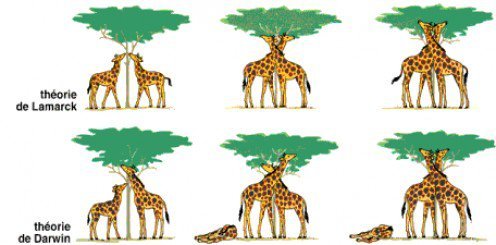
What would happen if the Giraffes never evolve?
a)
they would survive
b)
They would thrive
c)
They would become extinct
d)
They will find another source of food
17.
Why are advantageous traits more likely to be passed onto offspring?
a)
Because they are more likely to survive and reproduce.
b)
Because they come from dominant alleles.
c)
Because they come from recessive alleles.
d)
Because the trait is an acquired phenotype.
18.

Farmers breed cows to produce high amounts of milk. This is an example of...
a)
Natural Selection
b)
Variations in a species
c)
Selective Breeding
d)
inbreeding
19.
Which of the following is a fossil?
a)
a plant that has recently died
b)
a group of organisms that can reproduce
c)
a structure or organ that no longer functions
d)
a trace of an organisms that existed in the past
20.
Mutations are important because they bring about
a)
death of the organism in which they develop
b)
genetic variation needed for a population to evolve
c)
benefits for the individual, not for the population
d)
Hardey-Weinberg equilibrium within a population
21.

Charles Darwin came up with this theory
a)
Natural Selection
b)
Mutation
22.
Which scientist visited the Galapagos Islands and came up with the theory of natural selection?
a)
Theodor Schwann
b)
Gregor Mendel
c)
Charles Darwin
d)
Rudolf Virchow
23.
What most likely caused the finches on the Galapagos Islands to have beaks that were different from the finches on the mainland?
a)
There were different types of predators on the island.
b)
There were different types of food available on the island.
c)
The finches had no water to drink.
d)
The finches on the mainland could not fly high enough.
24.
What do we call a change in a species over time?
a)
Adaptation
b)
Evolution
c)
Extinction
d)
Environmental influences
25.

Darwin wrote that organisms with traits that are best suited to the environment will ________________
a)
increase in number
b)
become extinct
26.
What characteristic did Darwin observe about the finches on the Galapagos Islands?
a)
Their feathers
b)
Genotypes
c)
Their beaks
d)
Their body sizes
27.
The white feathers of a snowy owl allow it to blend in with its environment during the winter months (snow). This is an example of ________________
a)
Species
b)
Environmental Change
c)
Adaptation
d)
Variation
28.
What is the advantage of having different shaped beaks?
a)
To look different from other species.
b)
To be able to eat the food readily available in the environment.
c)
To protect itself against predators.
d)
To protect itself against prey.
29.
The struggle for existence against other members of an organisms species is
a)
Competition
b)
Natural Selection
c)
gene flow
d)
genetic drift
30.
Remains of ancient organisms are called
a)
Extinctions
b)
Fossils
c)
Mutations
d)
Variations
100 %

