
 Worksheets
Cold War
Total questions: 35
Worksheet time: 18mins

The primary goal of the U.S. Containment policy after WW II was to?
limit the use of atomic bomb and other nuclear weapons
end colonialism in Africa and Asia
stop the spread of Soviet Union influence in the world
bring German and Japanese war criminals to Justice

What was the term 'Iron Curtain' used to describe the division of?
North and South Vietnam
East and West Asia
North and South Korea
East and West Europe

President Truman adopted a new foreign policy during the Cold War know as the Truman Doctrine. It was originally designed to?
To expand trade with Europe
To limit the build up of nuclear weapons
To contain communism by giving aid to Greece and Turkey
to rebuild by extending economic aid

Why did the United States become involved in the Korean War?
President Truman wanted to unify Korea into one nation
General Mac Arthur had a plan to overthrow Communist Chine
Americans felt Korea was beyond the boundaries of the U.S. Containment Policy
American leaders felt it was important to resist Communist aggression

Trends of the 1950's
*Expansion of the middle class
*Development of the Interstate Highway System
*Growth of the suburbs
The above trends is a result of what?
increase in immigration after World War II
creation of the Dept of Housing and Urban Development
reduction in peacetime defense spending
economic prosperity following World War II

The first satellite in space launched by the Soviet Union in 1957 sparked?
The Cold War with the U.S.
Soviet aggression in Eastern Europe
American fears that the Soviets had achieve technological superiority
Disarmament between the Superpowers that were members of the NATO

What were the defining characteristics of the Cold War?
Expansion of national borders by imperialistic European powers
Growth of nuclear arsenals in the United States and Soviet Union
Implementation of isolationist foreign policies in Britain & China
Rapid industrialization of Southeast Asian countries

What foreign policy guided American presidents during the Cold War to stop the spread of communism?
Open Door Policy
Dollar Diplomacy
Big Stick Policy
Containment

What individual/group contributed to the Red Scare and accused American citizens of being communists?
Martin Luther King & Black Panthers
Jane Addams & Settlement Houses
Joseph McCarthy & HUAC
Cesar Chavez & United Farmworkers Union

How did the G.I. Bill contribute to the economic prosperity of the 1950s?
It decreased consumer spending.
It allowed Veterans to get an education and buy homes in suburbs.
It offered incentives under the Bracero Program to temporary laborers.
It created federal domestic programs as part of the Great Society.

After WWII what happened to the population of the U.S?
The population moved westward as a result of the railroad.
African Americans moved north as part of the Great Migration.
The population shifted from the Rust Belt to the Sun Belt.
The population grew due to the Baby Boom.

As a result of the Berlin Airlift, the United States was able to
transport Polish refugees to safety
bypass a Soviet blockade without provoking a military conflict
prevent the Nazi Party from reorganizing
intimidate Soviet leaders by demonstrating superior military power

Which of the following is most characteristic of the Cold War?
the expansion of national borders by imperialistic European countries
the implementation of isolationist foreign policies in Great Britain and China
the growth of nuclear arsenals in the United States and Soviet Union
the rapid industrialization of many Southeast Asian countries

Which of the following resulted from McCarthyism during the 1950's?
Membership in the U.S. Communist Party increased.
U.S. citizens were arrested for being suspected communist.
Recruitment procedures for the U.S. military branches were reformed.
U.S. diplomats began to express dissenting political viewpoints more freely.

The launch of Sputnik 1 intensified the Cold War tensions and caused the
Soviet Union to move missiles and warships to Cuba in order to threaten the United States
United States to send troops and aid to East Berlin to free it from Soviet control
Soviets to threaten Europe with nuclear attack if Soviet airspace were violated
United States to increase spending on technology and weapons to compete with the Soviet Union

Which factor links all of these modern innovations?
They were all products initially created for use in the U.S. communications industry.
They include material that was first grown on the U.S. experimental farms in the late 1900's.
They include technology originally developed for use in the U.S. space exploration.
They were special tools first created for U.S. transportation in the early twentieth century.

What was the American effort to rebuild Europe following WWII through the donation $13 billion in money, materials, and food?
The WWII Recovery Plan
Rebuilding Europe Plan
The Marshall Plan
FDR's Plan

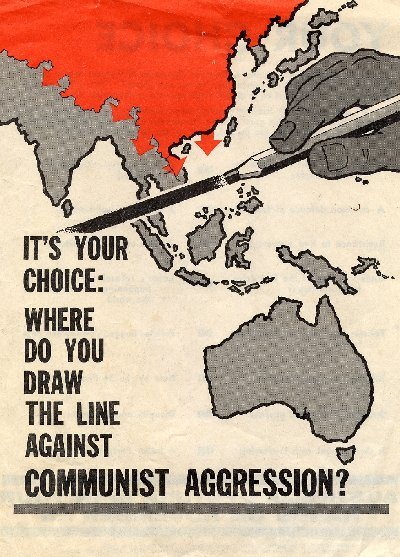
Images like this one refer to what theory about the spread of Communism in Asia (China, Korea, Vietnam)?
The Mar$hall Plan
The Domino Theory
Proxy Wars
Flexible Response

Why did the US adopt the motto in God We Trust in 1956?
to honor the financial and social contributions of religious organizations
to distinguish this nation from countries that restricted religious practices
to commemorate the social struggles uncovered by Christian leaders
to encourage growth of religious institutions throughout the country
The U.S. got involved in Korea and Vietnam because of what foreign policy?
containment
Good Neighbor policy
isolationism
Roosevelt Corollary

Which of these is an effect rock and roll had on society in the U.S. in the 1950's?
it reminded people of prewar days
contributed to a cultural divide between generations
it increased the fear of communist expansion
promoted values learned during the time of economic harship

Jonas Salk created a vaccine for what disease?
measles
mumps
meningitis
polio
How has the development of satellite technology affected the U.S. economy?
resulting in increased private funding of research institutions
increasing efficiency in telecommunications
enabling transoceanic air travel
facilitating the development of technologies that improve fuel efficiency

Which statement best summaries the primary goal of NATO?
to bring greater equality to the economics in Europe
to halt the spread of communist aggression in Asia
to aid those trying to flee communist oppression in Europe
to unite Western Europe in response to the thread of communist aggression

The term McCarthyism is sometimes used to describe
removing members of Congress
investigating civil service employees for corruption
using illegal means to obtain evidence in criminal trials
accusing people of subversive activities without sufficient evidence

Which couple was the first in American history to be given the death penalty (electrocution) for espionage?
JayZ & Beyonce
Bonnie & Clyde
Julius & Ethel Rosenberg
Tupac & Jada
Which statement explains how the Truman Doctrine guided U.S. foreign policy in Europe following World War II?
The United States provided financial aid to noncommunist governments fighting communist rebels
The United States divided countries and cities recovering from the war into zones occupied by international forces.
The United States established satellite governments in countries that share borders with the Soviet Union.
The United States boycotted international events held in countries allied with the Soviet Union.
What were the Marshall Plan and Truman Doctrine intended to do?
prevent a nuclear arms race
halt the spread of communism
help Asian countries recover from war
support former European colonies
“The free peoples of the world look to us for support in maintaining their freedoms. If we falter in our leadership, we may endanger the peace of the world—and we shall surely endanger the welfare of our own nation.” – President Harry Truman, speech to Congress, 1947
What policy does this represent?
Limitation of Arms
Collective Security
Containment of Communism
Mutually assured destruction
What title best fits this timeline of events?
- 1946- Communist government established in Albania
- 1947- Truman Doctrine announced
- 1948- Berlin Airlift begins
- 1949- NATO formed
- 1950- Korean War begins
Effects of the Marshall Plan
Developments of the early Cold War
Impacts of the Manhattan Project
Causes of the Cuban Missile Crisis
What was the purpose of the Bay of Pigs invasion?
overthrow Cuba's communist governments
Remove Soviet missiles that had been positioned in Cuba
Enforce a trade embargo on imports of Cuban sugar
Rescue Cubans who wanted to escape to the US
How did the Bay of Pigs incident and the Cuban Missile Crisis impact the Kennedy Administration?
The administration was praised for protecting the US against communism
The administration was humiliated as neither of these events were successful in overthrowing Fidel Castro
Kennedy was removed from office for spying of Cuba
These events did not impact the Kennedy administration at all
Which organization was created to disrupt communist expansion?
KGB
CIA
FCC
CSI
Which phrase best characterizes the central conflict of the Cold War?
monarchy vs democracy
intervention vs isolationism
ancient cultures vs modern cultures
free market economies vs command economies


