
Font size
 Worksheets
Section 1.9 - 2.6 Review
Total questions: 96
Worksheet time: 5hrs 56mins
f(1) = -3
f(2) = -2
f(-1) = 2
f(3) = -1
f(x)=2x-2


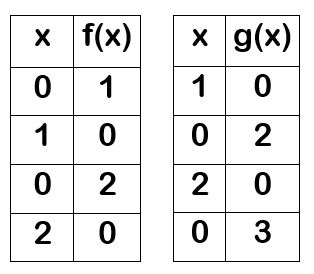
What is the best description?
They are both functions, but not inverse functions.
They are reflected over y=x, but they are not both functions.
They are not reflected over y=x, and they are not both functions.
They are inverse functions.
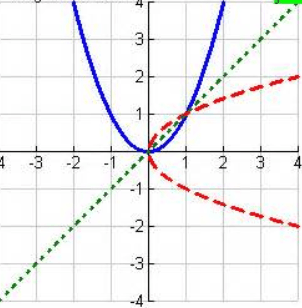
What's the best description?
They are both functions, but not inverse functions.
They are reflected over y=x, but they are not both functions.
They are not reflected over y=x, and they are not both functions.
They are inverse functions.
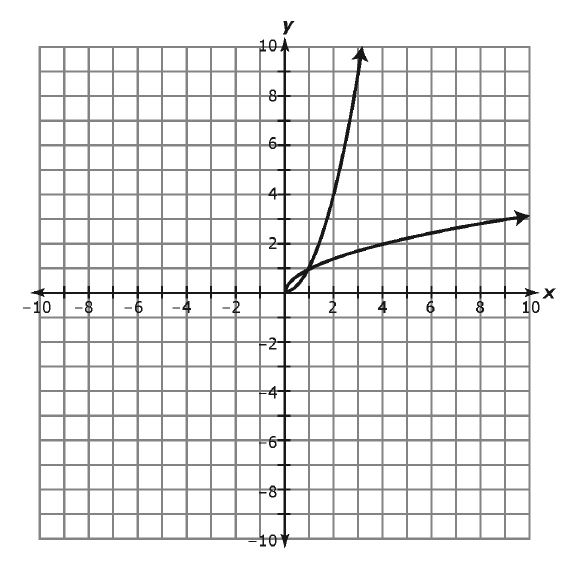
What's the best description?
They are both functions, but not inverse functions.
They are reflected over y=x, but they are not both functions.
They are not reflected over y=x, and they are not both functions.
They are inverse functions.
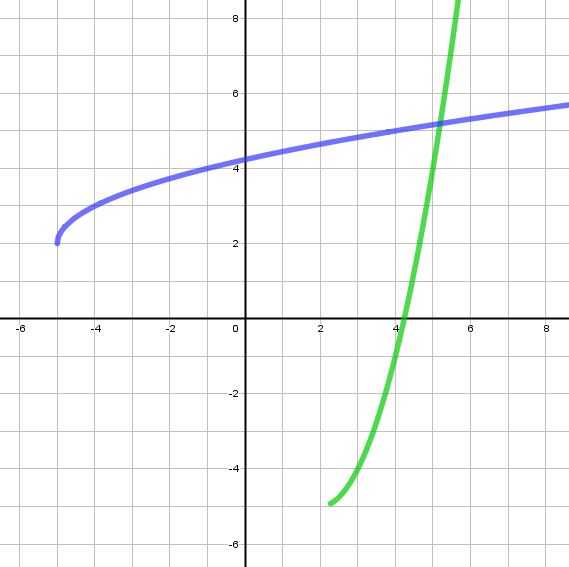
What is the best description?
They are both functions, but not inverse functions.
They are inverse functions.
They are reflected over y=x, but they are not both functions.
They are not reflected over y=x, and they are not both functions.

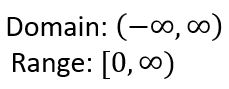
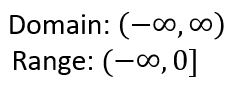
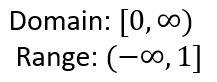
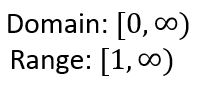
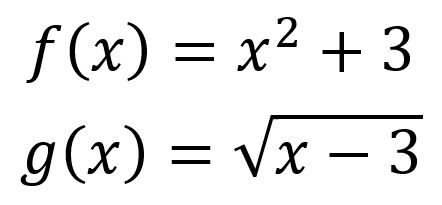
How must the domain of f(x) be restricted such that g(x)=f-1(x) ?
x ≤ 0
x ≥ 0
x ≤ 3
x ≥ 3
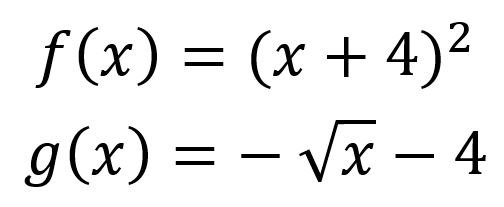
How must the domain of f(x) be restricted such that g(x)=f-1(x) ?
x ≤ -4
x ≥ -4
x ≤ 0
x ≥ 0
g(x) = x - 2
Find (f∘g)(0)


vertex: (4, -2)
point: (0,-6)
opens down
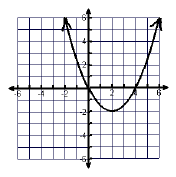
y=4x2-8x+9


f(x) = -x2 - 4x + 12.

f(x)= (x +1)2 + 5

to
g(x) = -3x2
Vertical line through the vertex, about which the parabola is symmetric.
x-intercept
Parabola
y-intercept
Axis of symmetry

Which statement about the graph is FALSE?
The vertex is also a zero of the function
The y-intercept is (0, -2)
The axis of symmetry is x = 2
The range is y ≥ 0

State the domain and range.
Domain: All real numbers, Range: y ≥ -9
Domain: All real numbers, Range: All real numbers
Domain: x ≥ -8, Range: y ≥ -9
Domain: x ≥ -8, Range: All real numbers
f(x) = 2x3 - 3x2 + 4x -10
What is the degree of f(x)?
3
2
1
0
f(x) = 2x3 - 3x2 + 4x -10
State the maximum and minimum number of zeros for f(x).
Max: 3 Min: 0
Max 2 Min: 0
Max: 1 Min: 1
Max: 3 Min: 1
f(x) = -3x4 + x3 - 2x2 + x - 1
State the maximum and minimum number of zeros for f(x).
Max: 4 Min: 1
Max: 3 Min: 0
Max: 4 Min: 0
Max: 3 Min: 1
f(x) = x3 - 3x2 - 4x
Find the zeros of f(x).
{-4, 0, 1}
{-1, 4}
{-1, 0, 4}
{-4, 1}
f(x) = 2x3 - x2 -x
Find the zeros of f(x).
{-½, 1}
{-1, 0, ½}
{-1, 0, 2}
{-½, 0, 1}
f(x) = x4 - 7x3 + 10x2
Find the zeros of f(x).
{0, 2, 5}
{0, 5}
{-4, 0, 2}
{0, 5/3, 2}
f(x) = x3 - 9x2 - 45x - 27
Find the remaining zeros given that -3 is a zero of f(x).
{-3, -6 ± 3√5}
{-3, 6 ± 3√5}
(-3, 3, 9}
{-3, 0, 3}

Write a polynomial function with the given zeros.
A
B
C
D


How many relative extrema are in the picture?
2
3
4
5
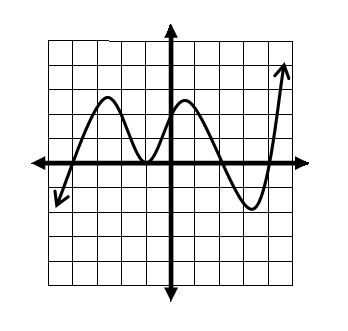

What are the zeros of the polynomial function?
y = (x + 2)(x - 7)3
-2, 7 multiplicity 3
-2, 7, 3
2, -7 multiplicity 3
2, -7, 3
Odd Multiplicities have which of the following effects on the x-axis?
Cross the x-axis
Tangent to the x-axis

Given
f(x) = 10x2(2x−2)3(x2+3) ,
what is the multiplicity of x=0 ?
10
3
2
0
Given f(x) = (2x +6)7(x−3)4 ,
what is the multiplicity of the root x=−3 ?
7
2
6
4
At the root x=1 on f(x) = (3x+3)7(6x−6)2(x2+1) the graph...
Bounces off of y=0 like a parabola
Passes through y=0 like a line
Passes through y=0 like a "wave"
x=1 is not a root
Which graph represents f(x) = −3x(x−1)2(x+3)3 ?


Based on the end behavior which option best describes the leading term?
Remember to look at your roots, multiplicity, and end behavior!!
Use your notes!
negative coefficient, even degree
negative coefficient, odd degree
negative degree, odd coefficient
negative degree, even coefficient

solve using long division
2x2 - x + 1 + 9/(x-2)
2x3 - x2 + x + 9
2x2 - x + 10
x2 - 2x + 1

solve using long division
x - 7
x2 - 7
x + 7
x2 + 3x - 54

solve using long division
x + 5 + (2/2x - 4)
x - 8
x - 5 + (3/2x - 4)
x + 5
(3 + 2i) + (4i + 6)
(4 + 7i) - (3 + 2i)
-3i(4 + 2i)
(2 - 3i)(5 + 4i)

(-7+6i)2
49+36i
85
13-84i
13+84i

Simplify
(-10+6i)/17
(1+50i)/61
(-23+36i)/25
(-21+33i)/34


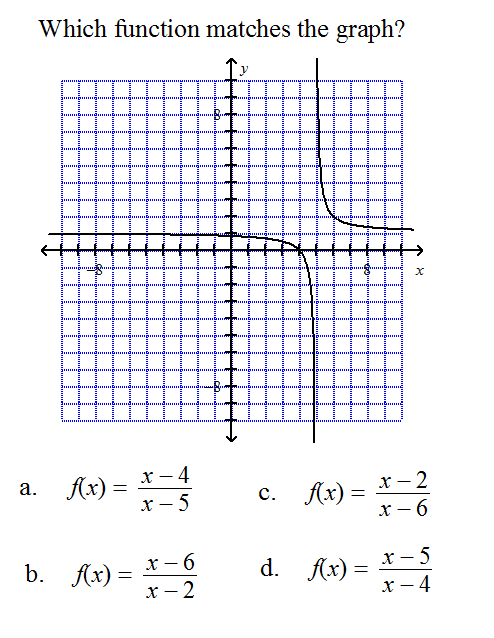

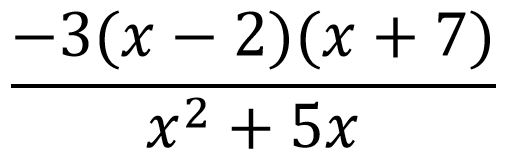


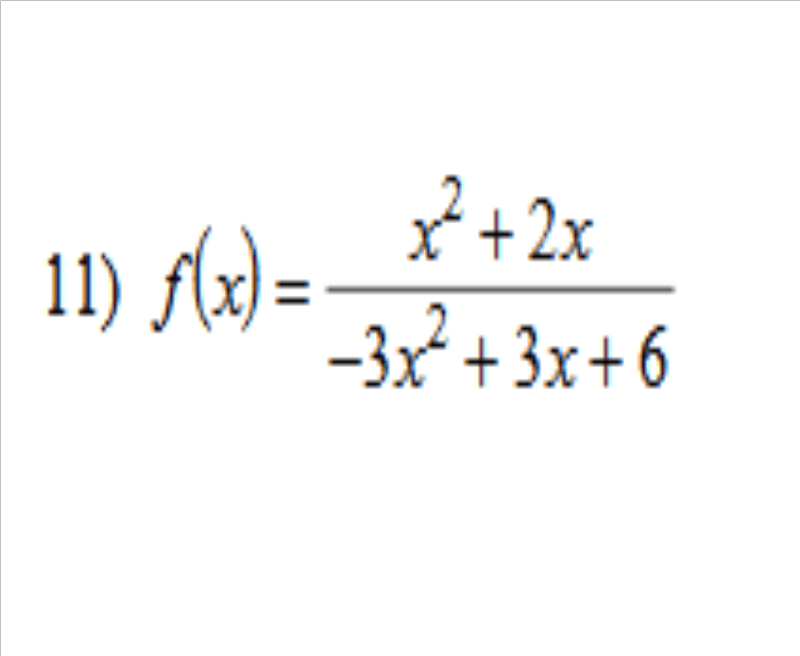

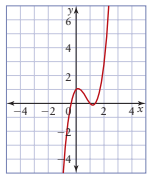
Which of the following could be a possible equation for the function shown?
f(x) =-2x3 + x2 - 5x + 1
f(x) = 2x3 - 4x2 + x + 1
f(x) = 3x2 + 5x + 1
f(x) = -2x3 +3x - 1
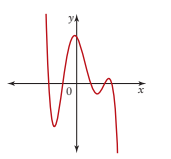
State the minimum degree of the function shown:
3
4
5
6
Select all the graphs which show even degree functions.
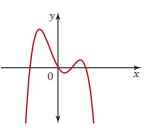
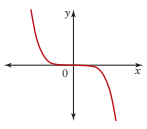
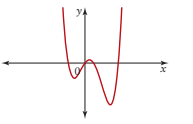
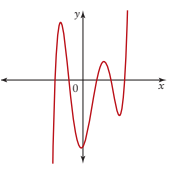
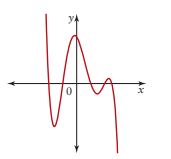
Which of the following functions could represent the graph shown?
f(x) = -2x5
f(x) = -2x4 + 7x3 + 3x2 -5x + 8
f(x) = 2x5 + 3x4 - 3x3 + 5x2 - 3x + 4
None of these functions could represent the graph shown.
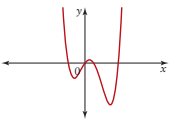
Which description best matches the function shown:
Odd degree with positive leading coefficient.
Even degree with positive leading coefficient.
Degree three, with negative leading coefficient.
Degree four, with negative leading coefficient.

Select all the even degree functions.
A
B
C
D

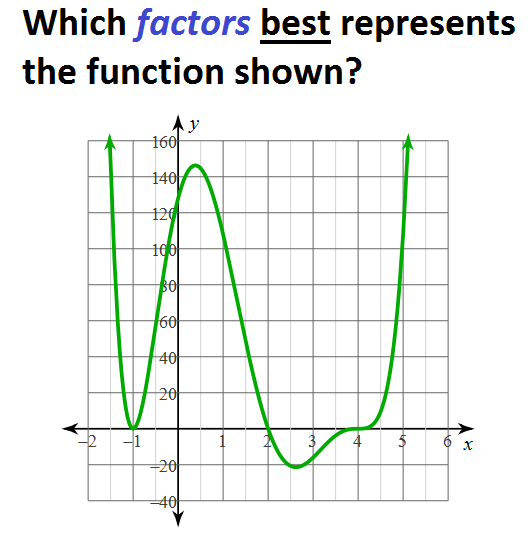

What's the horizontal asymptote of the function?
y = 0
No horizontal asymptote
y = 1/2
y = 1

What's the vertical asymptote of the function?
x = 5
x = 0
x =5 , x = -5
x = 25


