wayground logo

Free Printable Worksheets

Font size

S
M
L
XL
Worksheets

Unit 9H Quiz 2 - Catalysts

Total questions: 23

Worksheet time: 21mins

Name
Class
Date
1.

How does a catalyst work in speeding up a reaction?

a)

By lowering the activation energy or reaction

b)

by giving them more energy

c)

by making them more available

2.
The following graph shows two different reaction pathways for the same overall reaction at the same temperature. Which pathway is slower and why?
a)
Red, because the activation energy is larger
b)
Blue, because the activation energy is lower
c)
both reaction progress at the same rate
3.
What is the rate of reaction?
a)
How fast a reaction is 
b)
How big a reaction is
c)
How loud a reaction is
d)
How much gas a reaction produces
4.

The minimum amount of energy needed for colliding particles to react is called

a)

Chemical Energy

b)

Kinetic Energy

c)

Activation Energy

d)

Potential Energy

5.
A ______________ is a substance that increases the rate of a reaction without being used up during the reaction. 
a)
catalyst
b)
product
c)
reactant
d)
solute
6.
Catalysts permit reactions to proceed along a ___________energy path.
a)
lower
b)
higher
7.
A catalyst increases the efficiency of collisions between reactants.
a)
true
b)
false
8.

In a chemical reaction, how quickly or slowly reactants turn

into products is called the

a)

Catalyst

b)

Reaction Rate

c)

Concentration

d)

Temperature

9.

What is the name given to a catalyst in the human body?

a)

Biology

b)

Catalyst

c)

Chemical

d)

Enzyme

10.

What happens to an enzyme when it denatures?

a)

The activation energy of the reaction is doubled.

b)

The activation energy of the reaction is lowered.

c)

It's optimal conditions for temperature of the enzyme are doubled.

d)

The shape of the enzyme molecule is changed.

11.

Most enzymes are composed of .....

a)

Lipids

b)

Carbohydrates

c)

Proteins

d)

Nucleic Acids

12.

Enzymes in your body probably work best at which of the following temperatures>

a)

25oC

b)

98oC

c)

37oC

d)

210oC

13.
What is the purpose  of an enzyme?
a)
give permission for the reaction
b)
raise activation energy
c)
speed up reactions
d)
control how many reactions occur
14.
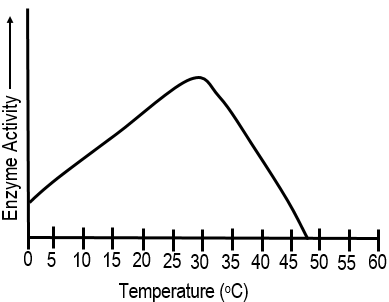
Based on the graph, what is the optimal temperature for this enzyme? 
a)
15oC
b)
40oC
c)
30oC
d)
35oC
15.
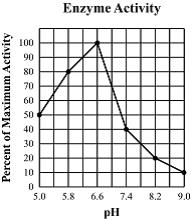
Which of the following conclusions can be drawn from this graph?
a)
The optimum pH of the enzyme is 6.6.
b)
The optimum pH of the enzyme is 5.8
c)
The enzyme’s activity increases as pH increases 5.0 to 9.0
d)
The enzyme’s activity is greater around pH of 8.0 .
16.
What happens when enzymes are heated to a high temperature?
a)
The enzymes die.
b)
The shapes of the enzyme are altered denature
c)
The enzymes' amino acid sequence changes.
d)
The enzymes remain the same
17.
What is another name for enzymes?
a)
chemical catalysts
b)
microorganisms
c)
biological catalysts
d)
inorganic catalysts
18.
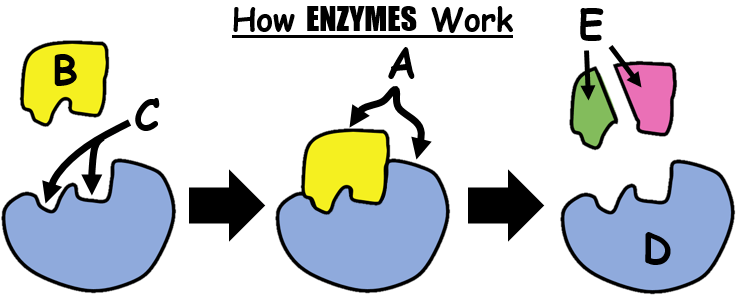
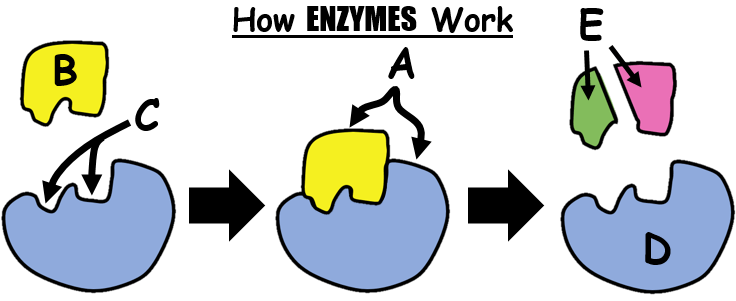
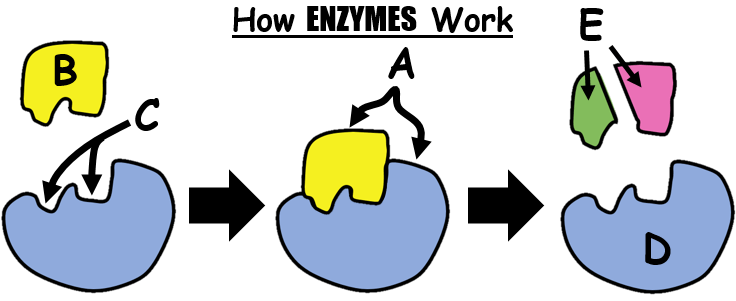
Letter D...
a)
active site
b)
enzyme
c)
substrate
d)
products
19.
Letter B...
a)
active site
b)
enzyme
c)
substrate
d)
products
20.
Letter C...
a)
active site
b)
enzymes
c)
substrate
d)
products
21.
Letter E...
a)
active site
b)
enzyme
c)
substrate
d)
products
22.
Any substance that is acted upon by an enzyme is called a(n)?
a)
Coenzyme
b)
Substrate
c)
Vitamin
d)
Polypeptide
23.

Which 2 factors can affect the rate of enzyme activity?

a)

Light intensity

b)

Temperature

c)

pH

d)

Oxygen concentration