
 Worksheets
EA5: Homework week ending 3.1.20
Total questions: 50
Worksheet time: 2hrs 32mins
Name
Class
Date
1.
Which statement is true about the fossil record?
a)
It is a record of all living things
b)
It shows how our climate has remained the same over time
c)
It provides evidence for history of life on Earth
d)
It does not support the theory of evolution
2.
An organism that no longer exists on Earth is called
a)
Decayed
b)
Evolved
c)
Extinct
d)
Preserved
3.

What type of fossil is this?
a)
Mold
b)
Cast
c)
Preserved remains
d)
Trace fossil
4.

What type of fossil is this?
a)
Trace fossil
b)
Mold
c)
Cast
d)
Carbon film
5.

What type of fossil is this?
a)
Mold
b)
Cast
c)
Preserved remains
d)
Petrified
6.

What is the correct order of the rock layers from oldest to youngest?
a)
B, C, D, E, A
b)
A, B, C, D, E
c)
E, D, C, B, A
d)
B, C, D, A, E
7.

What is the correct order of the rock layers from oldest to youngest?
a)
F, E, C, B, A, D
b)
A, B, C, D, E, F
c)
F, E, D, C, B, A
d)
D, F, E, C, B, A
8.
Fossils are usually found in
a)
igneous rock
b)
extrusions
c)
intrusions
d)
sedimentary rock
9.

Which of the following is NOT an example of a fossil?
a)
a petrified dinosaur bone
b)
a footprint captured in mud
c)
a seashell found on the beach
d)
an insect stuck in amber
10.
Which of the following is NOT something you could learn from a fossil?
a)
The size of the animal
b)
What the animal ate
c)
The color of the animal
d)
Where the animal lived
11.
In order for a fossil to form, which of the following events must happen FIRST?
a)
Slowly, minerals in the water replace the bone.
b)
Sediment covers the bone.
c)
An animal dies.
d)
The bone is no longer a bone, but a rock copy.
12.

Why don't we know what many ancient plants looked like?
a)
They had too many soft parts.
b)
They were all eaten by dinosaurs.
c)
There weren't ancient plants.
d)
They had too many hard parts.
13.
Where can the oldest layer be found?
a)
The top layer
b)
The middle layer
c)
They are all the same age
d)
The bottom layer
14.
How are fossils created?
a)
Traces of organisms get turned into stone.
b)
Dead organisms are quickly buried for millions of years.
c)
Animals get trapped.
d)
All of the above
15.

Which fossil layer is the youngest?
a)
A. Layer A
b)
B. Layer B
c)
C. Layer C
d)
D. Layer D
16.
The Law of Superposition helps scientists to determine what?
a)
The absolute age of rock layers
b)
The age of fossils
c)
The relative age of rock layers
d)
the super powers of rocks
17.

Look at the diagram, what layer did animal E first show up in?
a)
Layers #4
b)
Layers #5
c)
Layers #6
d)
Layers #7
18.
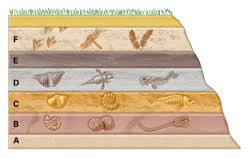
Which rock layer contains the newest fossils?
a)
F
b)
E
c)
B
d)
C
19.
What is hardened tree sap called?
a)
coprolites
b)
index fossils
c)
gastroliths
d)
amber
20.

Which layer formed first?
a)
Rock Layer W
b)
Rock Layer X
c)
Rock Layer Y
d)
Rock Layer Z
21.

What kind of fossil is this?
a)
Mold Fossil
b)
Cast Fossil
c)
True Form Fossil
d)
Trace Fossil
22.

What kind of fossils are these?
a)
Mold fossils
b)
Cast fossils
c)
True Form fossils
d)
Trace fossils
23.
Footprints, nests, and eggs are all examples of what kind of fossils?
a)
Mold fossil
b)
Cast fossil
c)
Trace fossil
d)
True Form fossil
24.
What can NOT become a fossil?
a)
plants
b)
animals
c)
soft body parts
d)
rocks
25.
Which animal part would MOST LIKELY form a fossil?
a)
fur
b)
lung
c)
bone
d)
muscle
26.
People who study fossils are called ____.
a)
meterologists
b)
fossilologists
c)
paleontologists
27.

Which of the following is NOT an example of a fossil?
a)
a petrified dinosaur bone
b)
a footprint captured in mud
c)
a seashell found on the beach
28.
What is hardened tree sap?
a)
coprolites
b)
index fossils
c)
gastroliths
d)
amber
29.
Which is NOT a type of fossil?
a)
carbon film
b)
mold or cast
c)
sediment
d)
petrified wood
30.
Aa, DD, bB, yy are all examples of
a)
genotypes
b)
phenotypes
31.
AA and Aa always show up as
a)
dominant
b)
recessive
32.
Which of the following genotypes is homozygous dominant?
a)
A
b)
Aa
c)
AA
d)
aa
33.
Which of the following genotypes is heterozygous?
a)
Bb
b)
BB
c)
bb
d)
B
34.
Which of the characteristics is a lion least likely to pass on to its offspring?
a)
fur color
b)
length of tail
c)
scars on leg
d)
body size
35.
In a heterozygous genotype, the ___________ allele takes over in the phenotype.
a)
recessive
b)
dominant
c)
lower case letter
d)
both
36.
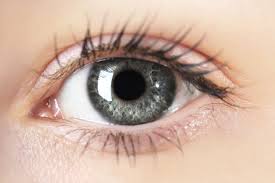
What you see, or the physical appearance.
a)
Genotype
b)
Phenotype
c)
Homozygous
d)
Heterozygous
37.
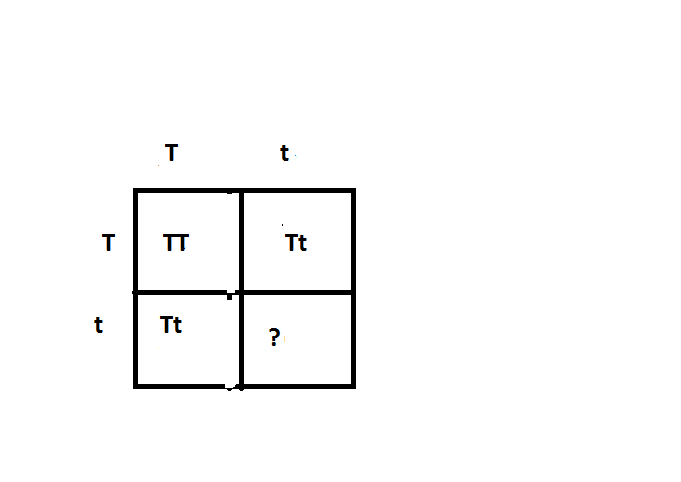
T - tall and t = short
In the punnett square below, what belongs in the missing square
In the punnett square below, what belongs in the missing square
a)
tt
b)
Tt
c)
Bb
d)
TT
38.
B = brown eyes
b = blue eyes
What is true about these two brothers that have brown eyes?
One has genotype BB the other Bb.
b = blue eyes
What is true about these two brothers that have brown eyes?
One has genotype BB the other Bb.
a)
they have same phenotype and genotype
b)
they have different genotypes and phenotypes
c)
they have same phenotype but different genotypes
d)
they have same genotype but different phenotypes
39.
Which of the following is a phenotype?
a)
Aa
b)
red hair
c)
heterozygous
d)
DNA
40.
Which of the following is homozygous recessive?
a)
Tt
b)
tt
c)
TT
d)
T
41.
Homozygous is when...
a)
the alleles are the same
b)
the alleles are different
c)
the alleles are absent
d)
the alleles are present
42.
Heterozygous is when...
a)
the alleles are the same
b)
the alleles are different
c)
the alleles are absent
d)
the alleles are present
43.

B = brown fur b = white fur
In the punnett square, what is the probability for white fur?
In the punnett square, what is the probability for white fur?
a)
0%
b)
25%
c)
50%
d)
75%
44.

In the punnett square shown, what must the genotype of the missing parent be?
a)
BB
b)
Bb
c)
bb
d)
Tt
45.
Which of the following is a phenotype?
a)
Aa
b)
black hair
c)
heterozygous genes
d)
mutated DNA
46.
Dominant or recessive?
tt
tt
a)
Dominant
b)
Recessive
47.
A characteristic that an organism can pass on to its offspring through its genes is ___________
a)
Trait
b)
Gene
c)
Allele
d)
Dominant
48.
An organism’s genetic makeup or allele combination.
a)
Genotype
b)
Phenotype
c)
Beanotype
d)
Notype
49.
Punnett squares can be used to predict the probability of:
a)
being exposed to a contagious disease and contracting it
b)
having an inherited disease or a genetically determined physical trait
c)
Both
50.

In a certain species of plant, the color purple (P) is dominant to the color white (p).
According to the Punnett Square, what is the probability of an offspring being purple?
According to the Punnett Square, what is the probability of an offspring being purple?
a)
25%
b)
0%
c)
100%
d)
50%
100 %

