wayground logo

Free Printable Worksheets

NEW

Font size

S
M
L
XL
Worksheets

Earth, Sun, and Moon

Total questions: 43

Worksheet time: 49mins

Name
Class
Date
1.

In a single day, the

a)

Earth revolves around the Sun

b)

Earth rotates on its axis

c)

Moon revolves around the Earth

d)

Sun rotates on its axis

2.

In a single day, the

a)

Earth revolves around the Sun

b)

Earth rotates on its axis

c)

Moon revolves around the Earth

d)

Sun rotates on its axis

3.

The time it takes the Earth to make a complete rotation on its axis is -

a)

one year

b)

one month

c)

one week

d)

one day

4.

It takes an entire year for the -

a)

Earth to rotate on its axis

b)

Earth to revolve around the Sun

c)

Moon to revolve around the Earth

d)

Sun to revolve around the Earth

5.

The time it takes the Earth to completely revolve around is

a)

one year

b)

one month

c)

one week

d)

one day

6.

The four seasons occur in -

a)

one year

b)

one month

c)

one week

d)

one day

7.

What causes the four seasons?

a)

The revolution of the moon around the Earth

b)

The revolution of the Earth around the Sun and position of its axis

c)

The revolution of the Sun around the earth

d)

The rotation of your body when you sit on a spinning chair

8.

Every day...

a)

the moon completely revolves around the Earth

b)

the sun rotates on its axis

c)

tides rise and fall

d)

the seasons change

9.

It takes just about a month for the moon to -

a)

completely revolve around the Earth

b)

travel to Earth

c)

leave its orbit

d)

revolve around the Sun

10.

If you saw a full moon today, how long would you have to wait to see another full moon?

a)

One day

b)

One week

c)

One month

d)

One year

11.

When the earth casts a shadow on a full moon, it is called a -

a)

Moon shadow

b)

Solar Eclipse

c)

Lunar Eclipse

d)

Rude

12.

When the moon completely blocks our view of the sun, it is called...

a)

a lunar eclipse

b)

a super moon

c)

a Solar eclipse

d)

Solar flare

13.

The dark spots on the moon are called...

a)

Blemishes

b)

Marias

c)

Oceans

d)

Craters

14.

The sun...

a)

rises in the east, sets in the west

b)

rises in the west, sets in the east

c)

rises in the north, sets in the south

d)

rises in the south, sets in the north

15.

Seasons are caused by...

a)

The moon

b)

The rotation of the Earth

c)

Giant heat lamps

d)

The position of the earth and the tilt of its axis

16.

What characteristics do the moon and earth NOT share?

a)

craters

b)

oceans

c)

rocks

d)

mountains

17.

"The Sun is a mass of...."

a)

hot stuff

b)

incandescent gas

c)

giant torches

d)

flamable liquid

18.

One Earth revolution around the sun equals

a)

one month

b)

one week

c)

one day

d)

one year

19.

Which is the hottest planet?

a)

Mercury

b)

Venus

c)

Mars

d)

Jupiter

20.

The star at the center of our solar system is called

a)

the Moon

b)

the Sun

c)

the Andromeda

d)

Beetlejuice

21.

What causes wind on Earth?

a)

Hot gases

b)

The Earth's rotation

c)

The Earth's revolution

d)

Uneven heating of the Earth's surface by the Sun
22.
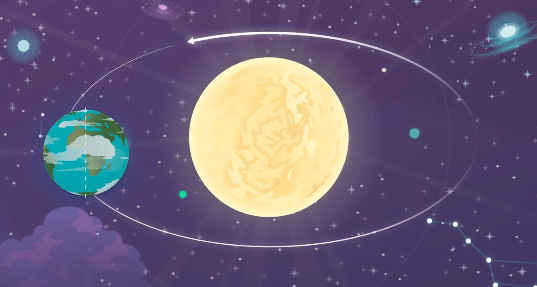
How long does it take for the Earth to make one full orbit around the Sun?
a)
one day
b)
one week
c)
one month
d)
one year
23.
The Earth is rotating on its axis, creating _____
a)
the 12 months
b)
the years
c)
the seasons
d)
day and night
24.
As the Earth travels around the Sun, it creates a pattern that makes _____
a)
the months
b)
the years
c)
the seasons
d)
day and night
25.
When the Earth completes a full orbit around the Sun, it has completed _____ rotations or days
a)
7
b)
30
c)
91
d)
365
26.
What looks to be the motion of the Sun in the sky is really caused by the motion of _____
a)
the Earth
b)
the stars
c)
the planets
d)
the Earth's axis
27.
The spinning movement of the Earth about its axis is called the Earth's _____
a)
revolution
b)
rotation
c)
precession
d)
orbit
28.
The movement of the Earth around the Sun is called its _____
a)
revolution
b)
rotation
c)
precession
d)
gyration
29.
When the part of the world that you're living in is leaning towards the Sun, its _____
a)
winter
b)
spring
c)
summer
d)
fall
30.
When the part of the world that you're living in is leaning away from the Sun, its _____
a)
winter
b)
spring
c)
summer
d)
autumn
31.
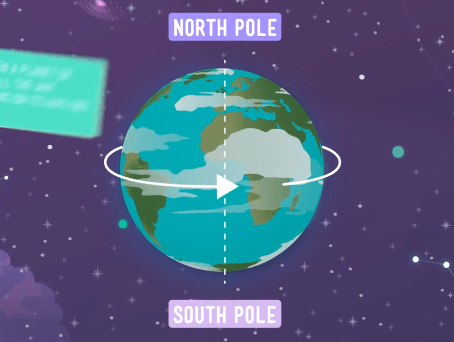
The invisible line that passes through the North Pole and the South Pole is called Earth's ____
a)
axis
b)
equator
c)
ecliptic
d)
prime meridian
32.
What looks to be the motion of the Sun in the sky is really caused by the motion of _____
a)
the Earth
b)
the stars
c)
the planets
d)
the Earth's axis
33.
The Earth is rotating on its axis, creating _____
a)
the 12 months
b)
the years
c)
the seasons
d)
day and night
34.
The earth's revolution is called an orbit, and we orbit around
a)
The moon
b)
The sun
c)
Earth
d)
Venus
35.
Which happens in one year’s time?
a)
The moon makes one complete revolution around Earth.
b)
Earth makes one complete revolution around the sun.
c)
Earth makes one complete spin on its axis.
d)
The sun makes one complete spin on its axis.
36.
What is the name of the imaginary line running through the North Pole to the South Pole?
a)
orbit
b)
axis
c)
equator
d)
latitude
37.
In order for us to experience day, the side of the Earth we live on must be __________ the Sun.
a)
facing away from the Sun
b)
facing toward
38.
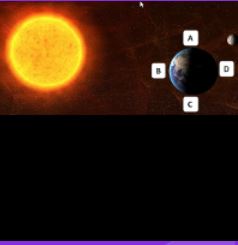
Which part of Earth is experiencing night?
a)
A
b)
B
c)
C
d)
D
39.
In the morning, the Sun is low in the sky and by noon the Sun is much higher in the sky because
a)
the Sun has increased its temperature
b)
Earth has rotated on its axis
c)
the Sun has turned to face the Earth
d)
the Earth has moved closer to the Sun
40.
If the earth rotated slower, how would that affect the length of the day?
a)
longer day
b)
shorter day
c)
same time,  24 hours
41.
The change from day time to night time, and back again, is caused by
a)
the position of the Moon
b)
the movement of the tides
c)
the brightness of the Sun
d)
the rotation of the Earth
42.
a)
A
b)
B
c)
C
d)
D
43.
True or False:
As Earth turns on its axis, stars APPEAR to move across the sky.

a)
T
b)
F