wayground logo

Free Printable Worksheets

Font size

S
M
L
XL
Worksheets

DNA Technology

Total questions: 30

Worksheet time: 15mins

Name
Class
Date
1.

A student performed a gel electrophoresis experiment. The results are represented in the diagram

below. Compared to the fragments at the top of the gel, the fragments at the lower end are

a)

larger, and move slower

b)

larger, and move faster

c)

smaller, and move faster

d)

smaller, and move slower

2.

Gel Electrophoresis is a technique used to separate DNA fragments based on ________.

a)

Size

b)

Number of A's and G's

c)

Animal species

d)

Criminal suspects

3.
Based on these results whose blood was found in the blood stain at the crime scene?
a)
Bob
b)
Sue
c)
John
d)
Lisa
4.
Which is the primary purpose of using restriction enzymes in gel electrophoresis?
a)
It allows the strands of DNA to be cut into various lengths for testing
b)
It restricts the number of base pairs that can be tested in a sample
c)
It makes the testing simpler by moving the strands into the gel faster
d)
It charges the DNA strands
5.
DNA fingerprinting works because
a)
Most genes are dominant
b)
Most people have DNA that contains repeats
c)
The most important genes are different among most people
d)
No two people, except identical twins, have exactly the same DNA 
6.
Which two bear species are most closely related?
a)
Bear 1 and Bear 2
b)
Bear 1 and Bear 3
c)
Bear 2 and Bear 3
d)
There’s no way to tell
7.
The purpose of selective breeding is to 
a)
Get bigger animals
b)
get smaller animals
c)
create animals with desirable traits
d)
create animals with bad traits
8.
What is NOT a reason to genetically modify plants? 
a)
To make the plants poisonous to insects
b)
Make plants drought resistant 
c)
To produce fewer plants
d)
Improve the nutrition of food grown
9.

What is a good argument for genetically modifying animals?

a)

Produce more meat

b)

Figure out how to make Spiderman

c)

Modifying your kids to make them more awesome

d)

New genes are needed to create new species

10.
Which of the following is NOT used in cloning? 
a)
Egg cell
b)
Somatic cell
c)
Sperm cell
d)
Surrogate 
11.
In cloning, what is the purpose of the surrogate mother? 
a)
Donate her DNA
b)
Donate her egg cell
c)
Incubate and carry the baby until birth
d)
Nothing.  She's useless.
12.
Putting the gene for bioluminescence into a fish is an example of...
a)
Genetic Engineering
b)
Selective Breeding
c)
Artificial Selection
d)
Gene Mutation
13.

It is the transfer of genetic material for the purpose of treating human disease.

a)

chemotherapy

b)

gene therapy

c)

gene transfer

d)

gene editing

14.
Gene therapy is the attempt to
a)
fuse cells taken from different species.
b)
treat disease by changing a patient's DNA.
c)
determine a baby's sex before birth.
d)
provide genes to people who have none.
15.
Which is true about embryonic stem cells?
a)
They no longer divide, their cell type is set and cannot change.
b)
They can develop into only one type of cell.
c)
They can become any cell type in the body.
d)
They are found in adults.
16.

Why is the use of embryonic stem cells controversial?

a)

The embryos are destroyed in the process of extracting the stem cells.

b)

People consider their use as destroying a life.

c)

They are taken from little kids, which is painful.

d)

They are put into a different person.

17.
Mr. Jones was killed in a car accident.  Afterwards, a former girlfriend filed a paternity suit claiming that Mr. Jones was the father of her child, and thus she was entitled to the man’s estate.  Which sample of DNA would have to be from Mr. Jones if he were the child’s father? 
a)
2
b)
3
c)
4
d)
5
18.
Bob was found dead in his home.  Crime scene analysis showed signs of a struggle.  Blood was collected from the crime scene, the victim, and three suspects.  Which suspect likely committed the crime? 
a)
Sue
b)
Lisa
c)
John
d)
None of these
19.
A boy moves to another country to live with his father.  Years later, the boy decides to move back to live with the woman who raised him.  Immigration officials suspected that the boy was the woman’s nephew, not her son, and therefore not legally entitled to residency.  Based on the DNA fragments, is it possible that she is the boy’s mother?
a)
Yes
b)
No
20.

The parents of a new baby believe they brought the wrong child home from the hospital. Gel electrophoresis was performed using DNA samples from the parents and the child. A section of the gel

electrophoresis results is shown below. Which conclusion is valid based on the gel electrophoresis results?

a)

They have the correct child, because her genetic information is identical to that of the father.


b)

They have the wrong child, because her genetic information does not match that of either parent.

c)

They have the correct child, because her genetic information came from both parents.


d)

They have the wrong child, because her genetic information matches only that of the mother.

21.

An argument in favor of food biotechnology is that it

a)

provides foods that cure viral diseases.

b)

provides more food to feed a growing population.

c)

provides a cash crop for low income nations.

d)

biotech foods are not controversial

22.

The process in which a stem cell is assigned its particular cell type and develops the necessary structures

a)

differentiation

b)

translocation

c)

nondisjunction

d)

gene sequencing

23.

The main issue associated with the use of stem cells is

a)

the destruction of embryos

b)

testing that lead to false positives

c)

we have 100 trillion bad genes to be replaced

d)

genetic discrimination by insurance and employers

24.

The main issue associated with mapping the Human Genome

a)

the destruction of embryos

b)

testing that lead to false positives

c)

we have 100 trillion bad genes to be replaced

d)

genetic discrimination by insurance and employers

25.
The main goal of the Human Genome Project (HGP) was to:
a)
Identify the unique parts of each person's DNA.
b)
Identify genes responsible for human diseases.
c)
Identify genes responsible for human behavior.
d)
Determine the entire sequence of human DNA.
26.
What is DNA sequencing?
a)
The total of genes carried by an individual or cell
b)
Coding genes in order to identify single nucleotide polymorphisms
c)
Deciphering the functions of various parts of the human genome
d)
The process of identifying the order of the bases in DNA
27.
Which best describes the impact that the Human Genome Project (HGP) has had on society?
a)
It has helped scientists determine that certain genes can cause diseases 
b)
It has led to discrimination against genetically flawed individuals
c)
It has led to the appearance of new diseases
d)
It has cost society billions of dollars without any major benefits
28.
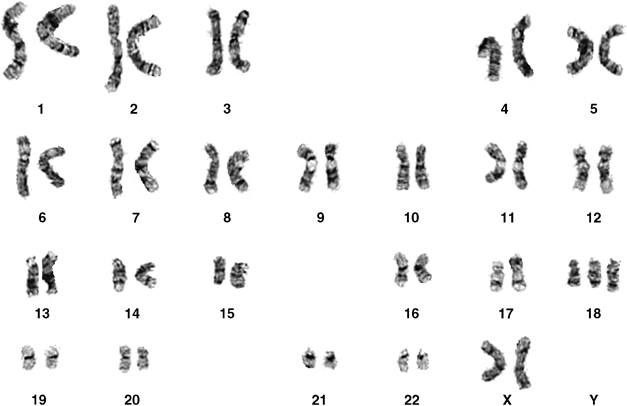
What is the chromosomal condition of the individual whose karyotype is seen in the image?
a)
Monosomy X (Turner's Syndrome)
b)
Trisomy 21 (Down's Syndrome)
c)
Trisomy 13 (Patau Syndrome)
d)
Trisomy 18 (Edwards's Syndrome)
29.

What would you call the failure of one or more pairs of homologous chromosomes or sister chromatids to separate normally during meiosis?

a)

nondisjunction

b)

anaphase I

c)

nondiploidy

d)

karyotype

30.
Determine the sex of the individual whose karyotype is displayed in the image.
a)
female
b)
male