
 Worksheets
Homeostasis
Total questions: 45
Worksheet time: 28mins

What does homeostasis do?
Coordinates body movement through nerve and muscle systems.
Controls growth through electrical impulses.
Controls the internal environment of an organism.
Coordinates the adaptation of organisms to their surrounding environments.
What homeostasis mechanism allows an organism to push an essential process to the finish line by continuing to increase signals?
neutral feedback loop
solar feedback loop
positive feedback loop
negative feedback loop
What homeostasis mechanism allows an organism to balance with it's surrounding environment?
neutral feedback loop
solar feedback loop
positive feedback loop
negative feedback loop
What kind of homeostasis mechanism maintains your body temperature?
negative feedback loop
positive feedback loop
What type of feedback system is illustrated with this example of an increasing response to a stimulus?
When you get cut, your skin cells release hormones that signal platelets to come and stop the bleeding. Platelets then release more hormones that signal even more platelets continuing in this fashion until the cut is closed.
Positive
Negative
What type of feedback system is illustrated with this example of an opposing response to a stimulus?
When you are cold you shiver and your blood vessels contract warming you up. When you are hot you sweat and your blood vessels expand cooling you down.
Positive
Negative
What type of feedback system is illustrated with this example of an increasing response to a stimulus?
When a woman is ready to give birth the release of hormones signal contractions to occur putting pressure on the cervix to widen. This increased pressure on their cervix then releases more hormones that signal even more contractions and puts more pressure on their cervix. It continues in this increasing loop until the baby is born.
Positive
Negative

What cell structure common to ALL LIFE FORMS (plant, animal, bacterial) is responsible for what goes in and out of the cell?
Cell Wall
Cell Membrane
Cytoplasm
DNA

What cell structure present in plants but NOT ANIMALS gives them their rigid shape and protection?
DNA
Protein
Cell Membrane
Cell Wall
What component forms the two layers of the cell membrane?
Carbohydrates
Proteins
Phospholipids
Cholesterol
What term best describe's a cell membrane's ability to allow only certain molecules into or out of the cell?
Semi-permeable
Permeable
Impermeable
Un-permeable
Which of the following molecules are embedded in the phospholipid bilayer of a cell's membrane to help substances pass through?
lipids
proteins
cholesterol
carbohydrates

Which letter refers to the hydrophobic (water hating) region of the cell membrane?
E
B
C
A
What molecule makes up most of the cell membrane?
Phospholipids
Carbohydrates
Proteins
Cholesterol
What molecule allows cells to recognize each other because it acts like an ID tag?
Carbohydrates
Proteins
Phospholipids
Cholesterol

Which letter indicates the part of the plasma membrane responsible for cell recognition?
C
E
B
D

Which molecule is represented by the yellow and brown portion of this image is?
proteins
phospholipids
carbohydrates
cholesterol
Which molecule is represented by the purple/pink regions of this image?
phospholipids
cholesterol
proteins
carbohydrates

Which letter is responsible for getting large molecules across the cell membrane?
E
B
C
D
What does “high concentration” mean?
Spread out
Tightly packed together
Uncrowded
Spacious
Passive transport is termed "passive" because it is an automatic response happening without the necessity for what?
concentration gradients
particles
motion
energy
How do molecules move during passive transport?
from low to high concentration
from high to low concentration
no movement occurs
molecules move everywhere randomly
Which is NOT a form of passive transport?
Osmosis
Facilitated diffusion
exocytosis
Diffusion
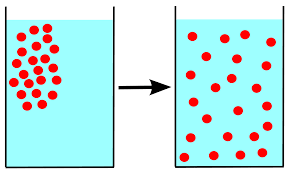
What process is shown in this picture?
facilitated diffusion
isotonic equilibrium
diffusion
active transport
What moves across a membrane during osmosis?
carbohydrates
energy
oxygen
water
How do molecules move during diffusion?
from low to high concentration
from high to low concentration
no movement occurs
molecules move everywhere randomly
How do molecules move during facilitated diffusion?
from low to high concentration
from high to low concentration
no movement occurs
molecules move everywhere randomly
Which type of Passive transport uses the help of a transport protein to maintain balance in homeostasis?
Osmosis
Facilitated diffusion
Diffusion
Active Transport
How do molecules move during osmosis?
from low to high concentration
from high to low concentration
no movement occurs
molecules move everywhere randomly

Which diagram best shows the end result of diffusion?
F
G
H
J
Why is diffusion and osmosis important to cells?
It allows them to take in or release materials without using energy.
It allows them to reproduce and evolve as a species
It allows them to absorb sunlight creating their own food
It allows them to use energy to take in or release materials

Which cell is placed into a hypotonic environment?
A
B
C
D

What will happen to this cell when placed in a hypotonic environment?
swell
shrink
stay the same
change color
Which cell is placed into a hypertonic environment?
A
B
C
D

What will happen to this cell when placed in a hypertonic environment?
shrink
swell
stay the same
change color
Which cell is placed into a isotonic environment?
A
B
C
D

Which way will the water molecules in this diagram move during osmosis?
Out of the cell, so the cell shrinks.
Out of the cell, so the cell swells.
Into the cell, so the cell shrinks.
Into the cell, so the cell swells.
Active transport is termed "active" because it is a movement of particles that only happens with what?
concentration gradients
particles
motion
energy
Which is NOT a form of cell transport using energy (ATP)?
Endocytosis
Osmosis
Exocytosis
Active Transport
How do molecules move during active transport?
high to low concentrations
move randomly, without pattern
remain at high / low concentrations
low to high concentrations
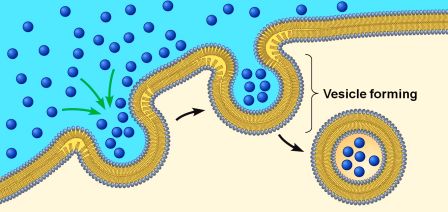
Which form of active transport is being shown?
Facilitated Diffusion
Exocytosis
Endocytosis
Protein Pumps
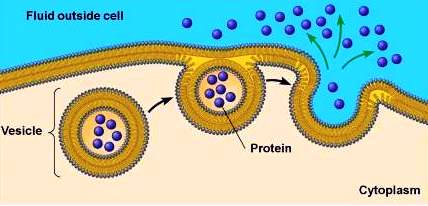
Which form of active transport is being shown?
Facilitated Diffusion
Endocytosis
Exocytosis
Osmosis

What type of transport is this?
Endocytosis
Facilitated Diffusion
Active Transport
Passive Transport
Which form of transport is occurring when cells form a vesicle (container) to take in materials?
Endocytosis
Exocytosis
Facilitated Diffusion
Osmosis
Which type of active transport gets rid of wastes?
Protein Pumps
Endocytosis
Exocytosis
Facilitated Diffusion

