

wayground logo

Free Printable Worksheets

NEW

Font size

S
M
L
XL
Worksheets

Blood & Blood Spatter

Total questions: 47

Worksheet time: 12hrs 45mins

Name
Class
Date
1.

How are you able to determine the height of the perpetrator?

a)

measuring the angle of impact

b)

checking the source of origin

c)

finding the area of convergence

d)

location of the blood spatter

e)

all of the above

2.

What would happen if you gave a person with A blood a type B blood transfusion?

a)

the person could die because the body would see the type B blood as foreign and attack it

b)

nothing, they can accept B blood

c)

the person would laugh uncontrollably and then spit rainbows

d)

all of the above

3.

What is luminol?

a)

a presumptive test to find blood

b)

a chemical that makes blood glow blue if present

c)

a chemical that reacts with iron in hemoglobin

d)

all of the above

4.

If you have the Rh factor then your blood is "positive".

a)

False

b)

True

5.
Which of the following is NOT a component of whole blood?
a)
Red Blood Cells
b)
Spinal Fluid
c)
Plasma
d)
Platelets
6.
Which of the following CANNOT be determined from blood spatter?
a)
Exact Weapon Used
b)
Manner of Death
c)
Velocity
d)
Area of Origin
7.
What type of evidence is blood type?
a)
Individual
b)
Class
c)
Trace
d)
Physical
8.
What blood stain pattern is created or formed by the force of gravity acting alone?
a)
Passive Drop
b)
Low Velocity Impact Spatter
c)
Flow Pattern
d)
Drip Pattern
9.
What blood spatter pattern is seen in the picture?
a)
Transfer/Contact
b)
Swipe
c)
Wipe
d)
Saturation
10.

What blood spatter pattern is seen in the photo?

a)

Wipe

b)

cast-off

c)

Walking Drip

d)

Flow

11.
What bloodstain pattern is created when an object moves through an existing stain, removing or altering its appearance?
a)
Swipe
b)
Walking Drip
c)
Wipe
d)
Contact
12.
What bloodstain pattern is created when blood is released or thrown from a blood-bearing object?
a)
Cast-Off
b)
Walking Drip
c)
Medium Velocity
d)
Void
13.
What type of blood spatter is typically created from a gunshot?
a)
Medium Velocity
b)
High Velocity
c)
Cast-Off
d)
Void
14.
The drop shown above would have more than likely been dropped from an angle of 
a)
90
b)
50
c)
30
d)
10
15.
The following indicates:
a)
cast off
b)
walking drip
c)
splash
d)
medium velocity impact 
16.
The following drops can tell you:
a)

direction  and low impact angle

b)

height of victim

c)

age of victim

d)

shoe type

17.
What pattern of blood spatter is this?
a)
arterial gushes
b)
splash
c)
smear
d)
pool
18.
The lines in the picture are referred to as lines of ___.
a)
convergence
b)
agreement
c)
tangents
d)
credit
19.
Based upon this picture, what test was done to determine whether or not a stain was blood (the picture shows a positive and negative test). 
a)
Kastle-Meyer presumptive blood test
b)
Leukomalachite green presumptive blood test
c)
Luminol presumptive blood test
20.
What would cause medium velocity blood spatter?
a)
Baseball bat
b)
Human hand
c)
Hand grenade
d)
Gunshot
21.
Which letter best shows the convergence point (origin point)?
a)
A
b)
B
c)
C
d)
D
22.
What type of pattern is created when blood is blown out of the nose, mouth, or a wound as a result of air pressure?
a)
Expirated blood pattern
b)
Cast - Off Pattern
c)
High Velocity Pattern
d)
Wipe Pattern
23.
What blood spatter pattern is seen in the picture?
a)
Cast Off
b)
Medium Velocity
c)
Void
d)
High Velocity
24.
A blood droplet has a width of 5 mm and a length of 6 mm.  What is the angle of impact?
a)
90 degrees
b)
56 degrees
c)
65 degrees
d)
46 degrees
25.

Which one of these was dropped from the greatest angle?

a)
1 (top left)
b)
4 (top right)
c)
7 (bottom left)
d)
9 (bottom right)
26.
How does the velocity of impact change the blood stain pattern?
a)
Higher velocity, larger diameter
b)
higher velocity, smaller diameter
c)
lower velocity, smaller diameter
d)
Medium velocity, small diameter
27.
The shape of blood drops is cause by a natural_______________ of blood. 
a)
cohesiveness
b)
satellite drops
c)
adhesiveness
d)
lines of convergence
28.
Blood platelets serve what function?
a)
They produce antibodies to kill bacteria and viruses
b)
They help clot blood and repair blood vessel damage
c)
They carry nutrients and wastes to the proper organs in the body
d)
They carry oxygen adn carbon dioxide to the proper organs in the body
29.
The drop shown above would have more than likely been dropped from an angle of around
a)
90
b)
50
c)
30
d)
10
30.

What blood spatter pattern is seen in the picture?

a)

Medium Velocity

b)

Expirated Blood

c)

Low Velocity

d)

Arterial Spurt

31.
What type of spatter creates the largest blood droplets?
a)
Low velocity impact
b)
Medium velocity impact
c)
High velocity impact
32.

Red blood cells:

a)

carry respiratory gases, mainly oxygen and carbon dioxide.

b)

fight disease and foreign invaders

c)

aid in blood clotting

d)

are involved in repairing damaged blood cells

33.

White blood cells secrete proteins:

a)

known as antibodies, which assist in the immune response.

b)

known as viruses, which assist in the immune response.

c)

known as bacteria, which assist in the immune response.

d)

known as parasites, which assist in the immune response.

34.

Blood typing is less expensive and quicker for analyzing blood evidence than DNA profiling. Since many different people share the same type, this blood evidence is considered to be:

a)

individual evidence.

b)

class evidence.

c)

trace evidence.

d)

biological evidence.

35.

Each blood type is determined by:

a)

a DNA reaction test.

b)

an antibody reaction test.

c)

a protein reaction test.

d)

a RF factor reaction test.

36.

A and B proteins are found on the surface of some red blood cells. If a person’s blood contains both the A and the B proteins, then he or she has:

a)

type A blood.

b)

type B blood.

c)

type AB blood.

d)

type O blood.

37.

What term describes the clumping of red blood cells?

a)

agglutination.

b)

antigens.

c)

eosinophil.

d)

Lymphocyte.

38.

Which type of bloodstain pattern suggests that bloody hair was dragged across the floor?

a)

wipe.

b)

arterial gush.

c)

swipe.

d)

transfer pattern.

39.

As the angle of impact gets smaller, what happens to the tail?

a)

Gets longer

b)

Gets shorter

c)

Stays the same

40.

As blood drops from increasing heights, what happens to the size of the blood stain?

a)

Gets larger.

b)

Gets smaller.

c)

Stays the same size.

41.

The pointed end of a bloodstain always faces:

a)

toward the position of the blood source.

b)

in its direction of travel.

c)

opposite its direction of travel.

d)

toward the direction from which the force came.
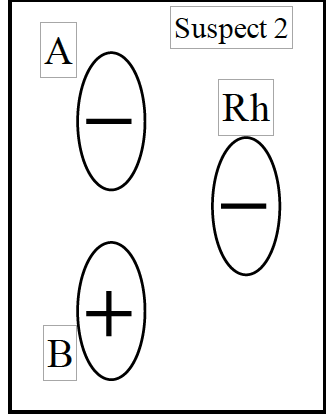
42.

What is suspect 2's Blood Type?

a)

A-

b)

B-

c)

A+

d)

B+

43.
What is the study of bodily fluids called?
a)
toxicology
b)
serology
c)
physiology
d)
histology
44.
Blood cells that have A antigen proteins are called
a)
Type A
b)
Type B
c)
Type AB
d)
Type O
45.
What component of RBCs carry oxygen?
a)
Hemoglobin
b)
Platelets
c)
Antibodies
d)
Antigens
46.

The arrow is pointing to a

a)

satellite

b)

spine

c)

parent drop

47.

The arrow is pointing to a

a)

satellite

b)

spine

c)

parent drop
