
NEW
Font size
 Worksheets
Just the Facts Test 1: Protest & Patriotism 2020
Total questions: 11
Worksheet time: 24mins
The major goal of the foreign policy of "containment" during the Cold War was to
surround a country with a Navy
attack any communist country
stop the spread of communism
place missiles in Cuba
When did the Berlin Wall fall, symbolizing the end of the Cold War?
November 9, 1989
June 26, 1963
December 7, 1941
August 6, 1945
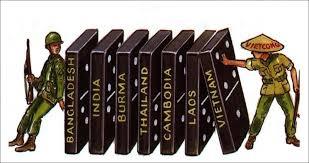
Containment policy was used in Southeast Asia during the Cold War. What is the idea that if South Vietnam, or later South Korea, fell to communism, other nations would soon follow...
Vietnamization
Communism
Domino Theory
Imperialism
What was the conflict between the United States and the Soviet Union that was a struggle between their ideologies of democracy and communism?
World War II
The Cold War
The Marshall Plan
Spanish American War
This Supreme Court case established students have a first amendment right to freedom of SPEECH as long as it doesn't cause a disruption.
Brown v. Board of Education, Topeka Kansas
Tinker v. DesMoines
Plessy vs Ferguson
Gideon v Wainwright
What was one result of Lyndon B. Johnson's domestic policy, called the Great Society?
Poverty was eliminated forever in the United States.
the lives of many underprivileged Americans improved.
President Johnson's popularity plummeted.
The federal government shrank considerably.
What was one of the significant effects of September 11th, 2001?
The U.S. economy received an immediate boost.
Transportation security became less strict.
The U.S. invaded Afghanistan and began the War on Terror
Congress issued a declaration of war against Saudi Arabia
• Affordable new houses were built.
• New highways were constructed.
• Low-interest home loans were granted.
The reasons listed above explain the post-World War II shift to live in
rural areas
inner cities
urban areas
suburban areas

What is the main idea of the cartoon?
There was strong disagreement in the US about American involvement in the Vietnam War.
A sizable anti-war movement emerged in the US over the war
Most Americans feared if Vietnam fell to Communism, neighboring states would be threatened.
All Americans felt that conflict was a civil war and we should be involved.
Read this quote about boxing champion, Muhammad Ali, who refused to enter the war after being drafted.
"On April 28, 1967, citing his religious beliefs, he refused induction (to sign up) into the United States Army at the height of the war in Vietnam. Ali's refusal followed a blunt statement, voiced fourteen months earlier: 'I ain't got no quarrel with them Vietcong.' And the American establishment responded with a vengeance, demanding, 'Since when did war become a matter of personal quarrels? War is duty. Your country calls; you answer.'"
Based on this evidence, what can you conclude about Ali's sense of duty?
Ali's sense of duty was to his own personal beliefs.
Ali's sense of duty was to his family.
Ali's sense of duty was to America.
Ali's sense of duty was to help the people of Vietnam

