Wayground logo

Free Printable Worksheets

Font size

S
M
L
XL
Worksheets

Common Ancestry

Total questions: 23

Worksheet time: 25mins

Name
Class
Date
1.
Which evidence of common ancestry is being studied in this visual?
a)
biogeography
b)
fossil record
c)
anatomical homology
d)
molecular homology
2.
Which evidence of common ancestry is being studied in this visual?
a)
biogeography
b)
fossil record
c)
anatomical homology
3.
Which evidence of common ancestry is being studied in this visual?
a)
biogeography
b)
fossil record
c)
anatomical homology
4.
Scientists compare the limbs of organisms to look for evidence of common ancestry. These limbs provide evidence of common ancestry because they -
a)
perform the same function
b)
are the same size
c)
have the same basic structure
d)
are parts of the same animal
5.
Which evidence of common ancestry is being studied in this visual?
a)
developmental homology
b)
molecular homology
c)
anatomical homology
6.
The similarities among early stages of the embryos provide evidence that -
a)
these organisms evolved from a common ancestor
b)
the organisms all retained their gills and tails
c)
the organisms belong to the same species
7.
Which evidence of common ancestry is being studied in this visual?
a)
developmental homology
b)
molecular homology
c)
anatomical homology
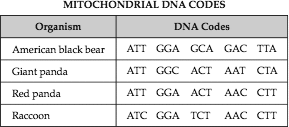
8.
What conclusions can be made based on this table shown?
a)
the American black bear and the giant panda are most closely related
b)
the giant panda and the red panda are most closely related
c)
the red panda and the racoon are the most closely related
9.
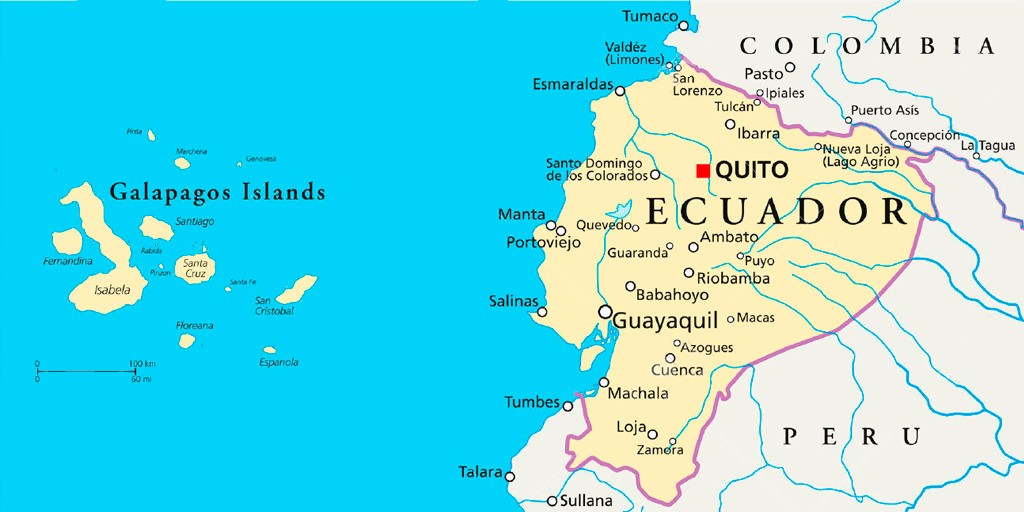
The Galapagos Islands, a small group of islands off the coast of Ecuador, is home to reptiles such as the giant tortoise and the iguana. The eastern islands are much older than the islands to the west.  Which statement about the origin of these reptiles is best supported by this information?
a)
The ancestor of each species came from different continents at different times.
b)
The common ancestors of the reptiles probably came from Equador.
c)
The common ancestor of each species evolved in Peru and came to the islands at the same time.
10.
The picture shows the members of the Camelidae family. The physical features and the geographical origin of these animals provide evidence that - 
a)
they live in the same type of environment.
b)
have slowly evolved to become herbivores.
c)
have a common ancestor.
d)
exchanged DNA in the past.
11.
  If two organisms have the same structures (even if they have a different function ex: leg bones of various mammals), it is considered _________________, but if they have different structures that perform the same function (ex: wings of birds and butterflies), it is considered ____________________.
a)
Analogous; Homologous
b)
b. Helpful; Harmful
c)
c. Homologous; Analogous
d)
d. Harmful; Helpful
12.
Using Data Table 1, which organism shares a most recent common ancestor with rabbits?
a)
Fly
b)
Bat
c)
Tree
d)
Bacterium
13.
Using the Data Table 1, which organism is least related to rabbits?
a)
Fly
b)
Bat
c)
Tree
d)
Bacterium
14.
 Using the cladogram to the right, flies are most closely related to:
a)
Beetles
b)
Wasps
c)
Butterflies
d)
Ants
15.
Using the cladogram to the right, which organism(s) do not have jaws?
a)
Lancelet
b)
Leopard
c)
Turtle
d)
Tuna
16.
 The evolutionary pathways of five species are represented in the diagram above.
Which statement is best supported by the diagram?
a)
Species C and Species D are related to species X
b)
Species C  is the ancestor of species B
c)
Species X evolved later than species D but before B
d)
Species D and E evolved from species B
17.
Which of the following best shows that two different organisms have a relatively recent common ancestor?
a)
They are the same size
b)
They have similar amino acid sequences
c)
They live in the same type of habitat
d)
They reproduce during the same season
18.

Evolution occurs as organisms ___________.

a)

are buried in sediment

b)

obtain structures that they no longer use

c)

are carbonized

d)

adapt to their environments

19.

A paleontologist uncovers a series of fossils in a piece of rock.


-Fossil A was found 1 meter deep.

-Fossil B was found 3 meters deep.

-Fossil C was found 4 meters deep.

-Fossil D was found 10 meters deep.


Which fossil is the oldest?

a)

Fossil A

b)

Fossil B

c)

Fossil C

d)

Fossil D

20.

Chicks and humans both have gill slits during development. What does this tell us about chicks and humans?

a)

Their embryos use gills to breathe during development.

b)

They both evolved from a common ancestor who had gills.

c)

Chicks are able to breathe underwater.

d)

They evolved from different ancestors.

21.

Which statement can be best supported by the pictures of the embryos.

a)

Chickens are more closely related to tortoises than rabbits are.

b)

Rabbits, chickens, tortoises, and fish are all equally related to each another.

c)

Fish do NOT share a common ancestor with other vertebrates.

d)

Fish and chicken are the least closely related.

22.

The ___________ states that older rocks are in deeper layers and rock layers on the top are younger.

a)

Law of Conservation

b)

Law of Old Rocks

c)

Law of Superposition

d)

Law of Young Rocks

23.

___________ is a method of determining whether an object is older or younger than other objects.

a)

Relative dating

b)

Time dating

c)

Fossil dating

d)

X-raying