
 Worksheets
The laws of thermodynamics
Total questions: 10
Worksheet time: 7mins
If an ideal gas is compressed isothermally, which of
the following statements is true?
Energy is transferred to the gas by heat.
No work is done on the gas.
The temperature of the gas increases.
The internal energy of the gas remains constant.
None of those statements is true
When an ideal gas undergoes an adiabatic expansion, which of the following statements is true?
The
temperature of the gas doesn’t change
No work is done by the gas.
No energy is delivered to the gas by heat
The internal energy of the gas doesn’t change.
The pressure increases

By visual inspection, order the PV diagrams shown in Figure 12.4 from the most negative work done on the system to the most positive work done on the system.
a, b, c, d
a, c, b, d
d, b, c, a
d, a, c, b
When an ideal gas expands at constant pressure, the change in the internal energy must be positive.
True
False
What is the equation for the first law of thermodynamics?
ΔU=Q−W
Q=ΔU+W
W=Q−ΔU
W=ΔU−Q
A gas is heated by supplying it with 250 kJ of
energy; at the same time, it is compressed
so that 500 kJ of work is done on the gas.
Calculate the change in the internal energy of
the gas.
250 kJ
750 kJ
-250 kJ
500 kJ
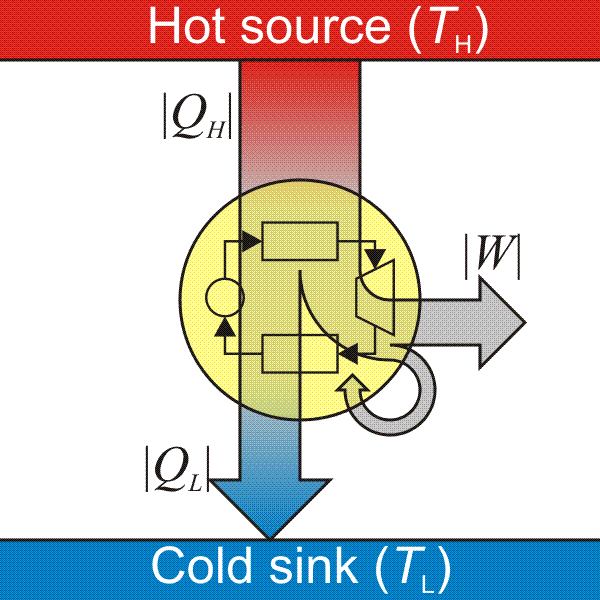
A heat engine
converts heat input to an equivalent amount of work
converts work to an equivalent amount of heat
takes heat in, does work, and loses energy heat
uses positive work done on the system to transfer heat from a low temperature reservoir to a high temperature reservoir
uses positive work done on the system to transfer heat from a high temperature reservoir to a low temperature reservoir

A Carnot cycle
is bounded by two isotherms and two adiabats on a p-V graph
consists of two isothermal and two constant volume processes
is any four sided process on a p-V graph
only exists for an ideal gas
has an efficiency equal to the enclosed area on a p-V diagram
A Carnot engine operates between 200°C and 20°C. Its maximum possible efficiency is
90%
100%
38%
24%
72%
Which of the following statements best describes the Second Law of Thermodynamics?
The internal energy of the universe is constant.
Energy can be neither created nor destroyed.
When an isolated system undergoes a spontaneous change, the entropy of the system will increase.
At absolute zero, the entropy of a perfect crystal is considered to be zero.

