
 Worksheets
Asexual vs Sexual Reproduction - Test Review
Total questions: 27
Worksheet time: 27mins
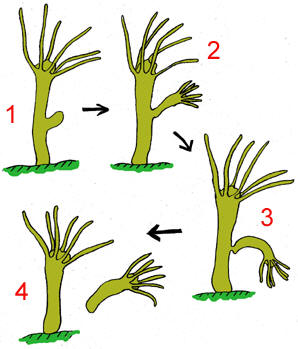
When an offspring grows off from the body of a parent organism it is called __________________.
budding
fission
fragmentation
sporulation
____________________ occurs when a male gamete (sperm) combines with a female gamete (egg).
sporulation
fertilization
fission
regeneration
Fully grown parent cells split into two halves resulting in two daughter cells with the exact DNA as the parent (example: bacteria).
Binary Fission
Budding
Fragmentation
Vegetative Reproductions
Happens when the parent's chromosomes are halved.
mitosis
meiosis
Male and female reproductive cells are collectively known as:
spores
pollen
gametes
offspring
If a sex cell has 10 chromosomes, how many chromosomes will there be after fertilization?
5
10
15
20
What organism reproduces using (asexual) regeneration?
coral
strawberries
bacteria
sea star

Asexual reproduction is associated with what type of cell division?
Mitosis
Meiosis
An organism that has been reproduced by asexual means receives ______________ of its chromosomes from its one parent.
3
25%
50%
100%

What is the type of cell division associated with sexual reproduction?
Mitosis
Meiosis
An organism that has been reproduced by sexual reproduction received ____________ of its chromosomes from the male parent.
4
25%
50%
100%
During mitosis the parent cell produces:
2 daughter cells with the same number of chromosomes as the parent cell.
2 daughter cells with the half the number of chromosomes as the parents cell.
4 daughter cells with the same number of chromosomes as the parent cell.
4 daughter cells with half the number of chromosomes as the parent cell.
During meiosis the parent cell produces:
2 daughter cells with the same number of chromosomes as the parent cell.
2 daughter cells with the half the number of chromosomes as the parents cell.
4 daughter cells with the same number of chromosomes as the parent cell.
4 daughter cells with half the number of chromosomes as the parent cell.

A fruit fly has 8 chromosomes like in the picture above. Which answer correctly shows the results of a fruit fly cell going through mitosis?


A fruit fly has 8 chromosomes like in the picture above. Which answer correctly shows the results of a fruit fly cell going through meiosis?

If a cow has 60 chromosomes in a somatic cell how many chromosomes would be in a cow's sex cell?
60
120
30
90

California blackworms, also known as mudworms, are able to break apart. Each body section that broke apart is able to become an identical new worm. What type of reproduction does this example represent?
Sexual reproduction
Asexual reproduction

Penguins lay 1-2 fertilized eggs that the male and female take turns incubating on their feet. What type of reproduction does this example represent?
Sexual reproduction
Asexual reproduction

Unique and different offspring is...
Mitosis and Sexual Reproduction
Meiosis and Asexual Reproduction
Mitosis and Asexual Reproduction
Meiosis and Sexual Reproduction

The fact that a baby is different from the parents...
Meiosis.
Mitosis.
Meiosis occurs in a:
Sex cell
Somatic cell
Mitosis occurs in a:
Sex cell
Somatic cell

During which process does the cell divide only once?
Mitosis
Meiosis
During which process does the cell divide two times?
Mitosis
Meiosis

