wayground logo

Free Printable Worksheets

NEW

Font size

S
M
L
XL
Worksheets

EA5: Homework week ending 3.08.20

Total questions: 75

Worksheet time: 56mins

Name
Class
Date
1.
Which of these choices is an example of something that is needed for survival?
a)
Adaptation
b)
Food 
c)
Water
d)
All of the above
2.
A woodpecker has a long, thin, pointed beak. How would this adaptation help it survive
a)
It can swim fast.
b)
It can catch other animals.
c)
It can easily catch fish. 
d)
It can easily pick bugs out of the bark in the trees.
3.
A penguin's layer of blubber is an adaptation that helps a bird survive in this environment. In which environment?
a)
the desert
b)
a hot environment
c)
a cold environment
d)
the water
4.
Why do some animals hibernate?
a)
The cold weather makes them sleepy.
b)
Their food supply is smaller in the winter.
c)
They have no one to play with.
5.
Environmental changes leads to
a)
variations
b)
pollution
c)
predation
d)
artificial selection
6.
Natural selection is when ____________ decides who survives and who doesn't
a)
nature
b)
humans
c)
animals
d)
years
7.
Where the better adapted organisms survive to pass traits along to offspring.
a)
Variation
b)
Natural Selection
c)
Extinction
d)
Artificial Selection
8.
What is the advantage of having different shaped beaks?
a)
To look different from other species.
b)
To be able to eat the food readily. available in the environment.
c)
To protect itself against predators.
d)
To protect itself against prey.
9.
Why are advantageous traits more likely to be passed onto offspring?
a)
Because they are more likely to survive and reproduce.
b)
Because they come from dominant alleles.
c)
Because they come from recessive alleles.
d)
Because the trait is an acquired phenotype.
10.
The purpose of selective breeding is to 
a)
get bigger animals
b)
get smaller animals
c)
create animals with desirable traits
d)
create animals with bad traits
11.
Problems with selective breeding include
a)
Better animals
b)
More Meat
c)
Animals can have bad health problems
d)
More diversity
12.
Which of the following would NOT be an adaptation?
a)
Long, strong running legs
b)
Claws with a powerful grip
c)
Camouflage
d)
A defective heart valve
13.
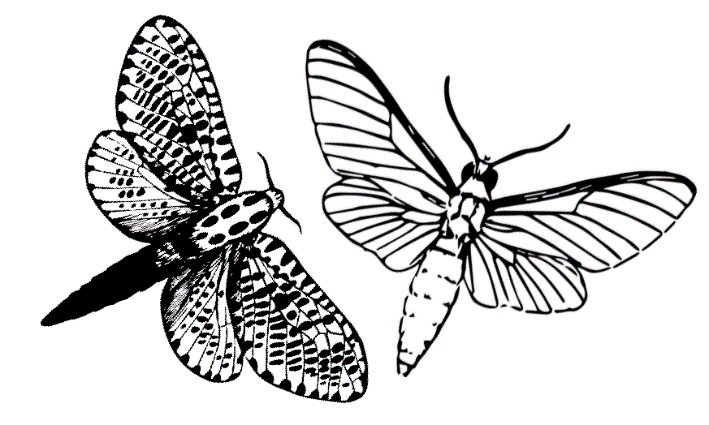
Why did the population of peppered moths in England change from light to dark after the Industrial Revolution?
a)
Light moths were easy to see against sooty trees and were eaten
b)
Light moths were killed by soot
c)
The birds that ate the dark moths were killed by soot
d)
Dark moths were produced by industrial processes
14.

According to natural selection, light colored tree trunks would favor

a)

light colored moths

b)

dark colored moths

c)

red colored moths

d)

red and light colored moths

15.
Behavioral changes of individuals of a species that allow for better survival. (Acquired traits)
a)
Variation
b)
Adaptation
c)
Behavior
d)
Environment
16.
These cause variations.
a)
mutations
b)
adaptations
c)
a desire to change
d)
injuries
17.
A slight difference in an inherited trait between individual members of the same species.
a)
variations
b)
adapatations
c)
homologous structures
d)
analogous structures
18.
Which is not an example of an adaptation?
a)
A bird's beak allows it to crack open hard nuts.
b)
A zebra's stripes allow it to confuse its predators.
c)
A frog's large hind legs allow it to jump from danger.
d)
A cat sleeps on the sofa to avoid the vacuum cleaner.
19.
Which of the following is a term for a group of similar organisms that can reproduce fertile offspring?
a)
individual
b)
population
c)
species
d)
fossil
20.
"Survival of the Fittest" describes which theory
a)
a) natural selection
b)
b) gravity
c)
c) heredity
d)
d) string theory
21.
Natural selection is when ____________ decides who survives and who doesn't
a)
nature
b)
humans
c)
animals
d)
years
22.

Adaptations can be:

a)

camouflage

b)

ability to survive cold weather

c)

hunting skills

d)

all of the above

23.

Differences in traits are called:

a)

natural selection

b)

genetic variations

c)

artificial selection

d)

adaptations

24.

A species could go extinct if:

a)

food becomes more plentiful.

b)

members of the species have adaptations to enhance survival.

c)

the environment changes drastically and no one can adapt.

d)

there is less competition for resources.

25.

Natural selection occurs during the lifetime of a single organism.

a)

True

b)

False

26.

TRUE or FALSE: Natural selection will still occur if each individual has the same exact traits

a)

TRUE

b)

FALSE

27.

How do you "win" at natural selection?

a)

survive

b)

go extinct

c)

survive & reproduce

28.
Where humans have bred organisms together based on traits we like.
a)
Evolution
b)
Natural Selection
c)
Extinction 
d)
Artificial Selection
29.

What process is being shown in this image?

a)

Selective/Artificial Breeding

b)

Natural Selection

30.
Domesticated dogs are an example of:
a)
Natural Selection
b)
Selective/Artificial Breeding
31.
The adaptations of the peppered moth are an example of:
a)
Natural Selection
b)
Selective Breeding
32.
The altering of corn to produce more kernels with much more sugar is an example of:
a)
Natural Selection, hybrid breed
b)
Selective/Artificial Breeding, hybrid breed
33.
A physical characteristic that allows an organism to survive in its environment.
a)
species
b)
Physiological adaptation
c)
Behavioral adaptation
d)
Structural adaptation
34.
Blending in with surroundings
a)
hibernation
b)
Natural Selection
c)
camouflage
d)
variation
35.
To pass the winter in a sleeping or resting state.
a)
migration
b)
camouflage
c)
hibernation
d)
variation
36.
A biochemical function that makes an organism better suited to its environment.
a)
Physiological adaptation
b)
Behavioral adaptation
c)
Structural adaptation
d)
Natural selection
37.
To move from one region or climate to another usually on a regular schedule for food or breeding.
a)
hibernation
b)
migration
c)
variation
d)
selective breeding
38.
Bahavior that helps an organism to survive and reproduce.
a)
behavorial adaptation
b)
structural adaptation
c)
physiological adaptation
d)
selective breeding
39.
Homozygous is when...
a)
the alleles are the same
b)
the alleles are different
c)
the alleles are absent
d)
the alleles are present
40.
Heterozygous is when...
a)
the alleles are the same
b)
the alleles are different
c)
the alleles are absent
d)
the alleles are present
41.
In a heterozygous genotype, the ___________ allele takes over in the phenotype.
a)
recessive
b)
dominant
c)
lower case letter
d)
both 
42.
T - tall and t = short
In the punnett square below, what belongs in the missing square
a)
tt
b)
Tt
c)
Bb
d)
TT
43.
B = brown fur  b = white fur
In the punnett square, what is the probability for white fur? 
a)
0%
b)
25%
c)
50%
d)
75%
44.
In the punnett square shown, what must the genotype of the missing parent be?
a)
BB
b)
Bb
c)
bb
d)
Tt
45.
Which of the following is a phenotype?
a)
Aa
b)
black hair
c)
heterozygous genes
d)
mutated DNA
46.
Dominant or recessive?
tt
a)
Dominant 
b)
Recessive
47.
What is a dominant allele?
a)
A trait that is always shown (capital letter)
b)
A trait that can be hidden (lower case letter)
c)
Alleles that are the same
d)
Alleles that are different
48.
This image shows a...
a)
Punnett Square
b)
Phenotype
c)
Genotype
d)
Dominant allele
49.
Which of the following genotypes is heterozygous?
a)
Bb
b)
BB
c)
bb
d)
B
50.
A characteristic that an organism can pass on to its offspring through its genes is ___________
a)
Trait
b)
Gene
c)
Allele
d)
Dominant
51.
An allele that is masked when a dominant allele is present. The "weaker" gene. 
a)
Dominant Allele
b)
Recessive Allele
52.
An allele whose trait always shows up in the organism when the allele is present. The "stronger" gene. 
a)
Dominant Allele
b)
Recessive Allele
53.
An organism’s genetic makeup or allele combination.
a)
Genotype
b)
Phenotype
c)
Beanotype
d)
Notype
54.
An organism’s physical appearance, or visible traits. 
a)
Genotype
b)
Phenotype
c)
Beanotype
d)
Notype
55.
What is called when a organism has two identical alleles for a trait. TT or tt. RR or rr
a)
Heterozygous
b)
Homozygous
c)
Domozygous
d)
Thermozygous
56.
Punnett squares can be used to predict the probability of:
a)
being exposed to a contagious disease and contracting it
b)
having an inherited disease or a genetically determined physical trait
c)
Both
57.
In a certain species of plant, the color purple (P) is dominant to the color white (p).
According to the Punnett Square, what is the probability of an offspring being purple?
a)
25%
b)
0%
c)
100%
d)
50%
58.
In a certain species of plant, the color purple (P) is dominant to the color white (p).
According to the Punnett Square, what is the probability of an offspring being white?
a)
25%
b)
0%
c)
100%
d)
50%
59.
A heterozygous long-tusked elephant is crossed with a homozygous recessive short-tusked elephant. What is the probability of the offspring having short tusks?
a)
0%
b)
25%
c)
50%
d)
75%
60.
A heterozygous long-tusked elephant is crossed with a homozygous recessive short-tusked elephant. What is the probability of the offspring having short tusks?
a)
0%
b)
25%
c)
50%
d)
75%
61.
What is the probability of a purple-horned unicorn if a heterozygous pink-horned unicorn is crossed with a heterozygous pink-horned unicorn?
a)
0%
b)
25%
c)
50%
d)
75%
62.
Identify the homozygous dominant genotype:
a)
FF
b)
Ff
c)
ff
63.
What you see, or the physical appearance.
a)
Genotype
b)
Phenotype
c)
Homozygous
d)
Heterozygous
64.
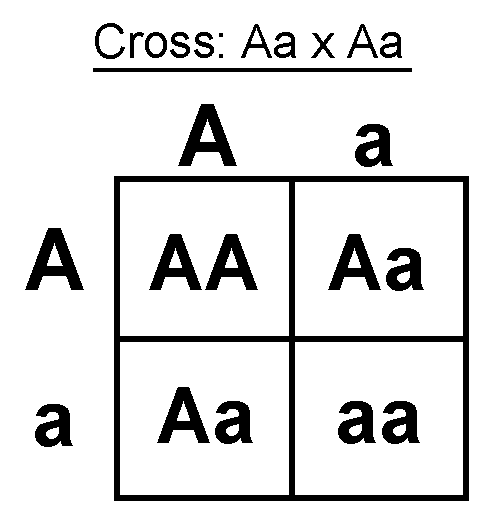
What is the probability of heterozygous offspring?
a)
25%
b)
50%
c)
0%
d)
100%
65.
What allele combination should go in the missing box?
a)
AA
b)
Aa
c)
aa
d)
none of these
66.
Each one of the boxes on the Punnett Square represents what probability of an offsprings' genotype?
a)
25%
b)
1%
c)
10%
d)
0%
67.
What is the phenotype of the offspring? (A-Brown hair; a-blond hair) 
a)
50 % Brown Hair and 50% Blond Hair 
b)
25 % Brown Hair and 75% Blond Hair 
c)
75 % Brown Hair and 25% Blond Hair 
d)
0% Brown Hair and 100% Blond Hair 
68.
What chance does the offspring have of showing a dominant trait?
a)
100%
b)
75%
c)
50%
d)
0%
69.
What chance does the offspring have of showing a recessive trait?
a)
50%
b)
75%
c)
100%
d)
25%
70.
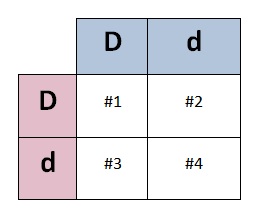
What is the allele combination for square 1?
a)
Dd
b)
DD
c)
dd
d)
D
71.
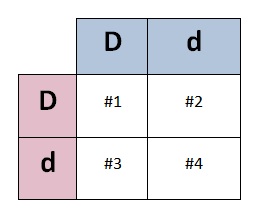
What is the possibility of this offspring having a dominate trait?
a)
50%
b)
75%
c)
25%
d)
0%
72.
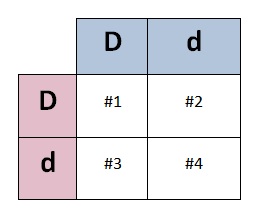
What is the chance of this offspring having a recessive trait?
a)
25%
b)
100%
c)
50%
d)
0%
73.
What is the missing allele?
a)
a
b)
A
c)
AA
d)
aa
74.
What is the genotype for the black chickens?
a)
BB
b)
Bb
c)
bB
d)
bb
75.
What is the phenotype for Bb?
a)
Black chicken
b)
Blue Chicken
c)
Dominant
d)
Red spot