wayground logo

Free Printable Worksheets

NEW

Font size

S
M
L
XL
Worksheets

(Practice Quiz) Weather, Climate & Seasons Quiz

Total questions: 31

Worksheet time: 34mins

Name
Class
Date
1.

What climate zone is the white area in the picture?

a)

Polar zone

b)

Temperate zone

c)

Tropical zone

d)

El Nino

2.

What climate zone is the red area in the picture?

a)

Polar zone

b)

Temperate zone

c)

Arctic zone

d)

Tropical zone

3.
Humidity is the...
a)
Amount of Water Vapor in the Air
b)
Amount of Wind in the Air
c)
Amount of Precipitation in the Air
d)
Amount of Pressure in the Air
4.
________________ are made of water vapor that condenses in the troposphere.
a)
dew
b)
clouds
c)
evaporation
d)
transpiration
5.
What layer does weather occur in?
a)
mesosphere
b)
troposphere
c)
thermosphere
d)
stratosphere
6.
Where is the ozone layer located?
a)
Thermosphere
b)
Troposphere
c)
Stratosphere
d)
Mesosphere
7.
The Earth's axis is tilted _____ degrees.
a)
23.5
b)
25.3
c)
30.2
d)
24
8.
What is the longest day of the year?
a)

Dec 21st

b)

Oct 23rd

c)

June 21st

d)

March 23rd

9.
What does the rotation of the earth cause us to experience?
a)
seasons
b)
year
c)
day & night
d)
eclipse
10.
How long does it take the earth to revolve once around the sun?
a)
12 hours
b)
24 hours
c)
30 days
d)
365.25 days
11.

At which position is the Northern Hemisphere experiencing a vernal equinox?

a)

A

b)

B

c)

C

d)

D

12.
T8 - As you go to the top of a mountain, what happens to temperature?
a)
Nothing
b)
It increases
c)
It decreases
d)
It goes up and down
13.
What is the difference between climate and weather?
a)
 Climate averages the weather conditions in a specific place over a long period of time, while weather describes the state of the atmosphere at a specific moment in time.
b)
 Weather averages the weather conditions in a specific place over a long period of time, while Climate describes the state of the atmosphere at a specific moment in time.
c)
Climate describes the weather conditions at night, while weather describes the conditions during the daytime.
d)
 There is not a difference between climate and weather.
14.

precipitation falling from clouds in the form of ice crystals (occurs when temperature from sky to ground is below freezing)

a)

rain

b)

sleet

c)

hail

d)

snow

15.

Any form of water that falls from clouds and reaches Earth's surface as rain, snow, sleet, or hail

a)

rain

b)

snow

c)

sleep

d)

precipitation

16.
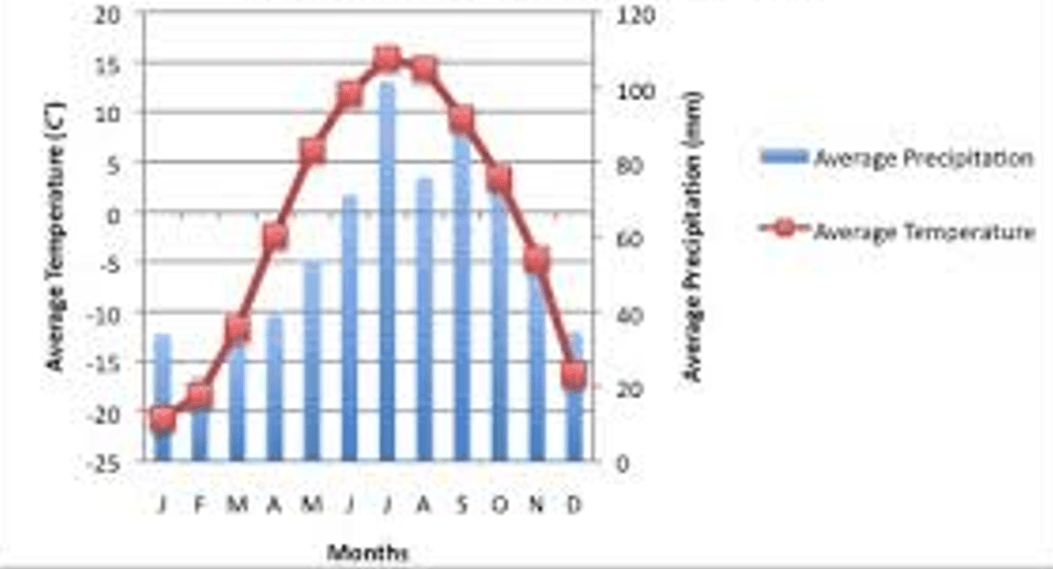
The line graph represents?
a)
Temperature
b)
Precipitation
c)
Wind Direction
17.
The bar graph represents?
a)
Temperature
b)
Precipitation
c)
Wind Direction
18.
Tornadoes are measured using which type of scale?
a)
Richter scale
b)
Bathroom scale
c)
Fujita Scale
d)
Mercator Scale
19.

What is the Hydrologic cycle?

a)

the 3 forms of water

b)

the movement of water on, above, or below the surface of the Earth

c)

when water melts

d)

when clouds form

20.

___________________ is the process by which water changes from a liquid to a gas or vapor. __________________ is the primary pathway that water moves from the liquid state back into the water cycle as atmospheric water

a)

Transpiration

b)

Deposition

c)

Percolation

d)

Evaporation

21.

Water that flows across the land and enters rivers and streams. It eventually flows into lakes and the ocean.

a)

Snowmelt runoff

b)

Surface Runoff

c)

Deposition

d)

Precipitation

22.
Which best explains why runoff is important?
a)
It returns water to other locations on Earth
b)
It increases the chance of flooding
c)
It makes evaporation occur faster
d)
It increases condensation
23.
What is the function of the ozone layer?
a)
to allow UV rays to get to Earth
b)
to block UV rays from getting to Earth
c)
To keep oxygen in
d)
to allow meteors to get to Earth
24.
Which phenomenon can be seen only in the ionosphere?
a)
ozone layer
b)
Aurora Borealis
c)
Highlands
d)
water vapor
25.
This is the layer where meteors, or shooting stars, burn up.
a)
Troposphere
b)
Stratosphere
c)
Mesosphere
d)
Thermosphere
26.

Currents that carry warm water are moving

a)

from the Equator to the poles

b)

from the poles to the Equator

c)

from the tropical zone to the polar zone

d)

from the polar to the mediterranean zone
27.
Which layer of the Earth is responsible for Earth's magnetic field?
a)
outer core
b)
inner core
c)
mantle
d)
crust
28.
When living things breathe, they interact with which of Earth's spheres? 
a)
Geosphere 
b)
Hydrosphere 
c)
Atmosphere 
d)
Biosphere 
29.

Earth magnetic field protects us from ___________.

a)

the heat

b)

the Solar wind

c)

the moon

d)

the stars

30.
Why do we experience the changing of the season on the earth?
a)
distance from the sun
b)
rotation of the earth
c)
change in solar output
d)
tilt of the earth's axix
31.
When are the equinoxes?
a)
June & December
b)
July & January
c)
April & October
d)
March & September