wayground logo

Free Printable Worksheets

NEW

Font size

S
M
L
XL
Worksheets

Ch. 7 Review - Geometry

Total questions: 61

Worksheet time: 1hrs 6mins

Name
Class
Date
1.
a)
A
b)
B
c)
C
d)
D
2.
a)
A
b)
B
c)
C
d)
D
3.
a)
A
b)
B
c)
C
d)
D
4.
a)
A
b)
B
c)
C
d)
D
5.
a)
A
b)
B
c)
C
d)
D
6.
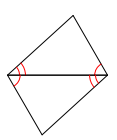
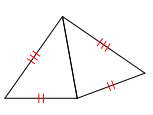
How are the triangles congruent?
a)
AAS
b)
SAS
c)
ASA
d)
SSS
7.
How are the triangles congruent?
a)
SAS
b)
SSS
c)
AAS
d)
HL
8.
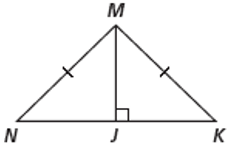
Which is NOT a criteria for triangles to be congruent by the HL Theorem?
a)
Right triangles
b)
congruent hypotenuses
c)
Two pairs of congruent legs
d)
One pair of congruent legs
9.
a)
A
b)
B
c)
C
d)
D
10.
Are these triangles congruent?
a)
Yes, by SSS
b)
Yes, by SAS
c)
Yes, by AAS
d)
Yes, by HL
11.
Are these triangles congruent?
a)
Yes, by SSS
b)
Yes, by SAS
c)
Yes, by AAS
d)
No, they are not congruent
12.
Are these triangles congruent?
a)
Yes, by SAS
b)
Yes, by SSS
c)
No they are not congruent
d)
Not enough information to know for sure
13.

ΔABE ≅ Δ_____ by _____

a)

ΔCDE , ASA

b)

ΔEDC , AAS

c)

ΔCDE , AAS

d)

Cannot Be Determined

14.

ΔWAT ≅ Δ_____ by _____

a)

ΔTRE , ASA

b)

ΔTER , ASA

c)

ΔTER , AAS

d)

Cannot Be Determined

15.
If DA bisects IE, then
a)
ID=ED
b)
IA=EA
c)
<IDA=<EDA
d)
<IAD and <EAD are right angles
16.
If DA is perpendicular to IE, then we can immediately conclude that
a)
IA=AE
b)
<IAD = <DAE
c)
<IDA=<EDA
d)
<IAD and <DAE are right angles
17.
In this picture,
a)
<BCA=<DCE because they are vertical angles and vertical angles are always congruent to each other
b)
<C=<C because they are vertical angles and vertical angles are always congruent to each other
c)
<EDC=<ACB because they are vertical angles and vertical angles are always congruent to each other
d)
None of the above; we don't actually have vertical angles
18.
What additional information is required for the 2 triangles to be congruent by ASA?
a)
A
b)
B
c)
C
d)
D
19.
What additional information is required for the 2 triangles to be congruent by SAS?
a)
A
b)
B
c)
C
d)
D
20.
Use the congruence statement to find the missing part of the statement
a)
WV
b)
WU
c)
VU
d)
WB
21.
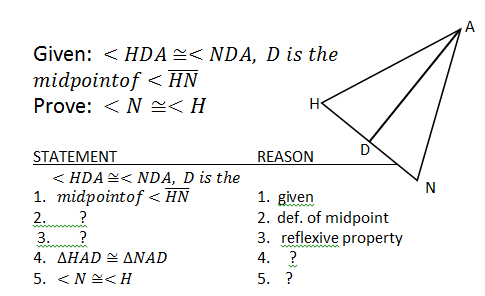
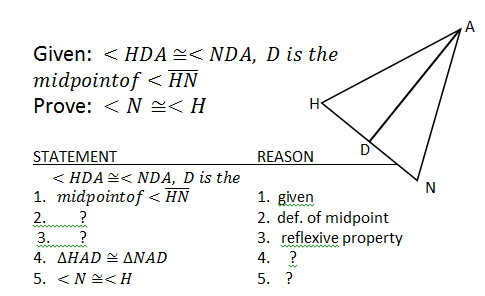
Fill in the missing proofs.
a)
Transitive Property, SAS(Side-Angle-Side)
b)
Reflexive Property, SAS(Side-Angle-Side)
c)
Reflexive Property, Vertical Angles Thm.
d)
Transitive Property, SSS(Side-Side-Side)
22.
What is the "statement" for step 2 of the proof?
a)
AD=AD
b)
AD=DA
c)
HD=DN
d)
HA = AN
23.
What is the "statement" for step 3 of the proof?
a)
AD=DA
b)
AN = AH
c)
HD=ND
d)
HD=DN
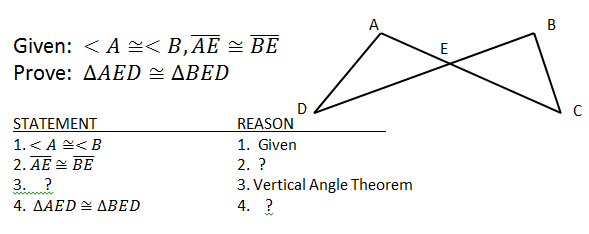
24.
What is the "statement" for step 3 of the proof? 
a)
∡EDA≅∡DCB
b)
∡AED≅∡BEC
c)
DE=CE
d)
∡AED≅∡CED
25.
What is the "reason" for step 3 of the proof?
a)
Proof
b)
Def. of Midpoint
c)
Reflexive Property
d)
Vertical angle Theorem
26.
When using hypotenuse leg (HL) in a proof, you must first state ...
a)
CPCTC.
b)
there are right triangles.
c)
that vertical angles are congruent.
d)
the reflexive property.
27.

What is Reason B?

a)

Definition of Congruence

b)

Definition of Vertical Angles

c)

Reflexive Property

d)

Vertical Angle Theorem

28.

What is Reason C?

a)

SSS Congruence

b)

SAS Congruence

c)

ASA Congruence

d)

AAS Congruence

e)

HL Congruence

29.

What is Reason B?

a)

Definition of Equality

b)

Definition of Congruence

c)

Definition of Bisector

d)

Definition of Midpoint

30.

What is Reason F?

a)

Given

b)

Definition of Congruence

c)

Triangle Congruence

d)

CPCF

31.
What is the justification (reason)?
a)
Reflexive Property
b)
Symmetric Property
c)
Transitive Property
d)
Substitution
32.
What is the justification (reason)?
a)
reflexive property
b)
definition of segment bisect
c)
definition of a midpoint
d)
substitution property
33.
A parallelogram is a rectangle when the diagonals ...
a)
are perpendicular.
b)
bisect each other.
c)
are congruent.
d)
are parallel.
34.
The opposite angles of a parallelogram are ...
a)
complementary
b)
congruent
c)
supplementary
d)
perpendicular
35.
In a parallelogram, consecutive angles are __________.
a)
congruent
b)
supplementary
c)
corresponding
d)
parallel
36.
In a parallelogram, diagonals are __________.
a)
perpendicular
b)
bisected
c)
congruent
d)
parallel
37.
Which is NOT a property of a parallelogram?
a)
Diagonals bisect each other
b)
Diagonals are congruent
c)
Both pairs of opposite sides are parallel
d)
Both pairs of opposite angles are congruent
38.
Find x.
a)
75
b)
85
c)
105
d)
95
39.
Find x.
a)
85
b)
105
c)
95
d)
75
40.
Find x.
a)
82
b)
92
c)
98
d)
102
41.
The figure is a parallelogram.  
Solve for x.  
Give a reason.
a)
9
b)
6
c)
10
d)
2
42.
If ABCD is a parallelogram, what is the length of BD? 
a)
10
b)
11
c)
7
d)
5
43.
Name that shape.
a)
trapezium
b)
quadrilateral
c)
parallelogram
d)
rhombus
44.
A quadrilateral with two pairs of parallel sides, 4 right angles, and 4 congruent (equal) sides is a __________________.
a)
trapezoid
b)
parallelogram
c)
rectangle
d)
square
45.
A _______________ is a quadrilateral with two sets of parallel sides.
a)
trapezoid
b)
parallelogram
c)
kite
d)
triangle
46.
How many degrees are in the missing angle?
a)
60
b)
114
c)
70
d)
360
47.
Is this quadrilateral a parallelogram?
a)
Yes. Diagonals bisect each other
b)
no
c)
Yes. Opposite angles are congruent
d)
Yes. Opposite sides are congruent
48.

Is this quadrilateral a parallelogram? If so, give a reason.

a)

No

b)

Yes. Opposite sides are parallel

c)

Yes. Opposite sides are congruent

d)

Yes. Opposite angles are congruent

49.
Is the quadrilateral a parallelogram? If yes, state how you know.
a)
Opposite sides parallel
b)
Opposite angles equal
c)
Opposite sides equal and parallel
d)
Not enough info
50.
Is the quadrilateral a parallelogram? If yes, state how you know.
a)
Opposite sides equal
b)
Opposite sides parallel
c)
Diagonals bisect each other
d)
Not enough info
51.
Is the quadrilateral a parallelogram? If yes, state how you know.
a)
Opposite sides parallel
b)
Opposite sides equal
c)
Opposite sides parallel and equal
d)
Not enough info
52.
Is the quadrilateral a parallelogram? If yes, state how you know.
a)
Opposite sides parallel
b)
Opposite sides equal
c)
Opposite sides parallel and equal
d)
Not enough info
53.
a)
kite
b)
rhombus
c)
parallelogram
d)
quadrilateral
54.
a)

Parallelogram

b)

Rhombus

c)

Square

d)

Rectangle

e)

Kite

55.
a)

Parallelogram

b)

Rhombus

c)

Square

d)

Rectangle

e)

Kite

56.
a)

Parallelogram

b)

Rhombus

c)

Square

d)

Rectangle

e)

Kite

57.
a)

Parallelogram

b)

Rhombus

c)

Square

d)

Rectangle

e)

Kite

58.
a)

Parallelogram

b)

Rhombus

c)

Square

d)

Rectangle

e)

Kite

59.
a)

Parallelogram

b)

Rhombus

c)

Square

d)

Rectangle

e)

Kite

60.
a)

Parallelogram

b)

Rhombus

c)

Trapezoid

d)

Isosceles Trapezoid

e)

Kite

61.
a)

Parallelogram

b)

Rhombus

c)

Trapezoid

d)

Isosceles Trapezoid

e)

Kite