

wayground logo

Free Printable Worksheets

Font size

S
M
L
XL
Worksheets

2020 Marking Period Three LIFT - U.S. II

Total questions: 68

Worksheet time: 58mins

Name
Class
Date
1.
When did the Stock Market crash?
a)
October 31, 1929
b)
September 29, 1931
c)
August 29, 1991
d)
October 29, 1929
2.
What is another name for the Stock Market Crash?
a)
Black Friday
b)
Taco Tuesday
c)
Black Tuesday
d)
Throwback Thursday
3.
Who was President of the US when the stock market crashed and Depression began?
a)
Theodore Roosevelt
b)
Franklin D. Roosevelt
c)
Herbert Hoover
d)
William McKinley
4.
Who was elected president because he had a plan to pull America out of the Great Depression?
a)
William McKinley
b)
Woodrow Wilson
c)
Theodore Roosevelt
d)
Franklin D. Roosevelt
5.
What was the name of FDR's plan to reconstruct America following the Great Depression?
a)
No Deal
b)
New Deal
c)
Reconstruction
d)
FDR's Plan
6.
During the Great Depression, there was a severe drought in the Great Plains. Strong prairie winds picked up the topsoil and spread dust everywhere. Many farm families packed everything up and moved west. What was this event called?
a)
Dust Bowl
b)
Salad Bowl
c)
Great Plains Panic
d)
Depressing Dust
7.
What were the 3 main programs President Roosevelt established to help reconstruct the U.S. economy?
a)
WPA, CCC, TAV
b)
CCC, TVA, WPA
c)
WAP, COP, WWW
d)
TVA, WPA, UGA
8.
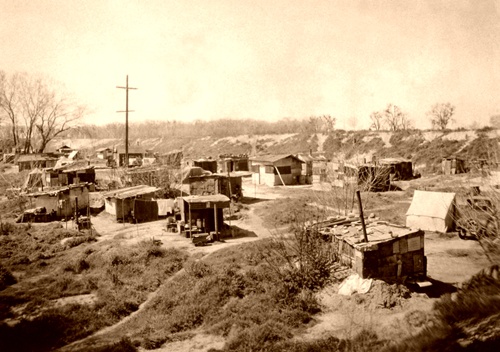
People who could no longer afford their homes were forced to live in cardboard shacks that they built in public parks. What were these shacks called?
a)
Shantyshacks
b)
Town Homes
c)
Tenement Housing
d)
Hoovervilles
9.

Unemployment is the number of people without.....

a)

money

b)

children

c)

jobs

d)

food

10.

Which event occurred on Black Tuesday?

a)

many factories closed

b)

many banks closed

c)

many people lost their homes

d)

the stock market crashed

11.

What was the "New Deal" of the 1930s?

a)

a government program that gave free land to homesteaders

b)

a government program that helped women get the vote

c)

a government program that spread civil rights throughout the country

d)

a government program designed to help people during the depression
12.
Which of the following European country faced the greatest economic challenges after WW I? 
a)
Austria
b)
Great Britian
c)
France
d)
Germany
13.
Did Prohibition Work?
a)
Yes
b)
No
14.
How did "bank runs" impact the American people during the Great Depression?
a)
Banks eventually ran out of money to loan, and people's life savings were gone.
b)
Banks made loans throughout the Great Depression, helping people pays bills until they could find work.
c)
Banks were able to people's deposits safe, but they could not loan out any more money.
d)
Banks were not at all involved in the Great Depression because people did not use them.
15.
Paying a small % of a stock's price & borrowing the rest is known as what?
a)
buying on margin
b)
speculation
c)
fiat money
d)
price supports
16.
Buying stock without knowing the risks, assuming it will just go up is known as ________.
a)
speculation
b)
buying on margin
c)
market capitalization
d)
hammering the market
17.
What percentage of Americans were unemployed in 1933?
a)
25%
b)
35%
c)
50%
d)
2%
18.
Pick the best answer.  Over-production of what led to the Great Depression?
a)
farm goods
b)
consumer goods
c)
farm and consumer goods
d)
iPhones
19.
What were the villages full of shacks located in cities filled with unemployed Americans called?
a)
Hoovervilles
b)
Okies
c)
Bonus Army Bases
d)
Rooseveltowns
20.
Which cause of the Great Depression led to the decrease in the prices of goods and food?
a)
Stock Market Crash
b)
Overproduction
c)
Federal Reserve did not help failing banks
d)
High Tariffs 
21.
What is a good title for this list?
a)
Culture of the 1920s
b)
The Great Migration
c)
Impact of the Great Depression
d)
Features of the New Deal
22.
How did stores and shopping change during the 20s?
a)
advertising lured shoppers into stores
b)
stores only offered limited things
c)
people stopped buying on credit and only paid cash
d)
stores became smaller
23.
How did Jazz influence this time period?
a)
it made people move out of Harlem
b)
it was very popular 
c)
it made people want to listen to classical music
d)
it only encouraged white people to become musicians
24.
How did things changes for women during the 20s?
a)
they could get a job
b)
they could earn more money than men
c)
they could only be housewives
d)
they had to have long hair and wear dresses
25.

The movement of African Americans from the south to the north and Midwest is called

a)

the Harlem Renaissance

b)

the Great Migration

c)

the Great Depression

d)

the Italian Renaissance

26.

Which of these were reasons that African Americans left the south? (3 push factors)

a)

Sharecropping

b)

too many jobs

c)

segregation

d)

freedom

e)

lynching

27.

People in the 1920's could enjoy which of these technologies for entertainment?

a)

television

b)

radio

c)

movies

d)

cassette players

28.

How did Prohibition change life in the United States?

a)

children stopped drinking alcohol

b)

African Americans moved north

c)

Women gained their independence

d)

Organized Crime increased because of illegal alcohol sales

29.

Affordable automobiles led to what changes in the United States in the 1920's?

a)

Drinking at speakeasies increased

b)

Americans had more freedom and roads were paved

c)

Americans began walking more

d)

Americans were outraged by the high prices of cars

30.

Who painted scenes like this of the Great Migration?

a)

Georgia O'Keeffe

b)

Jacob Lawrence

c)

Pablo Picasso

d)

Bessie Smith

31.

Who wrote about inequality and was part of the Harlem Renaissance?

a)

F. Scott Fitzgerald

b)

Louis Armstrong

c)

Langston Hughes

d)

John Steinbeck

32.

This Jazz Age Artist was known for playing the trumpet in songs like "When the Saints go Marching in" and "What a Wonderful World."

a)

Duke Ellington

b)

Bessie Smith

c)

Louis Armstrong

d)

George Gershwin

33.
Who first used the assembly line to produce automobiles?
a)
Thomas Edison
b)
Woodrow Wilson
c)
The Wright Brothers
d)
Henry Ford
34.
"Man’s First Flight Takes Place in Kitty Hawk, North Carolina."  This news headline describes who?
a)
Alexander Graham Bell
b)
Woodrow Wilson
c)
Wright Brothers
d)
Henry Ford
35.
Washing machines, Electric stoves, Water pumps are examples of what?
a)
electric lighting industries
b)
labor-saving products
c)
transportation-related industries
d)
time consuming products
36.
What places were created during Prohibition, for people to drink alcoholic beverages?
a)
Speak-easies
b)
Assembly lines
c)
Bootleggers
d)
Jazz clubs
37.
During Prohibition, who made and smuggled illegal alcohol and promoted organized crime?
a)
Progressives
b)
Bootleggers
c)
Yellow Journalists
d)
Prohibitionists
38.
What was the purpose of the 21st Amendment?
a)
To repeal Prohibition
b)
To prevent child labor
c)
To grant women suffrage
d)
To improve factory wages
39.
Which person was a poet who combined the experiences of African and American cultural roots?
a)
Bessie Smith
b)
Duke Ellington
c)
Langston Hughes
d)
Louis Armstrong
40.
Aaron Copland and George Gershwin composed
a)
books about migrant workers
b)
uniquely American music
c)
books about the Jazz Age
d)
poetry about African-American experiences
41.
Who is well known for urban scenes and paintings of the Southwest?
a)
Jacob Lawrence
b)
F. Scott Fitzgerald
c)
John Steinbeck
d)
Georgia O’Keefe
42.
Which novelist portrayed the strength of the migrant workers during the 1930’s?
a)
John Steinbeck
b)
Langston Hughes
c)
F. Scott Fitzgerald
d)
Bessie Smith
43.
The person pictured was a well known
a)
artist
b)
blues singer
c)
jazz composer
d)
novelist
44.
One of the greatest baseball players of all time, who helped professional sports become popular. 
a)
Babe Ruth
b)
Woodrow Wilson
c)
Charles Lindbergh
d)
Henry Ford
45.
A great aviator who became the first person to fly across the Atlantic Ocean by himself.
a)
Langston  Hughes
b)
Woodrow Wilson
c)
Henry Ford
d)
Charles Lindbergh
46.
People that risk everything to star their own business are called
a)
laborers
b)
specialists
c)
competitors
d)
entrepreneurs
47.

The 1920's in America were known as the...

a)

Revolutionary Era

b)

World War I

c)

Jazz Age or "Roaring Twenties"

d)

Civil Rights Movement

48.
The group most credited with pushing prohibition was
a)
The KKK
b)
African Americans
c)
Women
d)
Business Owners
49.
Al Capone gave this city a reputation of Corruption and Criminality.
a)
New York
b)
Boston
c)
St. Louis
d)
Chicago
50.
This was a major innovation found in most homes by the end of the 20s.
a)
Radio
b)
Television
c)
Telephone
d)
Microwave.
51.
Henry Ford is credited with mastering 
a)
Modern day filming.
b)
Use of the Assembly Line.
c)
Flying aeroplanes.
d)
Radio Broadcasting.
52.
Nativists are against _______?
a)
Corruption
b)
African Americans
c)
Railroads
d)
Immigrants
53.
a)

a

b)

b

c)

c

d)

d

54.
a)

a

b)

b

c)

c

d)

d

55.
a)

14th Amendment

b)

15th Amendment

c)

19th Amendment

d)

20th Amendment

56.
a)

14th Amendment

b)

15th Amendment

c)

19th Amendment

d)

20th Amendment

57.
a)

a

b)

b

c)

c

d)

d

58.
a)

a

b)

b

c)

c

d)

d

59.
The city in which there was a large celebration of African American culture
a)
Chicago
b)
New Orleans
c)
Harlem
d)
Detroit
60.
During the Great Migration, African Americans moved from
a)
North to South
b)
South to North
c)
East to West
d)
West to East
61.
The city identified on the map is known for which industry? 
a)
Textile 
b)
Steel 
c)
Meat 
d)
Automobile 
62.
a)

Utah

b)

Nevada

c)

California

d)

Arizona

63.
a)

Connecticut

b)

New York

c)

Pennsylvania

d)

New Jersey

64.
a)

Nevada

b)

Washington

c)

Oregon

d)

California

65.
a)

Alabama

b)

Missouri

c)

Louisiana

d)

Arkansas

66.
a)

Arkansas

b)

Nebraska

c)

Oklahoma

d)

Texas

e)

Kansas

67.
a)

Mississippi

b)

Wisconsin

c)

Michigan

d)

Ohio

e)

Illinois

68.

Near what color is WASHINGTON D.C., the nation's capital?

a)

red

b)

blue

c)

yellow

d)

green

e)

not on this map
