wayground logo

Free Printable Worksheets

NEW

Font size

S
M
L
XL
Worksheets

Unit 3 AoS 1 - Review quiz - 2024

Total questions: 48

Worksheet time: 37mins

Name
Class
Date
1.
What will most likely be the result if all of the mitochondria are removed from a plant cell?
a)
it will be unable to carry out respiration
b)
it will lose water through osmosis
c)
it will break down the ribosomes in the cell
d)
it will be unable to do photosynthesis
2.
This picture represents what type of cell transport?
a)
endocytosis
b)
exocytosis
c)
osmosis
d)
passive transport
3.
What process occurs when sugar is converted into ENERGY (ATP)
a)
Photosynthesis
b)
Cellular Respiration
4.
What is the correct equation for cellular respiration?
a)
6O2 + C6H12O6 -> 6CO2 + 6H2O + Energy
b)
6O2 + C6H12O6 + Energy -> 6CO2 + 6H2O
c)
6CO2 + 6H2O -> 6O2 + C6H12O6 + Energy
d)
6CO2 + 6H2O + Energy -> 6O2 + C6H12O6
5.

What is one of the inputs of cellular respiration?

a)
energy
b)
glucose
c)
carbon dioxide
d)
water
6.
How does adding more carbon dioxide affect the rate of photosynthesis?
a)
increased rate of photosynthesis
b)
decreased rate of photosynthesis
c)
rate of photosynthesis stayed the same
d)
stopped photosynthesis
7.
Draw a conclusion regarding how light intensity affects the rate of photosynthesis.
a)
greater light intensity = higher rate of photosynthesis
b)
lower light intensity = higher rate of photosynthesis
c)
greater light intensity = lower rate of photosynthesis
d)
there was no affect
8.
Which of the following is not needed for photosynthesis to occur?
a)
sunlight
b)
carbon dioxide
c)
water
d)
oxygen
9.
A student is collecting the gas given off from a plant in bright sunlight at a temperature of 27°C. The gas being collected is probably ________.
a)
oxygen
b)
carbon dioxide
c)
ATP
d)
glucose
10.
Most plants appear green because chlorophyll
a)
absorbs green light.
b)
absorbs violet light.
c)
reflects green light.
d)
does not absorb violet light.
11.
Which of the following is the correct equation for PHOTOSYNTHESIS?
a)
CO+ light + H2O --> O+ Sugar
b)
CO+ sugar + H2O --> O+ light
c)
O2 + light + H2O --> CO+ Sugar
d)
CO+ O2 + H2O --> Light+ Sugar
12.
Which of the following is not a nitrogen base found in DNA?
a)
Thymine
b)
Uracil 
c)
Guanine
d)
Adenine
13.

Which of the following is not a component of DNA?

a)

Deoxyribose Sugar

b)

Phosphate Group

c)

Carbon Base

d)

Nitrogen Base

14.

According to the Base Pair rule, Cytosine always pairs with

a)

Adenine

b)

Uracil

c)

Thymine

d)

Guanine

15.
Name this structure
a)
double helix
b)
nucelotide
c)
amino acid
d)
protein
16.
DNA codes for...
a)
bases
b)
proteins
c)
amino acids
d)
phosphates
17.

The two parallel strands of DNA are kept together by:

a)

Ionic bonds

b)

Covalent Bonds

c)

Phosphodiester bonds

d)

Hydrogen Bonds

18.
How does RNA differ from DNA?
a)
RNA contains uracil and deoxyribose
b)
RNA contains ribose and thymine
c)
RNA contains uracil and ribose
d)
RNA contains adenine and ribose
19.
How would the DNA sequence GCTATA be transcribed to mRNA?
a)
GCUAUA
b)
CGATAT
c)
CGAUAU
d)
GCUTUT
20.
The process by which the genetic code of DNA is copied into a strand of RNA is called
a)
translation
b)
transcription
c)
transformation
d)
replication
21.
Which of the following statements is true?
a)
DNA is single-stranded
b)
RNA is single-stranded
c)
DNA contains uracil
d)
RNA contains deoxyribose
22.

Which RNA brings amino acids?

a)

rRNA

b)

tRNA

c)

mRNA

23.

Which RNA forms part of the ribosomes?

a)

tRNA

b)

mRNA

c)

rRNA

24.

Which RNA carries the message?

a)

mRNA

b)

rRNA

c)

tRNA

25.
What would be the tRNA anticodon for the mRNA codon CAG?
a)
GTC
b)
GUC
c)
CUG
d)
CAG
26.
What would be the tRNA anticodon for the mRNA codon CAG?
a)
GTC
b)
GUC
c)
CUG
d)
CAG
27.
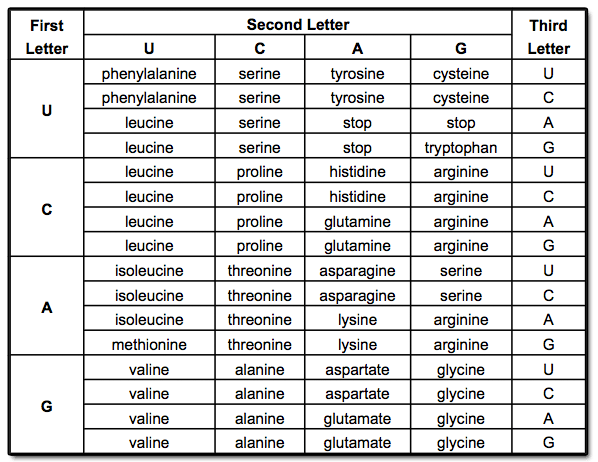
What is the term for a three-nucleotide sequence that codes for an amino acid?
a)
base
b)
codon
c)
amine
d)
serine
28.
How many amino acids are coded for by this sequence of nucleotides:
ATG GGA ACT CCA
a)
4
b)
2
c)
6
d)
12
29.
Which phrase best describes translation?
a)
converts mRNA into a polypeptide
b)
catalyzes bonds between amino acids
c)
produces RNA from DNA molecules
d)
recycles tRNA molecules for reuse
30.
What is the correct amino acid sequence for the mRNA code AUGCCAGUAUGA
a)
Met-Pro-Ala-Val
b)
Met-Pro-Val
c)
Tyr-Gly-His
d)
Tyr-Gly-Arg-His
31.
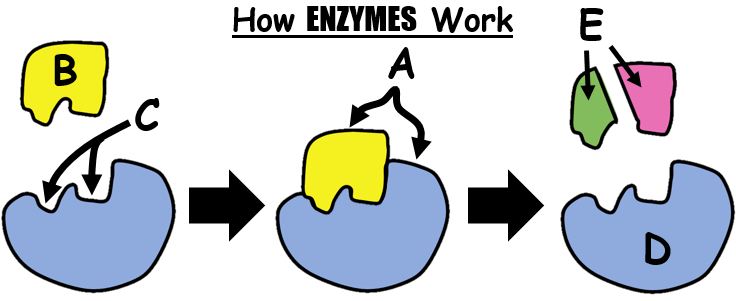
In the picture above, what is happening to the enzyme in the second step? 
a)
Chemical bonds are being broken in the substrate. 
b)
Product is being broken in two. 
c)
Substrate is beginning to bond to the enzyme. 
d)
None of the above. 
32.
The area on the enzyme where the reactant binds to is called the...
a)
Activation energy
b)
Active site
c)
Substrate
d)
Product 
33.
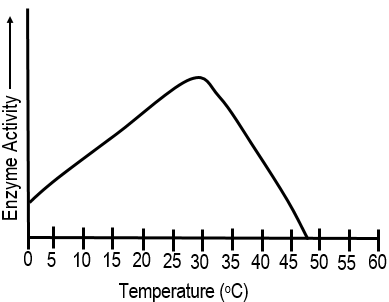
On the graph above, an increase in temperature results in....
a)
A decrease in the activation energy. 
b)
A decrease in the reaction rate. 
c)
An increase in activation energy. 
d)
An increase in the reaction rate. 
34.
The activation energy can be decreased if a _______ is involved
a)
Product 
b)
Substrate
c)
Reactant 
d)
Catalyst
35.
Use the picture above. All the following parts make up the ADP molecule EXCEPT....
a)
A
b)
A and B
c)
C
d)
D
36.
Between which two letters will the bond break to release energy? 
a)
B and C
b)
A and B
c)
B and C
d)
C and D
37.
Energy is released from an ATP molecule when...
a)
Converts a phosphate group to ADP
b)
Attaches an extra phosphate group
c)
Produces a sugar molecule
d)
It loses a phosphate group
38.

Enzymes are an example of

a)

Lipids

b)

Carbohydrate

c)

Protein

d)

Nucleic Acid

39.
Enzymes are capable of increasing the rate of a chemical reaction within a living cell.  Enzymes accomplish this through which of the following means?
a)
reducing the number of products   
b)
reducing the activation energy
c)
increasing the temperature of the cell
d)
increasing the concentration of reactants 
40.
Each enzyme only has 1 substrate that will fit its active site.  What is this called?
a)
reusable
b)
catalyst
c)
specific
d)
fragile
41.
What 3 letters do enzymes typically end in?
a)
-ose
b)
-ase
c)
-ese
d)
-tic
42.
In the diagram, what is letter A? 
a)
product
b)
substrate
c)
enzyme-substrate complex
d)
active site
43.
Based on the graph, what is the optimal temperature for this enzyme? 
a)
15oC
b)
40oC
c)
30oC
d)
35oC
44.

The bond formed in the condensation reaction between 2 amino acids, which holds together a poly peptide is called:

a)

Hydrogen Bond

b)

James Bond

c)

Peptide Bond

d)

Amino Acid Bond

45.

Which level of protein structure includes beta pleated sheets?

a)

Primary

b)

Secondary

c)

Tertiary

d)

Quaternary

46.

Which level of protein structure includes adding more than 1 polypeptide and/or other components?

a)

Primary

b)

Secondary

c)

Tertiary

d)

Quaternary

47.

Which of the following does NOT occur during post-transcription modification.

a)

Removal of introns

b)

Adding poly-A tail

c)

Adding a methyl cap

d)

Addition of Amino Acids

48.

Which of the following does NOT cause denaturing of enzymes?

a)

High temperature

b)

Low Temperature

c)

pH 1

d)

pH 13