
 Worksheets
ELECTROSTATICS
Total questions: 20
Worksheet time: 20mins
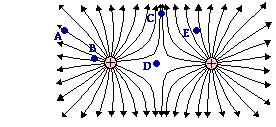
Electric field is a...
scalar.
vector.
Electric charge is a...
scalar.
vector.
What are the units of electric potential?
volts (V) or joules/coulomb (J/C)
joules (J)
newtons (N)
meters (m)

Where is the electric field stronger?
A
B
Which point is at a lower electric potential?
A
B
When the distance between two charges is halved, the electrical force between the charges
quadruples
reduces to one fourth
halves
doubles

vector EA
vector EB
vector Ec
the electric field at that point is zero
The quantity of electric potential, the volt, is dimensionally equivalent to __________.
force/charge
force x charge
electric field x distance
electric field/ distance
In which case does an electric field do positive work on a charged particle?
A negative charge moves opposite to the direction of the electric field.
A positive charge is moved to a point of higher potential energy.
A positive charge completes one circular path around a stationary positive charge.
A positive charge completes one elliptical path around a stationary positive charge.
If the distance between two isolated parallel plates that are oppositely charged is doubled, the electric field between the plates is essentially unchanged. However, the:
charge on each plate will double.
force on a charged particle halfway between the plates will get twice as small.
potential difference between the plates will double.
force on a charged particle halfway between the plates will get four times as small.
Which of the following is not a vector?
electric force
electric field
electric line of force
electric charge

